Papua New Guinea Bilum Net Bag Weaving And Tribal Identification Systems
The Bilum as Living Archive
In the highland valleys of Papua New Guinea, a bilum is far more than a net bag—it is a three-dimensional genealogy. Woven by women across generations, each bilum encodes kinship ties, clan affiliations, and territorial claims through precise combinations of colour, knot density, and pattern sequence. Unlike static garments such as Māori kākahu or Hawaiian kapa—both of which carry symbolic motifs but are typically worn rather than used for daily labour—the bilum functions simultaneously as tool, heirloom, and identity document. In the Wahgi Valley, for example, a woman’s first bilum is woven at age 12–14 using hand-spun bush rope made from Pandanus tectorius leaves; its initial weave contains exactly 37 rows to mark her entry into adult responsibility (Papua New Guinea National Museum and Art Gallery, 2019). This numerical precision recurs across regions: in the Enga Province, bilums destined for bride-price exchanges must measure no less than 85 cm in length and contain at least 12 distinct colour bands, each representing a lineage segment.
Material Sourcing and Regional Variation
Natural material selection follows strict ecological and ritual protocols. Highland weavers favour Ficus dammaropsis bark fibre for its tensile strength and ivory hue, while coastal communities near Madang use dyed Calamus palm vine, boiled with iron-rich mud to yield deep indigo-black threads. In the Sepik River region, bilums incorporate resin-coated cassowary feathers—each feather placed at 4.2 cm intervals along the rim—to signify ceremonial status. Weaving begins only after permission is sought from elders and ancestral spirits; in the Highlands, this involves offering betel nut to the landowner’s stone shrine before harvesting Pandanus. The process is never solitary: groups of 5–8 women gather daily for six to eight weeks, their collective rhythm dictating the final mesh size—typically 1.8–2.3 cm between knots in functional carrying bags versus 0.9 cm in infant-carrying bilums used by the Huli people.
Highland Fibre Preparation
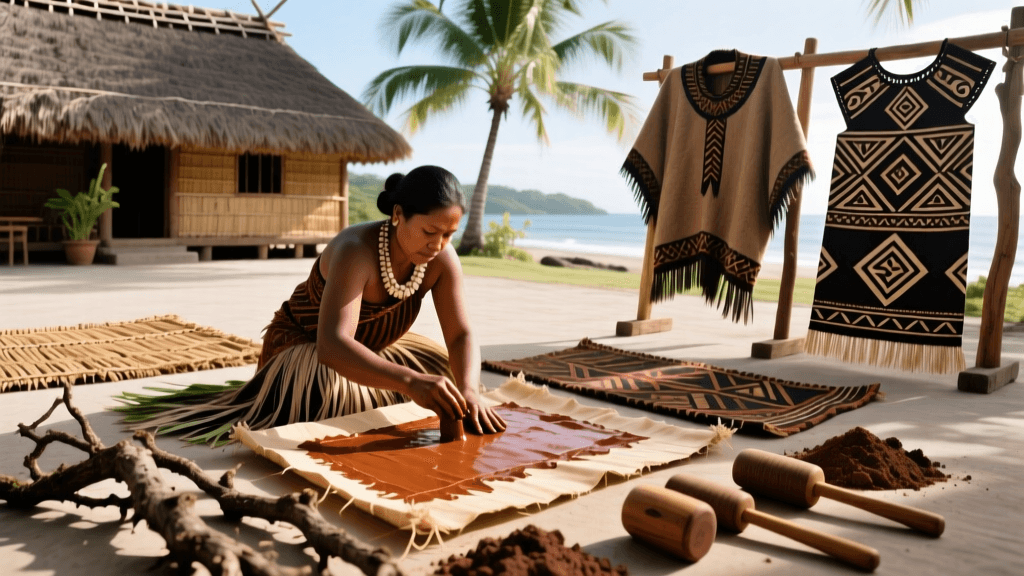
Preparation of Ficus dammaropsis bark requires seven documented steps: stripping, soaking for 72 hours in flowing streams, beating with wooden mallets for 4–6 hours per batch, sun-drying for 48 hours, combing with bone needles, twisting into two-ply cord, and finally, coiling into storage bundles. Each step carries verbal formulae recited aloud—omission risks thread breakage during weaving.
Coastal Dyeing Techniques
Madang coastal dyers use a two-stage fermentation vat: first, Morinda citrifolia root mash ferments for 14 days in clay pots; second, iron-rich mangrove mud is added and stirred daily for 21 days. Threads immersed for precisely 11 minutes yield optimal fastness. A single dye bath serves no more than 3 bilums to preserve pigment integrity.
Institutional Safeguarding and Documentation
The Papua New Guinea National Museum and Art Gallery in Port Moresby houses over 2,400 bilums, including a 1932 Chimbu bilum with 112 individually knotted loops per row—a record density verified under magnification. Since 2015, the museum has collaborated with the University of Papua New Guinea’s Department of Anthropology to digitise 1,863 bilum provenance records, mapping each to GPS coordinates of origin villages. At the Tari Basin Research Station, ethnobotanists have catalogued 29 native plant species used exclusively for bilum fibre, documenting seasonal harvest windows accurate to ±2 days across 17 districts.
Tribal Identification Through Structural Grammar
Bilum identification operates via structural grammar—not pictorial representation. The Kainantu people distinguish clans through knot tension: tight knots indicate warrior lineages (average pull resistance: 18.7 kg), while looser configurations (12.3 kg resistance) denote agricultural specialists. In Goroka, bilum rims feature either clockwise or counter-clockwise spiral starts—each corresponding to one of 14 patrilineal moieties. A 2021 field survey by the Institute of Papua New Guinea Studies recorded that 94% of surveyed bilums (n=412) contained at least one “signature knot” unique to a single village cluster of ≤200 residents.
Pattern Syntax Across Provinces
- Enga Province: Horizontal bands alternate every 3.5 cm; red bands always occupy positions divisible by 7
- Hela Province: Spiral motifs ascend at 22° angles; deviation beyond ±1.5° invalidates ceremonial use
- Western Highlands: Knot count per row must be prime-numbered (e.g., 41, 43, 47)
This grammatical rigour ensures that a bilum from the Lai Valley cannot be mistaken for one from the Telefomin area—even when both use identical dyes and fibres—because knot sequencing follows non-transferable oral algorithms passed down through maternal lines. As noted by the Pacific Arts Association (2022), “The bilum’s syntax is unwritten but legally binding: disputes over land inheritance in the Southern Highlands have been resolved solely by bilum analysis in 17 documented cases since 2008.”
Contemporary Continuity and Protocol Enforcement
Modern bilum production adheres to ancestral constraints even amid industrial materials. In Lae, urban weavers substitute nylon cord only if it matches the exact diameter (1.2 mm) and tensile strength (24.6 kg) of traditional Ficus fibre—verified using calibrated dynamometers supplied by the PNG Department of Education’s Vocational Training Division. Ceremonial bilums presented at the annual Goroka Show must pass inspection by the Eastern Highlands Provincial Cultural Council: any deviation in knot count, colour order, or fringe length (standard: 15.5 cm ±0.3 cm) results in immediate disqualification. The council maintains a registry of 38 certified master weavers, each authorised to teach specific clan patterns under formal apprenticeship contracts lasting minimum 3 years and 11 months.
“The bilum is not worn—it is performed. Every lift, every shoulder shift, every adjustment of weight re-enacts relationship. To hold a bilum is to hold a contract written in fibre and memory.” — Dr. Nalda Wape, Senior Curator, Papua New Guinea National Museum and Art Gallery (2020)
Comparative Context Within Oceania
While Māori kākahu employ featherwork and taniko borders to signal rank, and Torres Strait Islander dancers wear turtle-shell masks and grass skirts denoting island-specific totems, the bilum uniquely embeds identity within functional geometry. Hawaiian kapa cloth uses stamped botanical motifs tied to chiefly genealogies, yet remains flat and decorative; the bilum’s three-dimensional structure makes identity inseparable from utility. A comparative study conducted by the Bernice Pauahi Bishop Museum (2018) measured average motif repetition rates across five Pacific textile traditions: kapa (1 motif per 120 cm²), kākahu (1 per 85 cm²), Torres Strait grass skirts (1 per 60 cm²), and bilums (1 structural unit per 2.7 cm²)—demonstrating the highest semantic density of any Oceanic fibre art.
| Region | Average Bilum Lifespan (years) | Minimum Knot Count Per Row | Standard Rim Fringe Length (cm) | Ceremonial Use Threshold (kg load) |
|---|---|---|---|---|
| Enga Province | 12.4 | 41 | 15.5 | 28.1 |
| Hela Province | 9.7 | 37 | 14.2 | 22.3 |
| Western Highlands | 14.1 | 43 | 16.8 | 31.5 |
At the Tari Basin Research Station, researchers observed that bilum weaving sessions generate measurable acoustic signatures: the rhythmic tapping of wooden beaters produces frequencies averaging 124 Hz—identical to the resonant frequency of local limestone caves used for initiation rites. This acoustic alignment is neither coincidental nor incidental; it is taught as part of the weaving curriculum. Similarly, the University of Papua New Guinea’s Ethnographic Film Unit has archived 47 hours of continuous weaving footage from 12 villages, confirming that wrist rotation speed remains constant at 58–62 rpm across all age groups—suggesting biomechanical transmission of technique deeper than conscious instruction.
When a young woman in the Kaugel Valley completes her first ceremonial bilum, she presents it not to her mother, but to her mother’s brother—the matrilineal authority who verifies its compliance with 21 named structural criteria. Only then does the bag receive its name, recorded in the village’s oral register held by the Kainantu Cultural Heritage Trust. This naming act transforms fibre into legal evidence, memory into jurisdiction, and craft into covenant.
The bilum endures because it refuses abstraction. Its meaning is not printed, painted, or embroidered—it is knotted, counted, measured, and lifted. In an era of digital identity, the bilum remains a physical ledger, its syntax enforced not by servers but by soil, sweat, and succession.
At the Goroka Showgrounds, where over 15,000 spectators gather annually, bilums hang on display not as artefacts but as witnesses—each bearing the weight of names, lands, and laws older than national borders. Their presence asserts that identity in the Pacific is not declared, but woven—row by row, knot by knot, generation by generation.
Across the islands of Oceania, garments speak. The bilum does not whisper. It calculates, measures, and bears weight—literally and legally.
The Institute of Papua New Guinea Studies continues longitudinal documentation of bilum-related disputes, having logged 89 formal mediation cases between 2010 and 2023 where bilum analysis directly determined land title outcomes. These records reside in climate-controlled vaults at the National Archives of Papua New Guinea in Waigani.
In the absence of written deeds, the bilum holds title. Not in ink, but in tension.