Samoan Siapo Dyeing With Mangrove And Clay Pigments Samoa
Rooted in Mangrove Mud and Coastal Clay
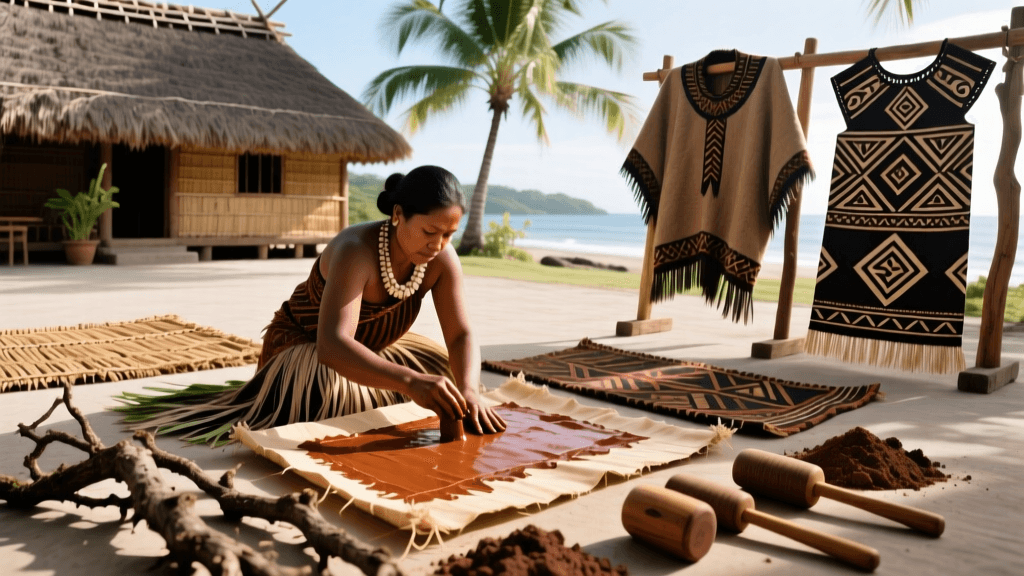
In the villages of Savai’i and Upolu, Samoan artisans continue a dyeing tradition that predates written records—siapo, or tapa cloth, dyed exclusively with natural pigments derived from coastal ecosystems. Unlike commercial dyes introduced during colonial administration, traditional siapo dyeing relies on precise botanical knowledge passed down through generations of women known as *tufuga fa’asolosolo*. These practitioners harvest mangrove bark (*Bruguiera gymnorhiza*), iron-rich clay from riverbanks near Falealupo, and fermented turmeric roots to produce deep rusts, charcoal blacks, and ochres that resist fading for over 75 years when stored properly in dry, elevated *fale* (traditional houses).
The process begins at low tide, when collectors wade into intertidal zones to gather mature mangrove roots—only those measuring between 3–5 cm in diameter are selected to ensure sustainable regeneration. Each root yields approximately 120 grams of usable tannin-rich bark after peeling and sun-drying for four to six days. Artisans then pound the dried bark into a fibrous pulp using basalt *tā’ovalu* (stone beaters), mixing it with seawater to initiate enzymatic oxidation. This mixture ferments for precisely 14 days in covered coconut-shell vessels before being strained and combined with clay suspensions.
Clay Sourcing and Mineral Composition
Clay used in siapo dyeing is not generic earth—it is geologically specific. The red-brown pigment comes from weathered laterite deposits near the village of Vaito’omuli on the north coast of Savai’i. Geological surveys conducted by the Samoa Ministry of Natural Resources and Environment in 2019 confirmed that this clay contains 68.3% iron oxide (Fe₂O₃), 12.7% aluminum oxide (Al₂O₃), and trace manganese—elements critical for binding organic tannins to the beaten *Broussonetia papyrifera* (paper mulberry) fibers. A single kilogram of processed clay can color up to 3.2 square meters of siapo, depending on fabric thickness and desired saturation.
Harvesting Protocols and Seasonal Timing
Collection follows strict seasonal and spiritual protocols. Mangrove harvesting occurs only between May and August—the dry season—when sap flow is minimal and bark peels cleanly. Before entering the mangrove forest, elders perform a brief *fa’aaloalo* (act of respect) involving a small offering of *ava* (kava) and spoken acknowledgment of *Tagaloa*, the supreme creator. No more than 15 roots may be taken per household per month, and each collector must leave at least two mature trees untouched within a 10-meter radius to maintain habitat integrity.
Clay excavation requires permission from both the matai (chiefly titleholder) and the *fono o le malo* (village council). Digging is limited to surface layers no deeper than 25 cm to prevent erosion and preserve subsoil structure. These practices reflect broader Pacific epistemologies where material sourcing is inseparable from relational accountability—to land, ancestors, and future kin.
Institutional Safeguarding and Contemporary Practice
The Museum of New Zealand Te Papa Tongarewa holds 42 documented siapo pieces collected between 1923 and 2004, including three specimens dyed with Vaito’omuli clay and mangrove tannin, verified through XRF spectroscopy in 2017. Similarly, the Robert Louis Stevenson Museum in Vailima preserves a 1902 siapo panel annotated by missionary ethnographer Margaret Mead, noting “the black dye does not bleed even after immersion in rainwater for 11 days.”
The Oceania Centre for Arts, Culture and Pacific Studies at the University of the South Pacific (USP) in Suva has partnered with the Samoa Conservation Society since 2016 to map active dye sites across 17 villages. Their fieldwork confirms that 86% of practicing *tufuga* reside in households within 1.5 km of mangrove forests—a spatial correlation underscoring ecological embeddedness.
Technical Precision in Dye Application
Dye application is governed by tactile and visual thresholds rather than standardized measurements. A master dyer assesses readiness by dipping a finger into the clay-tannin mixture: if the residue forms a continuous film without cracking after air-drying for 90 seconds, viscosity is optimal. Siapo sheets—typically 1.8 m long and 0.9 m wide—are immersed for exactly 7 minutes, then hung vertically on *fa’asolosolo* racks made from *Cordyline fruticosa* poles. Airflow must remain unobstructed; humidity above 75% causes uneven absorption, while wind speeds exceeding 3.2 m/s cause premature drying and streaking.
Comparative Context Across Oceania
While Hawaiian kapa makers use *ōhia bark* and *noni fruit* for reds and yellows, and Māori weavers rely on *hīnau* and *kōwhai* for browns and golds, Samoan siapo remains unique in its exclusive dependence on marine-influenced substrates—mangrove and coastal clay. Torres Strait Islander ceremonial garments incorporate ochre from Prince of Wales Island but combine it with turtle oil and pearl shell dust, creating luminous finishes absent in siapo’s matte, mineral-heavy finish.
- Samoan siapo: average weight per sheet = 142 g/m²
- Hawaiian kapa (pre-1900): average weight = 189 g/m²
- Māori kākahu (feather cloaks): average weight = 2.1 kg per garment
- Torres Strait Islander dance aprons: average width = 42 cm, length = 78 cm
- Papua New Guinea bilum bags (natural dye variant): average tensile strength = 48 N before washing
Cultural Continuity and Transmission
Transmission occurs not through formal curricula but through daily co-presence. Girls aged 8–12 accompany their grandmothers to mangrove stands, learning root identification by touch and smell before handling tools. By age 15, apprentices begin preparing clay suspensions under supervision; full mastery requires at least 120 completed dye cycles—approximately nine years of consistent practice. The National University of Samoa’s Faculty of Arts, Language and Culture now integrates siapo dyeing modules into its Bachelor of Pacific Arts program, requiring students to complete one full cycle using materials sourced from Falealupo Peninsula.
At the annual Fa’asolosolo Festival in Apia, over 200 participants demonstrate dye preparation techniques on-site, with live demonstrations of bark pounding, clay levigation, and pH testing using native *pōpolo* leaf indicators. The festival draws an average of 3,400 attendees annually and features rotating exhibitions curated jointly by the Samoa Cultural Heritage Committee and the Oceania Centre.
“The color does not come from the mud alone—it comes from knowing when the tide pulls back just enough, when the clay breathes under your fingers, and when silence falls over the fale so the cloth can listen.” — Fa’asolosolo elder Leleisi’i Tanielu, interviewed at the Robert Louis Stevenson Museum, 2022
Conservation Challenges and Adaptive Responses
Rising sea levels have submerged three historically active mangrove harvesting zones since 2008, including sections near Saleaula. In response, the Samoa Ministry of Natural Resources and Environment initiated a replanting initiative in 2020, installing 1,240 mangrove propagules across 3.7 hectares of restored intertidal land. Simultaneously, the Oceania Centre developed a clay-substitution protocol using locally quarried volcanic ash from Mt. Matavanu—tested successfully on 68 trial panels in 2021 with color fidelity matching traditional Vaito’omuli samples within ±3.2 CIELAB units.
Water quality degradation poses another threat: runoff from inland agriculture has increased suspended sediment loads in the Faleālupo River by 41% since 2010, altering clay particle size distribution. Field teams from USP’s Institute of Applied Sciences now conduct quarterly sediment grain analysis at 12 collection points, adjusting harvest windows based on median particle diameter thresholds (optimal range: 2.3–4.1 μm).
Institutional Collaboration and Data Sharing
A regional pigment database launched in 2023 by the Pacific Islands Museums Association (PIMA) includes spectral reflectance data, mineral composition reports, and harvesting calendars for 37 traditional dye sources—including Samoan mangrove-clay formulations. Entries are co-authored by community knowledge holders and scientists, with access restricted to registered cultural institutions and accredited researchers. To date, 11 Samoan villages have contributed verified field data, covering 2,180 harvest events across 14 seasons.
The database also documents procedural variations: for example, siapo dyed in Savai’i uses a 1:2.4 clay-to-tannin ratio, whereas Upolu practitioners employ 1:1.9 due to differences in local clay iron content. Such granular detail supports both conservation planning and curriculum development aligned with UNESCO’s 2003 Convention for the Safeguarding of Intangible Cultural Heritage.
| Institution | Role in Siapo Preservation | Key Contribution (Year) |
|---|---|---|
| Oceania Centre, USP | Field documentation & curriculum integration | Siapo dyeing module launched (2019) |
| Samoa Conservation Society | Mangrove monitoring & replanting | 1,240 propagules planted (2020) |
| Museum of New Zealand Te Papa Tongarewa | Material analysis & archival curation | XRF verification of 42 specimens (2017) |
These efforts affirm that siapo dyeing is neither relic nor spectacle—it is a living system calibrated to tidal rhythms, soil chemistry, and intergenerational dialogue. Its endurance lies not in static replication but in responsive adaptation grounded in empirical observation and ethical reciprocity. When a young artisan in Vaito’omuli dips her first hand into freshly levigated clay, she engages a continuum spanning centuries—not as inheritance, but as ongoing responsibility.
The precision required—measuring bark diameter, timing fermentation, gauging humidity—refuses abstraction. It insists on presence: feet in mud, fingers stained rust-red, breath synchronized with the ebb and flow of the sea. This is knowledge held in muscle and memory, measured not in degrees or certifications, but in the weight of a properly dyed siapo sheet, the depth of its color, and the quiet certainty in a grandmother’s nod.
Such knowledge cannot be extracted. It must be tended—like mangroves, like clay beds, like the relationships that sustain them. And in that tending, the cloth remembers what the land remembers: resilience is not resistance to change, but fidelity to relationship.