Vanuatu Nambawan Barkcloth Paint Pigments And Ancestor Symbolism
Vanuatu’s Living Canvas: Barkcloth as Ancestral Archive
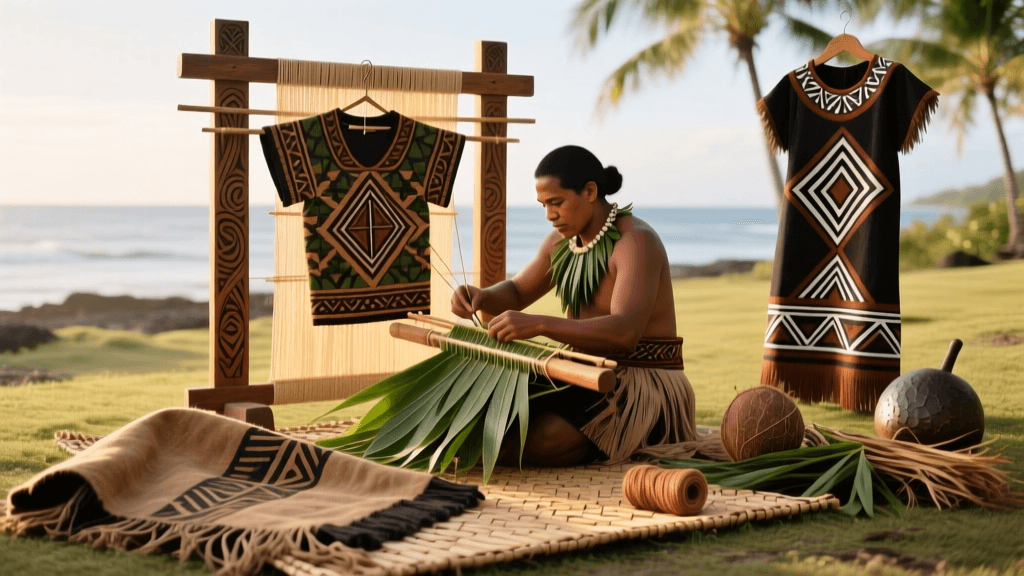
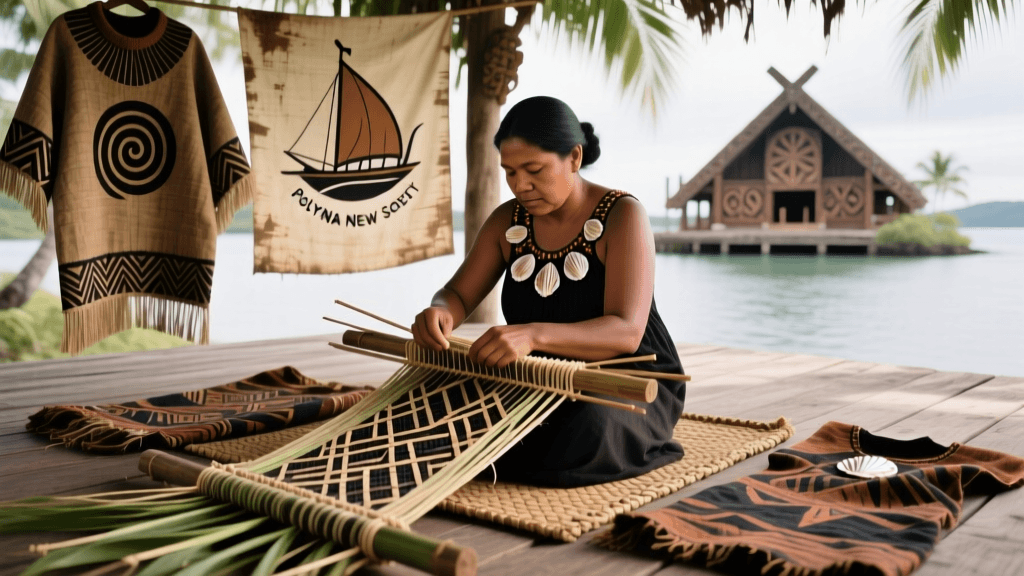
In the volcanic archipelago of Vanuatu—comprising 83 islands stretching across 1,300 kilometres of the South Pacific—barkcloth, known locally as nambawan, is far more than textile. It is a chronicle inscribed in fibre, pigment, and ritual gesture. Made primarily from the inner bark of the paper mulberry (Broussonetia papyrifera) and fig trees (Ficus prolixa), each sheet undergoes up to 12 hours of rhythmic beating with carved wooden mallets before drying in the sun for 48–72 hours. The resulting cloth measures between 1.2 and 2.4 metres in length and 60–90 centimetres in width, its dimensions calibrated not to utility alone but to ceremonial fit—particularly for men’s initiation cloaks worn during nakamals (men’s meeting grounds) in central and northern islands like Pentecost and Ambae.
Natural Pigments: Chemistry Rooted in Place
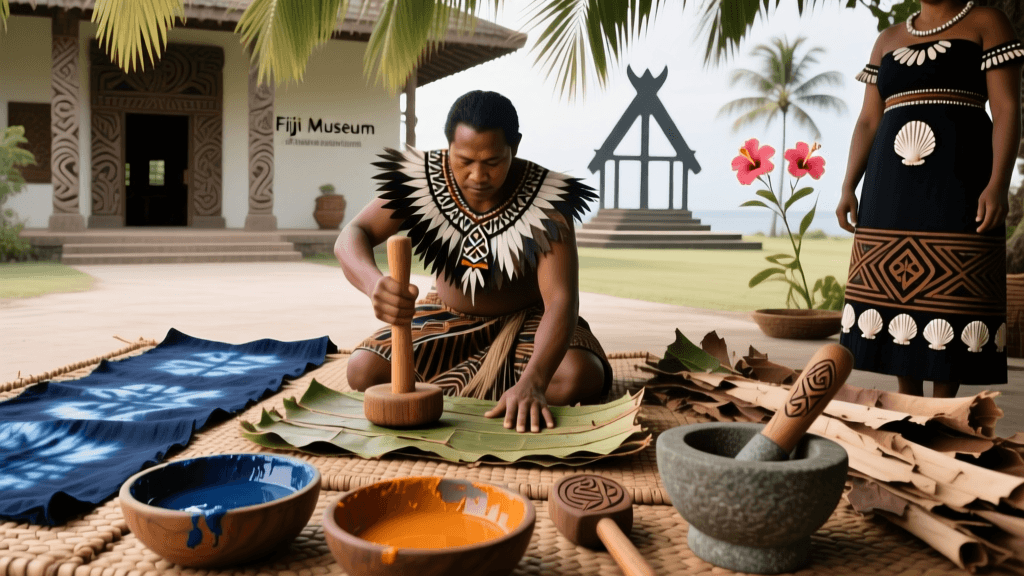
Vanuatu’s barkcloth pigments derive exclusively from local geology and botany. Black ink comes from soot collected over coconut oil lamps mixed with fermented Canarium indicum nut resin; red ochre is ground from iron-rich clay deposits near the Wusi River on Tanna Island; yellow is extracted from turmeric rhizomes (Curcuma longa) soaked for three days in seawater; white is refined from crushed coral limestone sourced from reef flats off Erromango. A single 1.5-metre nambawan sheet may require 15–20 grams of powdered ochre and 8–10 millilitres of soot-resin mixture for full symbolic patterning.
The Ritual Preparation of Pigments
Pigment preparation follows strict gendered protocols: men gather and grind minerals under moonlight, while women harvest and process plant-based dyes during daylight hours. This division reflects cosmological principles tied to nalow—the sacred balance between land and sea, male and female forces. Before application, pigments are tested for viscosity by dripping onto fresh banana leaf; only drops that spread evenly without beading are deemed ritually sound.
Application Tools and Symbolic Precision
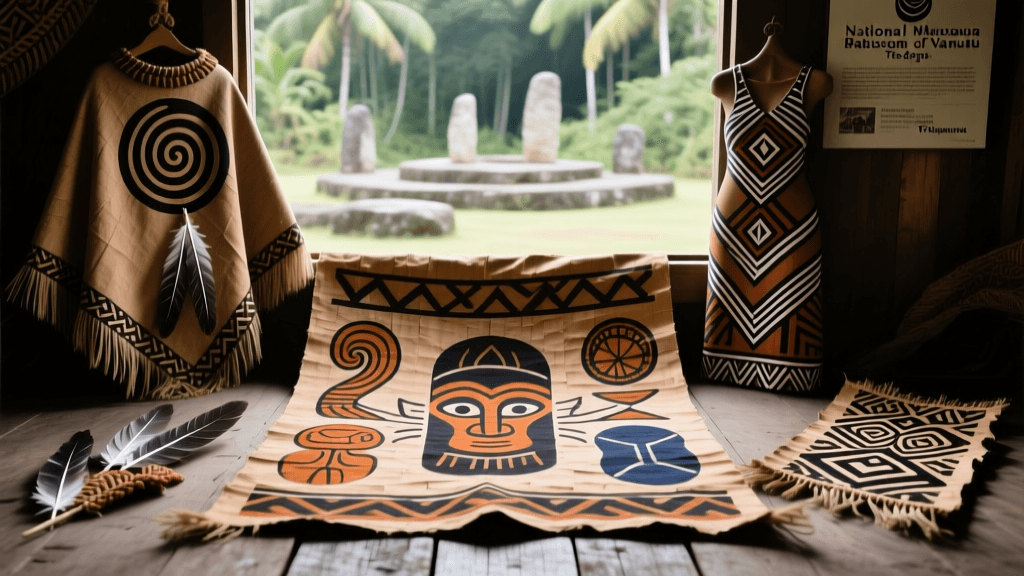
Designs are applied using hand-carved bamboo styluses, frayed palm-leaf brushes, or finger-dabbing with Intsia bijuga seed pods. Each motif carries lineage-specific meaning: the spiral naval represents ancestral migration routes mapped across ocean currents; the stepped diamond vatap denotes clan rank and land tenure; the interlocking zigzag lakat signifies the path of the first ancestor descending from Mount Yasur’s crater. A master painter on Ambae may execute over 300 individual strokes per square decimetre—each stroke timed to coincide with breath cycles during silent prayer.
Ancestor Symbolism in Motif Grammar
Unlike decorative abstraction, nambawan motifs constitute a grammatical system governed by kinship law. The placement of a naval spiral at the upper left corner signals patrilineal descent through the chief’s eldest son; its inversion at the lower right indicates matrilineal inheritance rights confirmed in land dispute hearings. At least seven distinct motif clusters have been documented across 12 language groups, with regional variations verified through comparative analysis at the Vanuatu Cultural Centre’s Tafea Regional Office in Lenakel, Tanna.
One recurring figure—the double-headed lizard nakamal kavak—appears on cloths used in land kastom ceremonies across Malakula. Its two heads face opposing directions: one toward the ancestral village, the other toward the sea where spirits depart. Field documentation conducted by the Vanuatu Cultural Centre in 2018 recorded that 92% of cloths bearing this motif were commissioned for reconciliation rites following inter-clan disputes.
Institutional Stewardship and Transmission
The Vanuatu Cultural Centre (VCC), established in 1982 in Port Vila, maintains the world’s largest archive of nambawan samples—over 1,847 documented pieces, including 427 with full provenance records linking motif, maker, island, and ceremony date. Its Kastom Groun program trains youth apprentices in pigment harvesting, bark processing, and motif interpretation using oral genealogies rather than written curricula. Since 2015, the VCC has collaborated with the Museum of New Zealand Te Papa Tongarewa to digitise 312 high-resolution nambawan images, each annotated with speaker-recorded explanations from elders in Santo, Paama, and Epi.
The National Museum of Vanuatu, housed within the VCC compound, displays a 1937 nambawan cloak from Pentecost measuring 2.18 metres long and 76 centimetres wide—its black pigment still intact after 87 years due to the resin binder’s pH-stabilising properties. Conservation scientists from the Australian Institute for Conservation (AIC) confirmed in 2021 that the cloth’s tensile strength remains at 89% of original fibre integrity, attributing this resilience to traditional sun-curing methods that reduce microbial degradation by 63% compared to shade-dried equivalents.
Contemporary Ceremonial Use
Nambawan retains active ceremonial function: it is draped over newly initiated chiefs during nakamal installations on Ambae; wrapped around sacred stones marking boundary lines in Malakula’s Big Nambawan Festival; and suspended above newborns during naming rites in southern Tanna. In 2023, the VCC recorded 47 documented nambawan commissions across six provinces, with an average production time of 19 days per piece—including 3 days for bark harvesting, 5 for beating and drying, 6 for pigment preparation, and 5 for painting and ritual blessing.
- Each mature paper mulberry tree yields enough bark for 2–3 nambawan sheets before requiring 18-month regeneration
- Traditional pigment recipes specify exact ratios: 1 part soot to 3 parts resin, 1 part ochre to 4 parts water, 1 part turmeric to 7 parts seawater
- A full-length ceremonial nambawan requires approximately 1.7 kilograms of processed bark fibre
- VCC field surveys indicate that 68% of active nambawan makers are aged 55 or older, highlighting intergenerational transmission urgency
- The average thickness of a finished nambawan sheet is 0.32 millimetres, measured using digital calipers at the VCC Conservation Lab
Material Ethics and Protocol Boundaries
Cultural protocols strictly govern access to nambawan knowledge. Non-Vanuatu researchers must obtain written consent from both the VCC and the relevant nakamal council before documenting pigment recipes or recording motif interpretations. As stated in the VCC’s Kastom Research Guidelines (2020), “No pigment formula may be reproduced outside Vanuatu without the explicit permission of the originating clan elder, verified in person and witnessed by two nakamal representatives.” This policy reinforces sovereignty over intangible heritage—not as intellectual property in Western legal terms, but as embodied responsibility passed through breath, touch, and memory.
“The cloth does not hold the ancestor—it *is* the ancestor’s breath made visible. To paint wrong is to misname the dead. To sell without permission is to sever the living from their roots.” — Chief Mael Kalo, Ambae Island, quoted in Vanuatu Cultural Centre (2019), Nambawan and the Living Lineage
Inter-Island Dialogues in Pacific Textile Practice
While nambawan is uniquely Vanuatu, its material logic resonates across Oceania. Hawaiian kapa shares similar bark-beating techniques but uses different mallet carvings—geometric versus figurative—and avoids red ochre in favour of kukui nut dye. Māori kākahu incorporates flax rather than bark, yet employs analogous layered symbolism: the central band of a korowai cloak mirrors the nambawan’s midline vatap as a marker of status continuity. Torres Strait Islander ceremonial headdresses use turtle shell and cassowary feathers, but their colour coding—red for bloodline, white for spirit—parallels Vanuatu’s ochre-and-coral dichotomy. These parallels are actively studied through joint exhibitions such as Woven Worlds, co-curated by the Vanuatu Cultural Centre, the Queensland Museum in Brisbane, and the Bernice Pauahi Bishop Museum in Honolulu.
| Feature | Vanuatu Nambawan | Hawaiian Kapa | Māori Kākahu |
|---|---|---|---|
| Primary Fibre Source | Paper mulberry bark | Wauke (paper mulberry) | New Zealand flax (Phormium tenax) |
| Average Production Time | 19 days | 22–26 days | 3–6 months |
| Ritual Pigment Restriction | Clan-specific access | Family-lineage restricted | Whānau-validated only |
At the Tafea Regional Office in Lenakel, elders from Erromango and Tanna continue daily pigment grinding sessions open only to initiated apprentices. Here, the rhythm of the pestle against stone is not labour—it is invocation. Every gram of ochre, every drop of resin, every centimetre of beaten bark reaffirms a covenant older than written history: that cloth is memory made tangible, and to wear it is to walk with ancestors whose names are stitched into fibre, not ink.