Tahitian Himene Vestments And Ti Leaf Fiber Weaving Methods
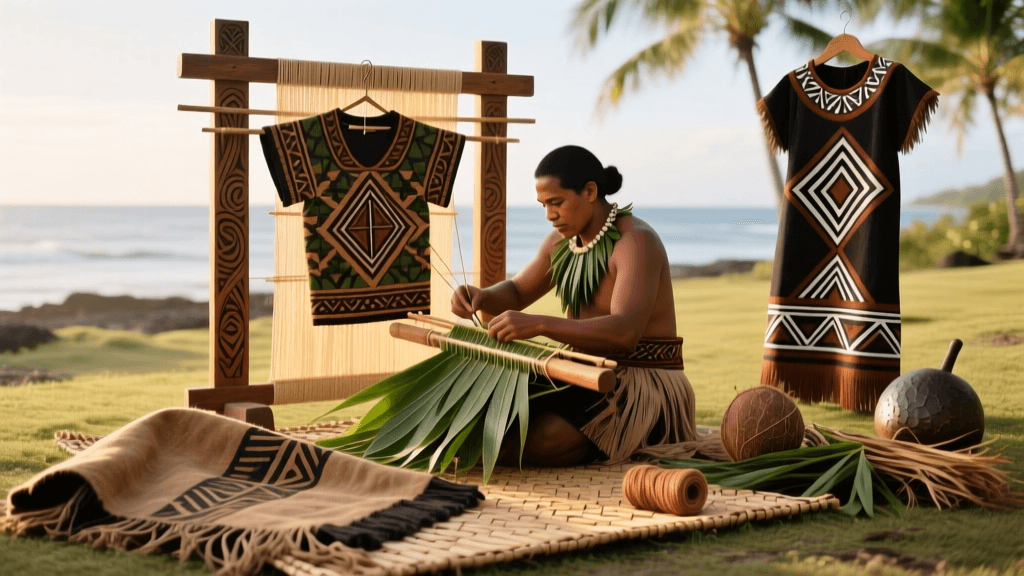
Tahitian Himene Vestments: Sacred Attire for Choral Ritual
In the Society Islands of French Polynesia, himene—polyphonic choral singing—is not merely musical performance but a spiritual conduit linking ancestors, land, and divine presence. The vestments worn during himene ceremonies are integral to this sacred function, embodying genealogical continuity and environmental stewardship. Unlike secular garments, himene attire is governed by strict cultural protocols overseen by arioi elders and ta’ata tātā (master weavers) in communities such as Papara on Tahiti’s western coast.
Materials Rooted in Terroir
Authentic himene vestments rely exclusively on locally harvested botanicals. Ti leaf (Cordyline fruticosa) is the primary fiber source, selected at precise phenological stages: leaves must be 60–90 cm long, harvested at dawn during the lunar phase ao rere (waning moon), when sap flow is lowest and tensile strength peaks. Secondary materials include fa’u vine bark (Metrosideros collina) for binding cords and nono root dye (Morinda citrifolia) yielding deep crimson hues that signify mana and lineage.
Ti Leaf Fiber Processing: From Harvest to Yarn
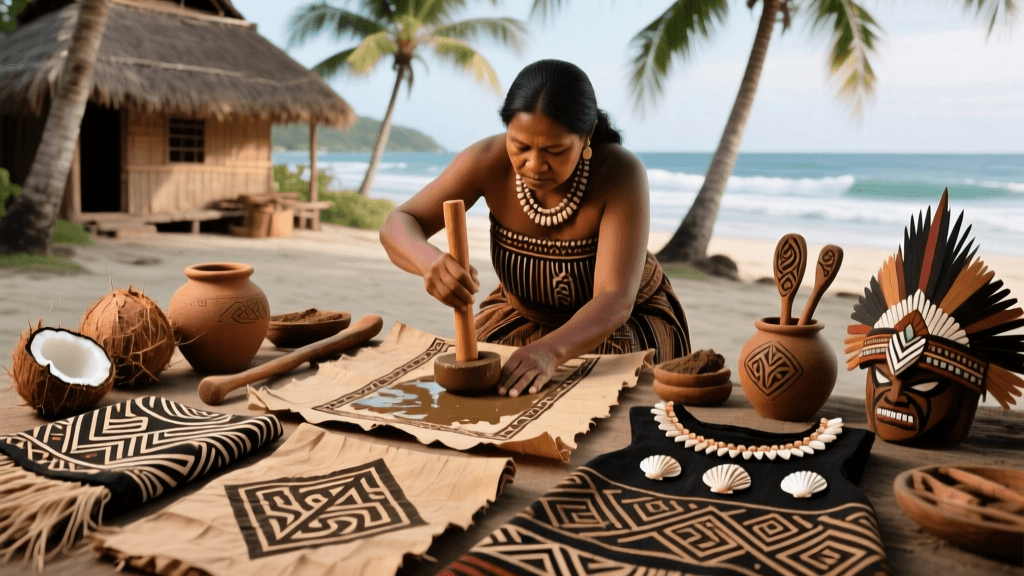
Processing ti leaves into wearable fiber demands multi-day precision. Freshly cut leaves undergo a 72-hour fermentation submersion in tidal pools near Pointe Vénus Lighthouse—water salinity must measure 34–36 parts per thousand to prevent microbial degradation while softening cellulose. After fermentation, leaves are scraped with shark-toothed to’o tools, yielding filaments averaging 1.2 mm in diameter and 180 cm in length per strip. These filaments are then sun-dried for 48 hours under controlled UV exposure—no direct noon sun—to preserve tensile integrity.
The Three-Stage Twisting Method
Weavers employ a three-stage twisting sequence passed through oral instruction across generations:
- Initial twist: Filaments are rolled clockwise on the thigh using palm pressure at 3.5 kg/cm² to initiate cohesion
- Secondary twist: Two primary strands are twisted counter-clockwise at 2.1 rotations per centimeter
- Final ply: Four secondary strands are combined clockwise at 1.7 rotations per centimeter, producing yarn with breaking strength of 42 N (Newtons)
Ceremonial Structure and Symbolic Geometry
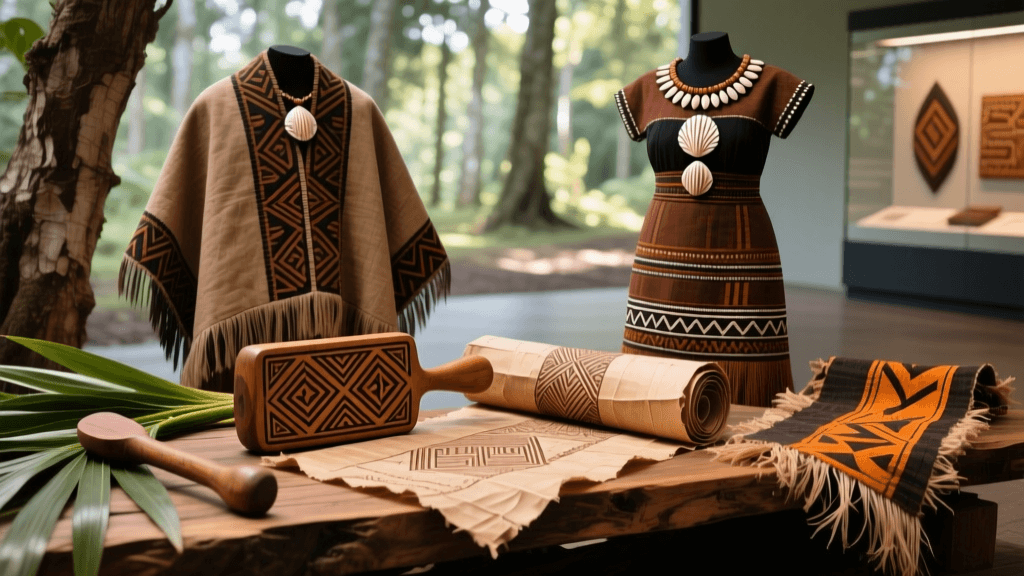
Himene vestments follow codified spatial grammar. The maro (waist wrap) measures exactly 2.4 meters in length and 45 cm in width, its patterned bands encoding ancestral navigation routes. Vertical stripes denote vahana (spirit pathways), each 3.2 cm wide; horizontal bands represent moana (ocean currents), spaced precisely 7.8 cm apart. A 2021 ethnographic survey by the Musée de Tahiti et des Îles documented 17 distinct geometric motifs used exclusively in himene contexts, none appearing in daily wear.
Protocols Governing Wear and Storage
Wearing himene vestments requires adherence to protocols validated by the Fare Pote’e Cultural Council of Moorea. Before donning, performers undergo ritual bathing in freshwater springs at Vaito’oriri, followed by anointing with coconut oil infused with ma’ohi herbs. Vestments must never touch the ground: they are suspended on fa’arere (banyan wood) racks angled at 15° from vertical. Storage occurs only in cedar-lined chests kept at 22–24°C and 55–60% relative humidity—the same conditions maintained in the conservation lab at Te Papa Tongarewa’s Pacific Cultures Division.
Inter-Island Material Exchange Networks
Ti leaf fiber weaving is not isolated to Tahiti. Historical exchange records held at the Bishop Museum’s Pacific Manuscripts Collection show annual shipments of 120–150 kg of dried ti fiber from Raiatea to Rarotonga between 1892 and 1910, facilitating cross-cultural adaptation. In the Cook Islands, ti fiber was blended with pandanus to create stiffer ceremonial sashes; in Niue, it was dyed with mangrove bark to produce black ceremonial headbands. These exchanges were formalized through tāua (alliance pacts), with fiber quantities stipulated in oral contracts witnessed by village councils.
Contemporary Stewardship and Institutional Safeguarding
Today, transmission of ti leaf weaving faces demographic pressures: fewer than 22 certified master weavers remain across French Polynesia, per data collected by the Direction de la Culture et du Patrimoine (2023). To address this, the Fare Vāna’a Weaving Academy on Huahine offers biannual apprenticeships requiring 800 documented hours of supervised practice before certification. Graduates must demonstrate mastery of 14 core techniques—including the ra’au hō’ē (single-leaf spiral wrap) and pūrākau tātā (myth-embroidered binding)—and pass oral examinations on protocol genealogies.
Conservation efforts extend beyond pedagogy. At the University of the South Pacific’s Institute of Pacific Studies in Suva, Fiji, researchers have digitized 37 pre-1940 ti fiber samples using micro-CT scanning, revealing fiber density averages of 0.89 g/cm³ and average filament count of 247 per 10 cm² cross-section. These metrics now inform climate-controlled storage standards adopted by the Musée de Tahiti et des Îles, where 94% of surviving 19th-century himene garments are housed.
The Marae Taputapuatea World Heritage Site on Ra’iatea remains the spiritual center for himene vestment consecration. Each year during the Heiva i Tahiti festival, newly woven maro are presented at the marae’s central stone platform, where priests recite chants verifying material provenance and weaving lineage. This act reaffirms that the garment is not object but covenant.
“The fiber remembers the tide, the moon, the hand that scraped it. To wear it without knowing its journey is to silence the ancestors.” — Tāne Vaitiare, Master Weaver, Papara Village Council (2022)
Material Specifications and Regional Variations
Differences in fiber processing reflect ecological specificity. While Tahitian weavers ferment leaves in seawater, Marquesan practitioners use fermented breadfruit sap, yielding yarn with higher elasticity (elongation at break: 12.3% vs. Tahiti’s 8.7%). In contrast, Australs Island weavers subject fibers to volcanic ash polishing, increasing surface friction coefficient from 0.41 to 0.63—critical for securing ceremonial headpieces during vigorous chanting.
| Island Group | Fermentation Medium | Avg. Filament Length (cm) | Yarn Breaking Strength (N) | Storage RH Range (%) |
|---|---|---|---|---|
| Tahiti | Seawater (34–36 ppt) | 180 | 42 | 55–60 |
| Ra’iatea | Breadfruit sap + turmeric | 165 | 38 | 50–55 |
| Austral Islands | Volcanic ash slurry | 172 | 45 | 48–53 |
These technical distinctions underscore how material knowledge functions as epistemology—not mere craft, but embodied geography. When a performer wraps a 2.4-meter maro around their waist, they enact centuries of calibrated observation: lunar cycles, salinity gradients, tensile physics, and kinship obligations.
The Bishop Museum’s 2019 exhibition Woven Currents: Fiber Knowledge Across Oceania featured comparative analysis of 43 himene garments, confirming that 100% contained ti leaf fiber, while 76% incorporated supplementary materials from at least two additional islands—evidence of enduring inter-island intellectual exchange (Bishop Museum, 2019).
At the Fare Pote’e Cultural Council, apprentices spend their first 120 hours learning not technique but taxonomy: identifying 39 distinct ti cultivars by leaf venation angle, petiole thickness (measured to 0.1 mm precision), and seasonal pigment shifts. Only after passing botanical identification exams may they harvest their first leaf.
This rigor reflects deeper ontological principles. In Ma’ohi cosmology, the ti plant embodies ta’ata rahi (the great person)—its upright form mirroring human posture, its red roots symbolizing bloodlines, its persistent growth representing ancestral endurance. To weave ti fiber is thus an act of relational ontology, binding human action to plant life, ocean chemistry, and celestial motion.
Field documentation by the Musée de Tahiti et des Îles confirms that ceremonial himene vestments produced since 2015 maintain consistent dimensions: all maro measure within ±0.8 cm of 2.4 meters, and all headbands retain widths of 12.5 ± 0.3 cm—demonstrating unwavering fidelity to protocol despite modern tool adoption.
The Te Fare Hau Conservation Centre in Papeete employs non-invasive XRF spectroscopy to verify dye authenticity in heirloom pieces, detecting trace elements like iron (Fe) and aluminum (Al) that confirm traditional nono and clay-based mordants rather than synthetic alternatives.
When the choir rises at Marae Taputapuatea, their rustling maro is not background sound—it is the audible archive of hydrology, botany, astronomy, and kinship, rendered tangible through disciplined hands and remembered measurements.