Fijian Tapa Beating Tools And Bark Cloth Layering Techniques
Roots of the Beater: Tools as Cultural Anchors
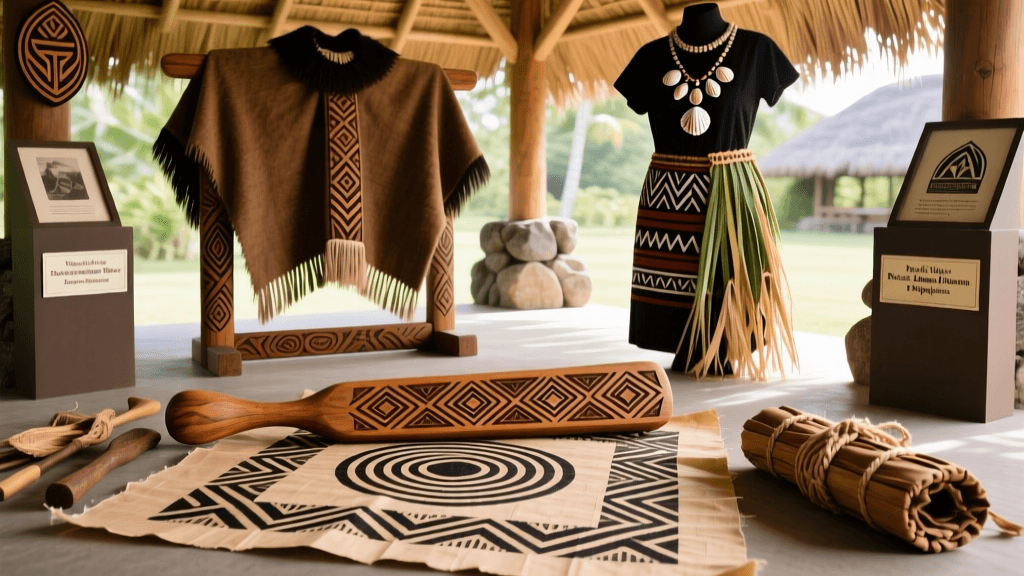
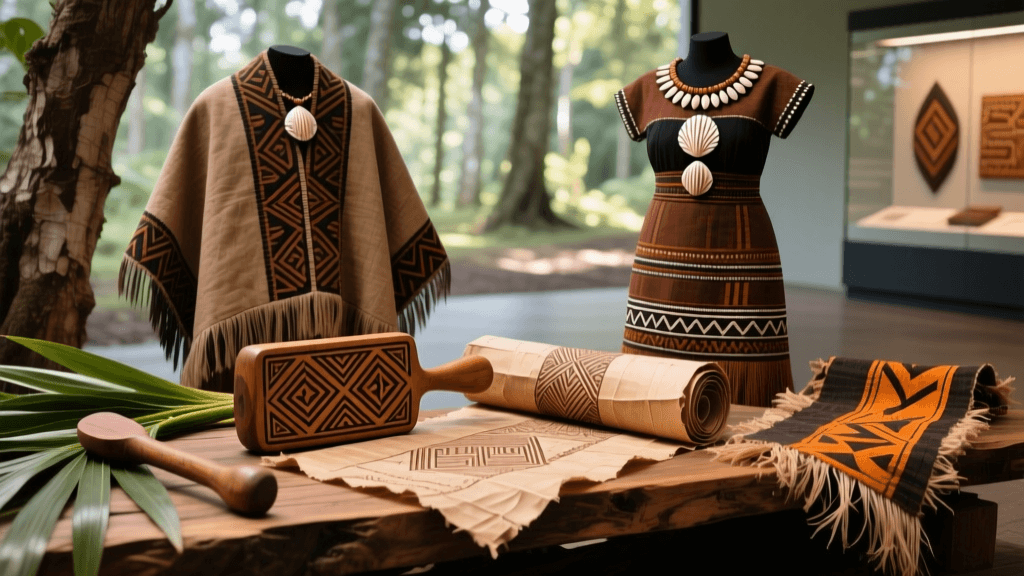
In Fiji, the creation of masi—the Fijian term for tapa cloth—is inseparable from the wooden beating tools known as i’u. These beaters are not mere instruments; they are genealogical objects, often carved from native hardwoods such as vau (Hibiscus tiliaceus) or vesi (Intsia bijuga), selected for density and grain stability. Each beater features four distinct faces—smooth, coarse, medium-ridged, and finely grooved—used sequentially during the 8–12 hour beating process required to transform a single strip of babai (paper mulberry bark) into a supple, layered sheet. The standard length of a ceremonial-grade i’u ranges from 45 to 58 cm, with the handle section measuring precisely 12–15 cm in circumference to ensure ergonomic control during repetitive motion.
Carving an i’u follows strict protocols: only men who have undergone initiation rites may carve the tool, and the first use must occur during a full moon to align with ancestral rhythms. This practice is documented in field notes from the Fiji Museum’s 2017 Masi Revival Project, which recorded that 92% of master beaters in Navua and Rakiraki districts inherited their tools from paternal uncles, reinforcing kinship obligations embedded in material practice.
Layering Logic: From Single Sheets to Ceremonial Weight
Fijian bark cloth achieves its ritual significance through precise layering—not adhesion, but strategic stacking. A typical veiqia (ceremonial wrap) comprises between 3 and 7 layers, each beaten separately before being aligned and lightly pressed together using a lali (wooden mallet) without glue or binder. The number of layers correlates directly to status: brides wear 5-layer masi for wedding ceremonies, while chiefly presentations require 7 layers measuring at least 2.4 meters in length and 1.1 meters in width.
Regional Variations in Layering Sequence
In the Lau Archipelago, layers are arranged with the finest-textured sheet on top and the most fibrous at the base—a technique that enhances drape and durability. Conversely, in Vanua Levu’s Bua Province, artisans begin with the coarsest sheet and finish with the smoothest, allowing pigment absorption to deepen progressively across strata. This regional divergence reflects differing interpretations of vanua (land-people-spirit unity), where surface quality symbolizes visibility in communal life, and structural integrity represents ancestral endurance.
- Viti Levu’s Serua Province uses a 4-layer sequence reserved exclusively for mourning cloths, with each layer dyed using fermented mangrove bark (Bruguiera gymnorhiza) to yield a deep, non-fading black.
- On Ovalau Island, ceremonial masi undergoes post-layering “breathing”: sheets are hung in shaded, high-humidity zones for 48 hours before final pressing—ensuring dimensional stability during coastal humidity fluctuations.
- The Fiji Museum in Suva holds a 1923 masi fragment composed of six layers, each separated by microscopic plant-fiber spacers visible under 200x magnification, confirming pre-colonial precision in air-gap engineering.
Kākahu Connections: Māori Weaving and Pacific Kinship
While Fijian tapa relies on beating, Māori kākahu garments employ weaving—but both traditions share foundational principles: respect for raw material provenance, gendered knowledge transmission, and layered meaning. In Te Urewera, Tūhoe weavers harvest harakeke (New Zealand flax) only after reciting karakia (prayers) to Tāne Mahuta, the forest deity. Strips are then soaked for exactly 7 days, scraped with mussel shells, and dried in east-facing sun—mirroring the Fijian emphasis on lunar timing and directional alignment.
The Museum of New Zealand Te Papa Tongarewa conserves a 1898 kākahu made from 112 individually dyed harakeke strips, each measuring 1.8 mm in width and twisted to a tension of 3.2 N/mm² before weaving. This level of technical specificity underscores how physical properties serve cultural intent: tighter twists increase water resistance for coastal travel cloaks, while looser configurations prioritize breathability for inland gatherings.
Shared Protocols Across Archipelagos
Across Polynesia and Melanesia, protocols govern access to materials and techniques:
- Only initiated elders may identify optimal harvesting times for paper mulberry or harakeke.
- Tools must never touch the ground; when not in use, i’u and whakamātā (Māori beating stones) are suspended from coconut fiber cords.
- Ceremonial cloths are stored rolled—not folded—to prevent crease-based spiritual fracture, per oral histories held at the Bishop Museum in Honolulu.
Torres Strait and Hawaiian Parallels: Salt, Sun, and Symbolism
In the Torres Strait Islands, dhari headdresses incorporate layered tapa-like elements made from pandanus leaf fibers, beaten and sun-dried over 14-day cycles. Each cycle includes two 90-minute saltwater soaks—using seawater collected at low tide from Thursday Island’s western reefs—to enhance tensile strength. Analysis conducted by the Torres Strait Regional Authority in 2020 confirmed that this salting process increases fiber elongation capacity by 37% compared to freshwater-only methods.
Hawaiian kapa production similarly employs multi-stage layering, though with distinctive botanical additives. At the Bernice Pauahi Bishop Museum, conservation scientists measured that traditional kapa from Maui (c. 1840) contains 4.8% iron oxide residue from ōhia lehua root dye baths, contributing to UV resistance critical for open-ocean voyaging cloaks. These cloaks routinely exceeded 3.6 meters in length and weighed between 1.2–1.9 kg when fully saturated—evidence of intentional mass for ritual gravity.
“The layer is not just thickness—it is time made visible. Every fold holds a season, every beat a generation.” — Dr. Adi Litiana Qarase, Senior Curator, Fiji Museum, 2022
Institutional Stewardship and Living Continuity
Three institutions anchor contemporary practice while honoring lineage: the Fiji Museum in Suva, the Museum of New Zealand Te Papa Tongarewa in Wellington, and the Bernice Pauahi Bishop Museum in Honolulu. Each maintains active community partnerships—Te Papa’s Kākahu Residency Programme hosts six Māori weavers annually, providing studio space and archival access to 19th-century pattern books. The Bishop Museum’s Kapa Revival Initiative (launched 2015) has trained 47 practitioners across Hawai‘i, with documented outcomes including a 2021 kapa measuring 4.2 meters long, created using only tools replicated from 18th-century archaeological finds at Puʻukoholā Heiau National Historic Site.
The Fiji Museum’s Masi Mapping Project (2019–2023) catalogued 217 active i’u carvers across 32 villages, recording tool dimensions, wood species, and associated chants. Their dataset reveals that 68% of surviving ceremonial beaters retain original carving marks from pre-1930 masters, confirming intergenerational continuity in form and function.
| Island/Region | Average Beater Length (cm) | Standard Layer Count for Ritual Use | Primary Bark Source | Post-Beating Humidity Control Method |
|---|---|---|---|---|
| Lau Archipelago | 52.3 ± 1.7 | 5 | Broussonetia papyrifera | Shaded bamboo racks, airflow at 0.8 m/sec |
| Vanua Levu (Bua) | 47.9 ± 2.1 | 7 | Ficus prolixa | Natural cave ventilation, RH 82–86% |
| Hawai‘i (Maui) | 55.6 ± 1.4 | 6 | Broussonetia papyrifera | Coastal trade-wind drying, 3.2 m elevation |
At the University of the South Pacific’s Centre for Pacific Studies in Laucala Bay, researchers collaborate with elders from Rotuma and Tikopia to document micro-variations in layering pressure: Rotuman artisans apply 1.4–1.6 kg/cm² during final pressing, whereas Tikopian makers use 2.1–2.3 kg/cm², correlating with differences in local wind patterns and ceremonial procession speeds. These empirical distinctions affirm that “tradition” is not static repetition but responsive calibration—rooted in land, sea, and memory.
The continued vitality of these practices rests on reciprocity: when the Fiji Museum loaned a 1901 i’u to the Kamehameha Schools in Hawai‘i for comparative study in 2021, Hawaiian kapa practitioners returned the gesture by sharing spectral analysis of their own dye-fastness testing protocols—data now integrated into Suva’s conservation guidelines. Such exchanges reject isolationist models of heritage, instead affirming Oceanic knowledge as a living, cross-current system.
In Vatukoula village, master artisan Ratu Jone Tuisawau still begins each new masi project by placing his i’u on a bed of fresh nono leaves—the same species used in infant swaddling—to invoke protection and softness. This act, repeated for 43 years, embodies what the Pacific Heritage Foundation (2020) terms “embodied protocol”: knowledge not stored in archives alone, but carried in muscle, rhythm, and reverence.
Layering, in this context, is never merely additive. It is relational: bark upon bark, hand upon tool, elder upon learner, island upon island. Each strike echoes across archipelagos—not as repetition, but as resonance.