Samoan Tapa Printing Tools And Geometric Motif Meanings
Tools of Transformation: Carving, Beating, and Stamping Tapa
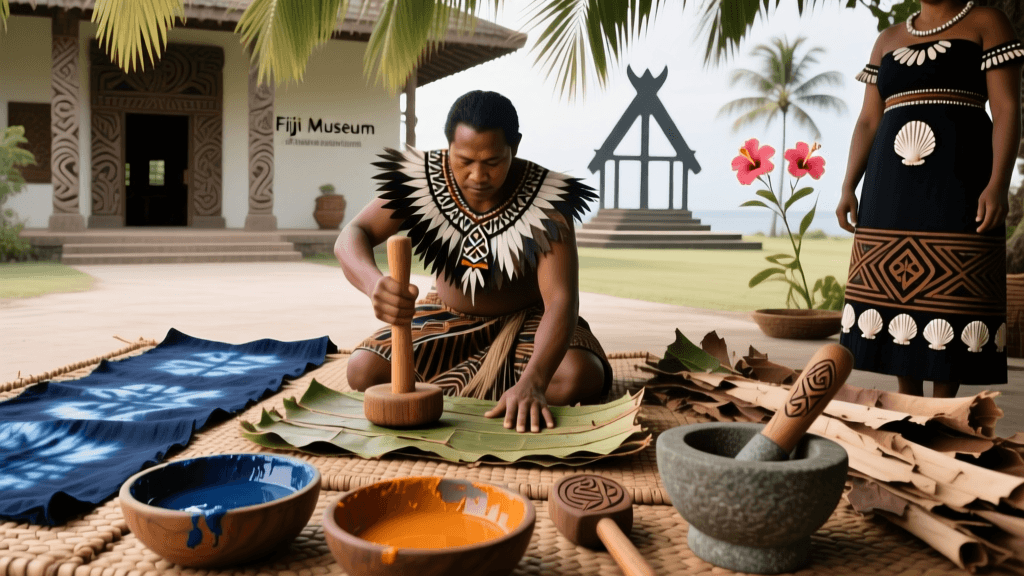
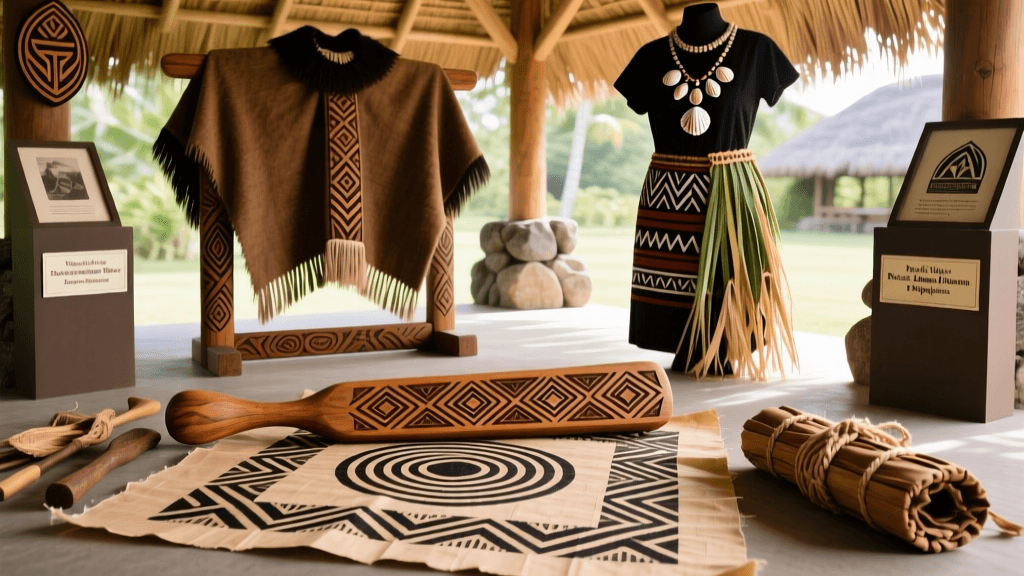
Samoan tapa cloth—known locally as siapo—is not woven but beaten from the inner bark of the paper mulberry tree (Broussonetia papyrifera). The process begins with harvesting mature stems, typically 12–18 months old, which are stripped, soaked in freshwater for 3–5 days, and scraped clean with shark-toothed or shell-edged tools. A single sheet of finished siapo may measure up to 3.2 meters long and 1.4 meters wide, requiring up to 12 hours of continuous beating with wooden mallets called i‘e tō’i. These mallets feature four distinct beater faces: two smooth for initial fiber separation, one grooved for thinning, and one finely textured for surface finishing. Each face is carved with precision—grooves spaced exactly 1.5 millimeters apart—to ensure even tension and consistent thickness.
Geometric Language: Motifs as Kinship Maps
Every geometric motif in Samoan siapo carries relational meaning, functioning less as decoration and more as a visual genealogy. The fa’atua (zigzag) pattern symbolizes mountain ridges and ancestral migration paths between Savai‘i and Upolu; its angular repetition mirrors the stepped volcanic terrain of the islands. The lē fā (four-leaf motif) represents the four founding lineages of the Sa Malietoa paramountcy and appears exclusively in cloths commissioned for chiefly investitures. Its central node measures precisely 2.3 centimeters in diameter—a measurement echoed in ceremonial staff carvings held at the Museum of New Zealand Te Papa Tongarewa.
Regional Variations Across Samoa
Western Savai‘i artisans favor dense, interlocking diamond grids (fa‘alelei) that encode land boundaries and matai title succession. In contrast, eastern Upolu weavers emphasize open-field compositions with floating motifs like the ta’ovala-shaped lozenge, referencing the woven waist mats worn by elders during village councils. On the island of Manono, a rare variant uses charcoal-based black pigment mixed with fermented coconut water to produce matte, non-reflective surfaces—distinct from the glossy iron-rich reds used elsewhere.
The Stamp: From Coconut Shell to Sacred Geometry
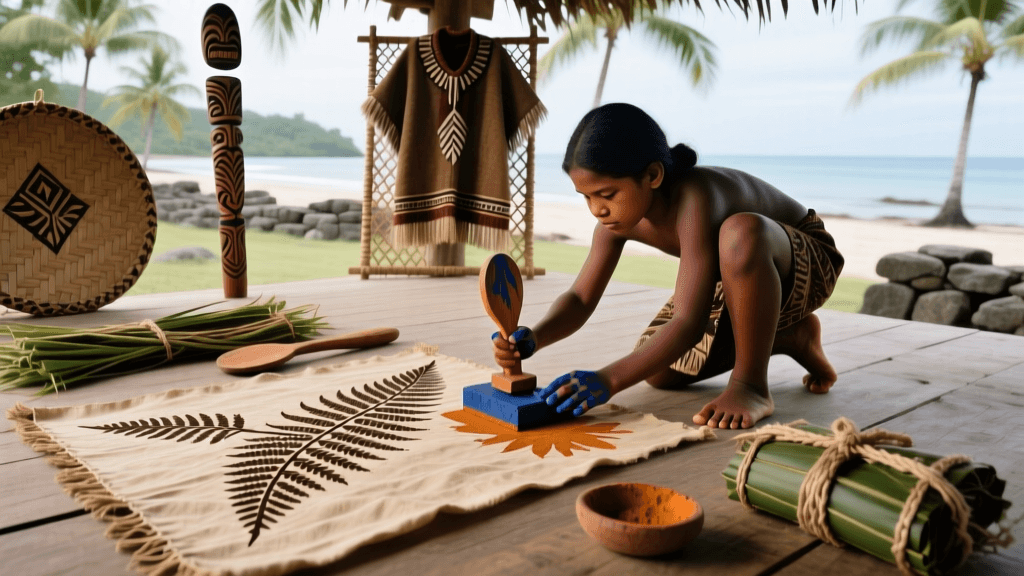
Traditional siapo stamps—upo—are carved from hardwoods like ifilele (Intsia bijuga) or Pacific rosewood (Pterocarpus indicus). Each stamp block is no larger than 7.5 × 5.2 cm to fit comfortably in the palm, yet contains up to 42 individual incised elements arranged in rotational symmetry. Master carvers apprentice for 8–10 years before carving ceremonial stamps, and must observe strict protocols: no stamping occurs during lunar waning phases, nor within 24 hours of a death in the village. The National University of Samoa’s Ethnographic Archive documents over 1,260 distinct upo designs collected since 1978, with 87% tied directly to specific family histories rather than generic symbolism.
Materials and Their Ritual Significance
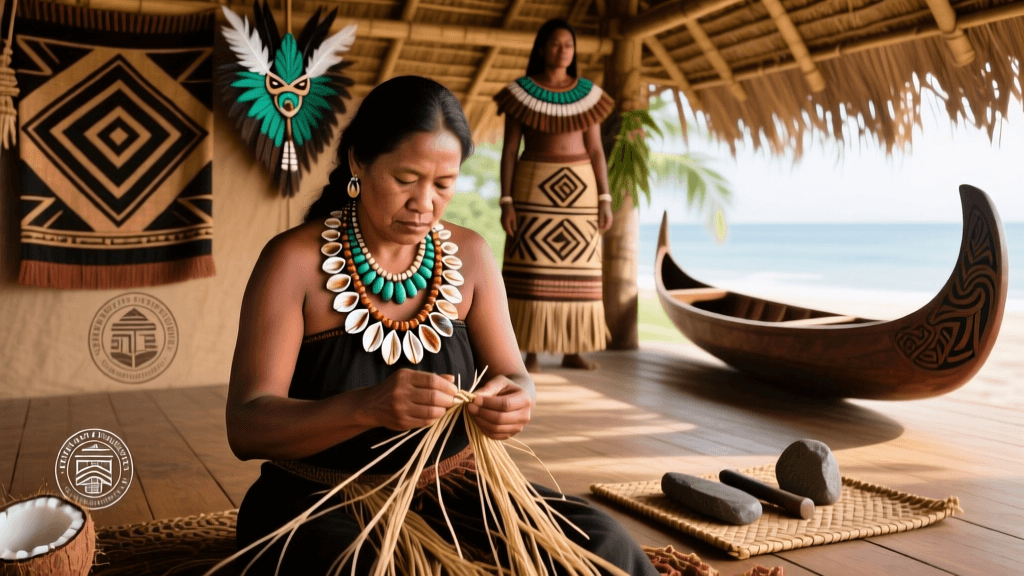
Natural pigments derive exclusively from local sources: red from roasted and ground laterite clay mixed with sap of the noni fruit (Morinda citrifolia), black from burnt candlenut kernels (Aleurites moluccanus), and yellow from turmeric root (Curcuma longa). Preparation follows prescribed ratios—1 part clay to 3 parts noni sap—and requires stirring counterclockwise for exactly 11 minutes, a duration linked to the 11 villages of the ancient Tumua confederacy. The pigments are applied using handmade brushes of frayed coconut midribs, each brush discarded after a single use to prevent contamination across lineage-specific designs.
Institutional Stewardship and Living Practice
The O le Siapo Museum in Apia preserves over 427 historic siapo pieces, including a 1903 ceremonial wrap measuring 2.8 × 1.1 meters, documented with oral histories from 12 elder women of the Faleata district. At the University of the South Pacific’s Institute of Pacific Studies in Suva, researchers collaborate with master practitioners like Fa’asolopito Leau from Sāmoa to digitize stamp matrices and map motif distribution across 23 villages in the Gaga’emaaga district. Their 2021 field survey recorded that 68% of active siapo makers maintain personal upo collections passed down through matrilineal lines, with 41% still sourcing raw materials from designated family forest plots.
Cultural Protocols in Contemporary Use
Siapo remains embedded in protocol: it cannot be displayed vertically on walls without prior consultation with village elders, and unrolled cloths must never touch the floor. During the 2019 opening of the new Pacific Arts Centre at the Auckland War Memorial Museum, curators worked with Samoan cultural advisors to install a 4.1-meter-long siapo horizontally on a raised platform draped with fresh ti leaves—a requirement verified by the museum’s Pacific Advisory Group. As noted by the Pacific Islands Museums Association (2020), “Tapa is not static artifact—it is breath, memory, and obligation made visible.”
- Each i‘e tō’i mallet weighs between 1.8–2.4 kg, calibrated to the artisan’s body mass for ergonomic control
- Finished siapo sheets average 0.3–0.5 mm thickness, measured with vernier calipers during quality review
- Traditional upo stamps require 22–27 hours of hand-carving per block, using only adze and chisel tools
- The Museum of New Zealand Te Papa Tongarewa holds 317 documented Samoan tapa pieces, 92% acquired pre-1950
- A full ceremonial siapo ensemble—including matching headband, waist wrap, and shoulder mantle—requires 19–23 days of collective labor
At the Fale o le Siapo in Lotopa, students learn not only technique but the genealogical weight behind each line: how the la’u fa’asolosolo (woven vine motif) references the 17th-century alliance between the villages of Fasito‘outa and Faleāpuna, or how the spacing of parallel lines in the fa’asolosolo pattern corresponds to the exact distance—1.7 kilometers—between two sacred springs on the southern coast of Upolu. This precision is not aesthetic convention but covenant.
Conservation efforts prioritize living transmission over archival storage. The Samoa Cultural Centre in Apia mandates that all siapo loaned to international exhibitions must include a practicing artisan as co-curator, ensuring contextual accuracy and ritual continuity. Similarly, the Fiji Museum’s 2022 exhibition Tapa Across the Seas featured real-time video links to workshops in Savai‘i, allowing visitors in Suva to observe stamp carving alongside elders from the village of Safotu.
Unlike Hawaiian kapa or Māori kākahu, which often integrate featherwork or flax weaving, Samoan siapo foregrounds the flat plane as sovereign space—every centimeter calibrated to kinship, geography, and divine order. When a young woman completes her first full-size siapo under the guidance of her grandmother, she does not sign it. Instead, she places a single thumbprint—measured at 1.9 cm in width—on the reverse side near the lower left corner, aligning it precisely with the ancestral motif’s baseline. That print becomes part of the cloth’s provenance record, archived at the National Archives of Samoa.
“The stamp is not pressed into the cloth—it presses into the maker’s spirit first. Only then can it carry truth.” — Fa’asolopito Leau, Senior Siapo Practitioner, O le Siapo Museum, 2023
Contemporary artists such as Loto Vao in Apia now experiment with layered siapo—bonding multiple sheets with natural cassava paste to achieve relief effects up to 3.8 mm high—yet adhere strictly to traditional pigment recipes and motif sequencing. Her 2022 installation at the Pacific Arts Festival in Nouméa included a 5.6-meter wall piece composed of 14 individual siapo panels, each representing a different village in the Ātua district, with seam lines aligned to match the actual coastal contours mapped by the Samoa Land Survey Department in 1984.
These practices resist commodification not through isolation but through insistence on relational accountability. A siapo sold outside the archipelago must accompany a signed protocol agreement specifying display conditions, handling restrictions, and annual reporting requirements to the Ministry of Culture and Heritage in Apia. Such frameworks affirm that geometric patterns are not abstract—they are covenants rendered in plant fiber, mineral pigment, and human time.
| Motif Name | Physical Dimensions | Primary Symbolism | Associated Village Cluster |
|---|---|---|---|
| fa’atua | 12.5 cm repeat unit | Ancestral migration routes | Savai‘i Highlands |
| lē fā | 2.3 cm central node | Four founding lineages | Malie, Tuālātai |
| la’u fa’asolosolo | 3.1 cm vine loop | Inter-village alliances | Fasito‘outa–Faleāpuna corridor |
The continued vitality of siapo lies in its refusal to be reduced to ornament. It is mathematics rooted in place, geometry governed by genealogy, and pigment bound by covenant. When the mallet strikes bark, it echoes not just fiber separation—but the enduring resonance of identity, measured in millimeters, remembered in meters, and carried forward in every precise, deliberate impression.