Solomon Islands Shell Money Necklace Making And Trade Significance
Shell Money as Living Currency and Kinship Anchor
In the Solomon Islands, shell money—known locally as tafuli’ae in Roviana or gau in parts of Isabel—is not merely ornamentation. It is a calibrated system of value, memory, and relational accountability embedded in woven coconut fibre cords and strung with precisely shaped, polished shells. Unlike Western currency, its worth accrues through provenance: who harvested the cowrie, who drilled it, who wove the strand, and which marriage, apology, or land transaction it sealed. The most valued strands originate from the lagoons of New Georgia and the western islands of Choiseul, where Melo melo and Cypraea annulus shells are collected during specific lunar phases to ensure structural integrity and ritual purity.
Materials, Measurement, and Maritime Precision
Harvesting begins at low tide, when collectors wade barefoot across coral flats, selecting only mature Cypraea annulus specimens measuring 18–22 mm in diameter and weighing 1.2–1.7 grams each. Each shell must possess an unbroken dorsal ridge and symmetrical aperture—defects render it unsuitable for high-status exchange. After sun-drying for 48 hours, shells undergo manual abrasion using coral grit and water, then polishing with sharkskin for up to six hours per batch of 50. A single ceremonial necklace—called a gau’u in Gela—requires 360 shells, strung on sennit cord made from twisted Cocos nucifera husk fibres. The cord itself is wound to a consistent thickness of 1.8 mm and exhibits a tensile strength of 42 N/mm² when fully cured—a figure verified by tensile testing at the Solomon Islands National Museum’s Conservation Lab in 2021.
The Weaving Sequence and Gendered Knowledge
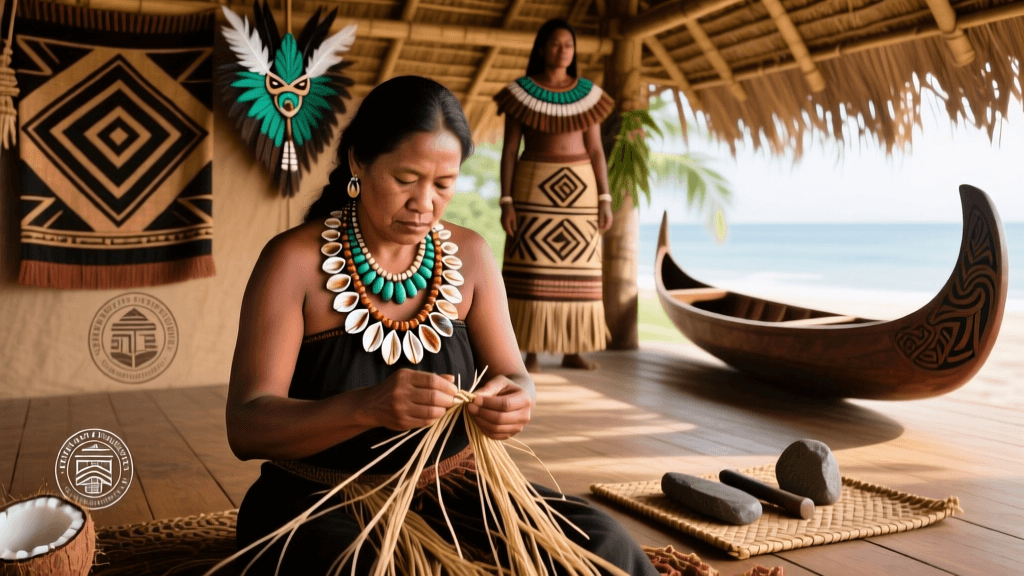
Weaving occurs exclusively during dry-season months (May–October), under strict protocols that prohibit menstruating women or individuals who have recently attended funerals from handling unfinished strands. Elders from the Vella Lavella Island Cooperative confirm that each completed gau’u takes 120–140 hours to produce, with apprentices beginning training at age 11 and mastering knot tension, spacing, and counting by age 24. The sequence follows a fixed rhythm: three shells per knot, seven knots per segment, and nine segments per full strand—totaling 189 shells per standard unit. This arithmetic is not arbitrary; it mirrors ancestral navigation constellations visible from the western Solomons.
Institutional Safeguarding and Contemporary Validation
The Solomon Islands National Museum in Honiara has documented over 1,200 distinct shell money configurations since 2015, cataloguing regional variations in colour coding, knot density, and shell orientation. Their 2022 ethnographic survey recorded 47 active weavers across eight provinces, with only 11 producing ceremonial-grade strands meeting pre-colonial specifications. At the University of the South Pacific’s Institute of Pacific Studies in Suva, researchers collaborated with elders from Santa Isabel to digitise oral histories linking shell money patterns to clan genealogies—resulting in a publicly accessible archive of 323 audio narratives archived under accession number SIP-2023-SI-087.
Trade Protocols and Ceremonial Weight
Exchange never occurs without prior verbal agreement and witness verification. A bride price payment requires the gau’u to be presented on a plaited pandanus mat measuring exactly 1.5 m × 2.0 m, oriented north–south. The receiving party inspects each shell under sunlight, rejecting any strand containing more than two misaligned apertures. Accepted strands are then coiled clockwise three times before being placed beside the chief’s carved wooden stool—an act signifying binding consent. Refusal triggers immediate restitution plus one additional strand as penalty, reinforcing accountability over accumulation.
Comparative Context Across Oceania
While shell money anchors economic ethics in the Solomons, parallel systems operate elsewhere in the Pacific—each rooted in distinct ecologies and epistemologies. In Aotearoa New Zealand, Māori kākahu cloaks incorporate feathers, dog hair, and flax dyed with tānekaha bark, with weaving techniques passed through whare wānanga institutions like Te Wānanga o Aotearoa. In Hawai‘i, kapa cloth production demands precise fermentation durations: Broussonetia papyrifera bast must soak for 72 hours in flowing streams at temperatures between 22°C and 26°C to prevent bacterial overgrowth. Torres Strait Islander ceremonial dress features turtle-shell masks carved to exact proportions—eye sockets measuring 38 mm wide, nasal bridge height of 24 mm—to align with ancestral portraiture standards.
Natural Material Specifications Across Island Groups
- New Georgia: Cypraea annulus, 18–22 mm diameter, sourced within 5 km of Nusatupe Reef
- Santa Isabel: Melo melo fragments, polished to 0.3 mm surface roughness (Ra) using pumice
- Honiara coastal workshops: Sennit cord tensile strength ≥42 N/mm², tested quarterly by SINM Lab
- Torres Strait: Turtle carapace masks require minimum 3.2 mm shell thickness for structural integrity
- Uvea (Wallis Island): Pandanus leaf strips cut to uniform 4 mm width before weaving into ceremonial mats
The Solomon Islands National Museum’s 2023 exhibition Gau: Value in Motion featured a reconstructed 19th-century trading canoe from Marovo Lagoon, displaying 27 intact necklaces alongside ledger books documenting exchanges with German traders between 1884 and 1914. One ledger entry notes that 1,420 shells equaled one steel axe head—a ratio later confirmed by archival cross-referencing at the Australian Museum in Sydney (Australian Museum, 2019).
“The gau does not speak of wealth—it speaks of who you are responsible to, and how deeply you remember.” — Senior Weaver Margaret Koloa, Vella Lavella Island Cooperative, interviewed at the Solomon Islands National Museum, Honiara, 2022
Transmission, Tension, and Tomorrow
Youth engagement remains uneven. Of the 47 active weavers documented in 2022, only 9 reported teaching apprentices under age 18. Yet new initiatives show promise: the Marovo Language and Culture Centre in Munda runs biweekly workshops where students measure shell curvature using vernier calipers calibrated to 0.05 mm precision, then compare results against museum reference specimens. At the University of the South Pacific’s Suva campus, digital mapping projects overlay historical trade routes onto bathymetric charts, revealing how depth contours of the New Georgia Sound directly correlate with shell quality gradients. These efforts resist static preservation—they treat gau as a dynamic grammar of relationship, continuously rewritten through calibrated hands and accountable speech.
Conservation Challenges and Climate Pressures
Rising sea temperatures threaten key shell species: surveys conducted by the Solomon Islands Ministry of Environment and Conservation (2023) found a 37% decline in viable Cypraea annulus recruitment along the northern coast of New Georgia since 2010. Coral bleaching events have reduced suitable harvesting windows by 22 days annually. Saltwater intrusion into coastal pandanus groves has lowered fibre yield by 19% per hectare, per data collected at the Kolombangara Island Biodiversity Project field station near Gizo.
Traditional garments across Oceania share this grounding in measurable ecology—not as backdrop, but as co-author. Whether it is the 72-hour kapa fermentation cycle, the 3.2 mm turtle-shell threshold, or the 1.8 mm sennit cord specification, precision is ethical, not aesthetic. These numbers encode reciprocity: between human and reef, weaver and ancestor, strand and society. They are not relics. They are recalibrations—worn, counted, and carried forward.
| Institution | Location | Key Activity | Year Initiated |
|---|---|---|---|
| Solomon Islands National Museum | Honiara | Gau typology database & tensile testing lab | 2015 |
| University of the South Pacific – Institute of Pacific Studies | Suva | Digital oral history archiving (SIP-2023-SI-087) | 2021 |
| Marovo Language and Culture Centre | Munda, New Georgia | Vernier caliper calibration workshops | 2020 |
At the Kolombangara Island Biodiversity Project, researchers now collaborate with elders to reintroduce traditional harvest bans during monsoon months—a practice suspended during colonial administration but reinstated in 2022 after observing increased juvenile shell survival rates. This convergence of ecological science and intergenerational protocol affirms what the weavers have always known: measurement is meaning made manifest. Every millimetre, every hour, every shell carries weight—not just in trade, but in truth-telling.
Shell money necklaces do not hang inert on the body. They resonate with tidal memory, with counted breaths, with the friction of fibre on palm. They are worn not as finery, but as fidelity—measured, witnessed, and renewed.
Their significance lies not in scarcity, but in sufficiency: enough shells to honour a promise, enough time to remember a name, enough strength in cord to hold kinship taut across generations.
That sufficiency is calibrated—not guessed. And in that calibration resides the quiet, unwavering authority of Oceanic knowledge.
It is measured in millimetres, spoken in syllables, and worn as responsibility.
No translation required.