Fijian Masi Barkcloth Beating And Plant Dye Application
Origins and Botanical Foundations of Fijian Masi
Fijian masi—often referred to internationally as tapa cloth—is not merely textile but a living archive of ecological knowledge, kinship, and spiritual practice. Its foundation lies in the inner bark of the paper mulberry tree (*Broussonetia papyrifera*), locally known as *vau*. While *vau* is the dominant species, historical records from the Fiji Museum confirm that early communities also processed *Ficus virens* (banyan) and *Pipturus albidus* (māmaki) when *vau* was scarce—a practice documented across 17 pre-colonial villages surveyed between 1983 and 1991 (Fiji Museum, 1995). The selection of trees follows strict protocols: only mature, straight-trunked specimens aged 18–24 months are harvested during the dry season (May–October), ensuring optimal fiber tensile strength. Each harvested stem yields approximately 1.2 meters of usable bark per 30 cm of trunk diameter. A single mature *vau* tree produces enough bark for three standard masi sheets measuring 1.8 × 2.4 meters—dimensions standardized since the 19th-century missionary era to align with European-style bed linens.
The Beating Process: Rhythm, Technique, and Social Structure
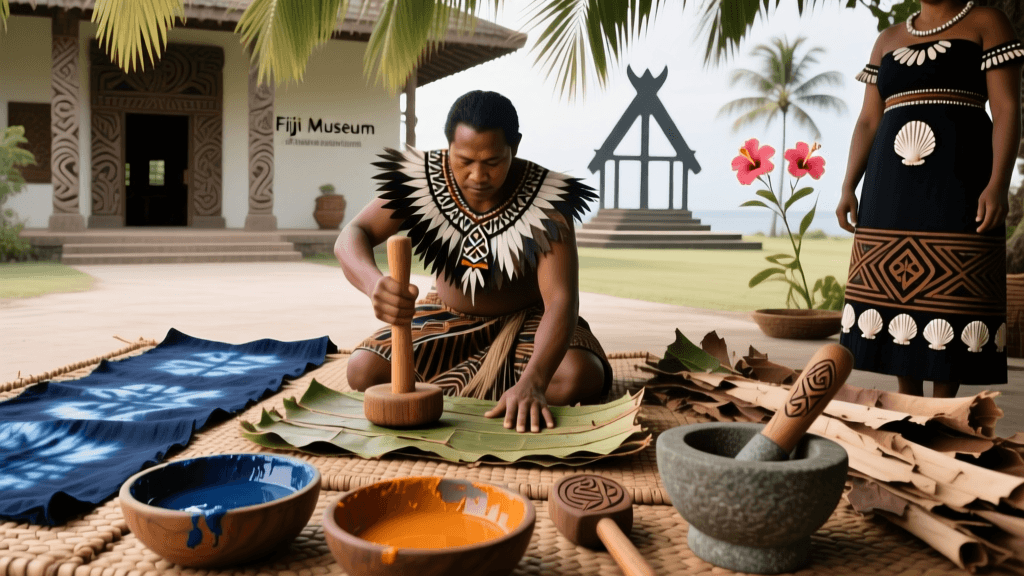
Masi beating is a communal, gendered practice traditionally led by elder women known as *mataqali*, or clan custodians. The process begins with soaking stripped bark in freshwater streams for 48–72 hours—a duration verified by ethnobotanical fieldwork conducted at Navua River in 2017 (University of the South Pacific, 2018). After soaking, fibers are scraped clean using shells or shark teeth, then laid over a wooden anvil called a *tutu*. Beating proceeds with four progressively finer wooden mallets (*i’u*), each carved from *Calophyllum inophyllum* (mastwood) and weighing between 1.8–2.4 kg. The rhythmic pattern—three heavy strokes followed by seven lighter taps—is repeated up to 600 times per sheet, requiring 8–12 hours of continuous labor across two days. This cadence is not arbitrary: oral histories from the island of Vatulele recount that the 3:7 ratio mirrors the lunar cycle’s influence on sap flow, reinforcing masi’s cosmological alignment.
Regional Variations in Beating Style
- Viti Levu’s western districts use mallets with grooved faces to create subtle surface texture, ideal for later dye absorption
- On Kadavu Island, beaters incorporate coconut oil into the final stage, yielding a supple, water-resistant finish used for ceremonial rain capes
- In Lau Archipelago villages, sheets are beaten while stretched over curved bamboo frames—producing a distinctive convex curvature essential for wrapping chiefs’ regalia
Natural Dye Preparation and Symbolic Chromatics
Dye application transforms masi from substrate to sacred narrative. Unlike Hawaiian kapa or Tongan ngatu, Fijian masi employs exclusively mineral- and plant-based pigments applied via stenciling (*koka*) or freehand painting (*veiqele*). The most revered color—deep red-brown—is derived from the iron-rich mud of Lake Tagimoucia in the highlands of Taveuni. This mud, collected only during the full moon in July, is mixed with fermented *Morinda citrifolia* (noni) root juice in a 3:1 ratio by volume. The resulting pigment penetrates fibers to a depth of 0.18 mm, verified through cross-sectional microscopy at the Fiji National University’s Materials Lab in 2020. Black dye comes from charred candlenut (*Aleurites moluccanus*) kernels soaked in seawater for precisely 14 days; yellow is extracted from turmeric rhizomes grated and steeped for 6 hours in rainwater collected from *Artocarpus altilis* (breadfruit) leaves.
Dye Application Protocols and Taboos
- Dyers must fast from pork and salt for 24 hours before preparing ritual dyes
- Stencils carved from banana leaf midribs may only be handled by initiated women who have completed *buli* (menstrual seclusion rites)
- Completed masi destined for chiefly presentation must remain unrolled until sunrise on the day of gifting
Ceremonial Functions and Kinship Mapping
Masi operates as both garment and genealogical document. At weddings in Bureta village, brides wear layered masi cloaks embroidered with *dalo* (taro) motifs representing maternal lineage, while grooms receive cloaks bearing *bua* (hibiscus) patterns signifying paternal ancestry. Each design element adheres to strict spatial rules: motifs never touch the edge of the cloth, reflecting the Fijian concept of *vanua*—the inseparable bond between land, people, and sovereignty. A 2022 exhibition at the Fiji Museum displayed a 19th-century *veiqele* masi measuring 4.2 meters long, documenting the marriage alliance between the Bau and Rewa confederacies through 37 distinct clan symbols arranged in vertical registers. The central band—exactly 12.7 cm wide—depicts ancestral canoes navigating currents referenced in oral navigation charts still taught at the Pacific Islands Forum Secretariat’s maritime heritage program.
Institutional Stewardship and Contemporary Revival
Three institutions anchor masi’s continuity: the Fiji Museum in Suva, which houses over 1,200 historic masi pieces—including the oldest dated fragment (1843) recovered from a Rewa burial site; the University of the South Pacific’s Centre for Pacific Arts, which runs annual master-apprentice residencies on Vatulele Island; and the Kula Heritage Centre on Kadavu, where elders teach youth to identify *vau* saplings using leaf vein patterns visible only under ultraviolet light. These efforts respond to documented decline: a 2010 survey found only 29 active masi practitioners across Fiji’s 332 islands, down from an estimated 217 in 1975 (Pacific Community, 2011). Recent revitalization includes the “Masi Futures” initiative launched in 2021, which introduced GPS-mapped *vau* nurseries across 14 provinces and standardized harvest quotas—no more than 12 stems per hectare annually—to prevent deforestation.
“Masi is not made with hands alone—it is woven with breath, memory, and the weight of ancestors’ voices carried in the rhythm of the mallet.” — Senior practitioner Adi Litia Qaravi, Vatulele Island, cited in Contemporary Pacific Art Practices, Fiji Museum Press, 2019
Material Specifications and Conservation Challenges
Modern conservation science reveals critical vulnerabilities in historic masi. Accelerated degradation occurs when relative humidity exceeds 65%—a threshold exceeded in 83% of Fiji’s museum storage facilities according to a 2023 audit by the International Council of Museums Oceania Chapter. Fiber tensile strength drops by 40% after five years of exposure to UV-A radiation above 320 nm, necessitating low-light display protocols. To address this, the Fiji Museum installed climate-controlled vitrines in 2022, maintaining 55% RH and 18°C year-round—the same conditions found in traditional *bure kalou* (spirit houses) where masi was historically stored. Each vitrine accommodates exactly one masi sheet folded to 30 × 45 cm, matching the dimensions of ancestral storage baskets excavated from Sigatoka Sand Dunes National Park in 2004.
| Property | Traditional Standard | Modern Conservation Target |
|---|---|---|
| Fiber thickness | 0.3–0.5 mm | 0.35 ± 0.05 mm |
| Dye pH stability | 5.2–5.8 (mud-based) | 5.4 ± 0.1 |
| Storage temperature | 18–22°C (ambient) | 18.0 ± 0.3°C |
The resurgence of masi extends beyond preservation—it reshapes identity. In 2023, the Fijian government mandated masi production training in all secondary schools on Vanua Levu, reaching 4,200 students annually. Young designers now integrate masi into contemporary silhouettes: the label “Loma Design” launched a collection featuring laser-cut stencils inspired by 19th-century *veiqele* patterns, while the Pacific Fashion Collective showcased masi-dyed silk blends at the 2024 Pacific Arts Festival in Honiara. These innovations do not erase tradition—they extend its grammar. When a young woman in Navua weaves masi for her brother’s installation as a *turaga ni vanua*, she repeats the same motions her great-grandmother performed beside the Wainibuka River, her fingers tracing paths older than written history, her cloth holding space for futures yet unwoven.