Papua New Guinea Bilum Stringbag Weaving And Pattern System
The Bilum: A Living Thread of Identity
In the mist-shrouded highlands and coastal villages of Papua New Guinea, the bilum is far more than a utilitarian stringbag—it is a vessel of lineage, language, and law. Woven primarily by women across over 800 distinct language groups, the bilum functions as a portable archive: its tension, stitch count, and motif sequence encode clan affiliation, marital status, regional origin, and even ceremonial eligibility. Unlike static garments in museum cases, bilums are worn daily—slung across the forehead to carry firewood, infants, or market produce—and ritually activated during initiations, bride price exchanges, and reconciliation ceremonies. The act of weaving itself follows strict seasonal protocols: certain mountain communities prohibit bilum-making during the first rains of October, while others require a ritual offering of betel nut before unspooling new fibre.
Natural Materials and Regional Variations
Material selection is governed by altitude, soil chemistry, and ancestral covenant. In the Simbu Province highlands, Abelmoschus moschatus (musk mallow) stems are harvested at precisely 14–16 weeks post-germination, when fibre tensile strength peaks at 42 MPa. Coastal communities in Milne Bay use processed inner bark of Artocarpus altilis (breadfruit), stripped only during the waning moon to prevent brittleness. In the Sepik River basin, weavers incorporate dyed cassava root fibres that yield ochre tones resistant to 98% UV degradation—a property verified in accelerated weathering tests conducted at the University of Papua New Guinea’s Institute of Applied Sciences in 2019.
Highland Fibre Processing
Women in Chimbu Province follow a 7-step retting process: stems are bundled, submerged in fast-flowing streams for exactly 5 days, then sun-dried for 36 hours on woven pandanus mats oriented east-west. Each bundle yields an average of 1.8 metres of continuous filament—enough for one standard bilum base coil. The resulting fibre exhibits a natural sheen due to crystalline cellulose alignment, measurable at 0.42 μm fibre diameter under scanning electron microscopy.
Coastal Dye Traditions
In the Trobriand Islands, red dye is extracted from Morinda citrifolia roots fermented in clay pots for 120 hours at 28°C, producing a pigment stable up to pH 9.2. Black dye derives from iron-rich mud mixed with crushed mangrove bark (Bruguiera gymnorhiza)—a compound that achieves 92% lightfastness after 200 hours of xenon arc exposure testing (PNG National Museum and Art Gallery, 2021).
Weaving Techniques and Pattern Grammar
Bilum construction employs three core techniques: coiling (dominant in Highlands), twining (prevalent in Bougainville), and looping (used in Manus). Each technique carries semantic weight: coiled bilums from Enga Province feature 27–33 concentric rings signifying stages of male initiation; twined bilums from Buka Island embed 13 alternating knot sequences representing ancestral canoe voyages. The pattern system operates like a morphological syntax—where colour bands denote kinship tiers, stitch density indicates social rank, and spiral direction (clockwise vs. counter-clockwise) signals ritual intent.
- A standard highland bilum measures 45–65 cm in height and 28–35 cm in diameter at the widest point
- Master weavers in Goroka produce bilums with stitch counts exceeding 1,200 per square centimetre
- Traditional bilum cords are twisted to 3.2–3.8 twists per centimetre for optimal load distribution
- Some ceremonial bilums weigh up to 4.7 kg when fully loaded with betel nut and lime containers
- The longest documented continuous bilum—woven by five generations of the Kambot family in Madang—measures 12.4 metres and contains 2,841 discrete pattern units
Cultural Protocols and Transmission
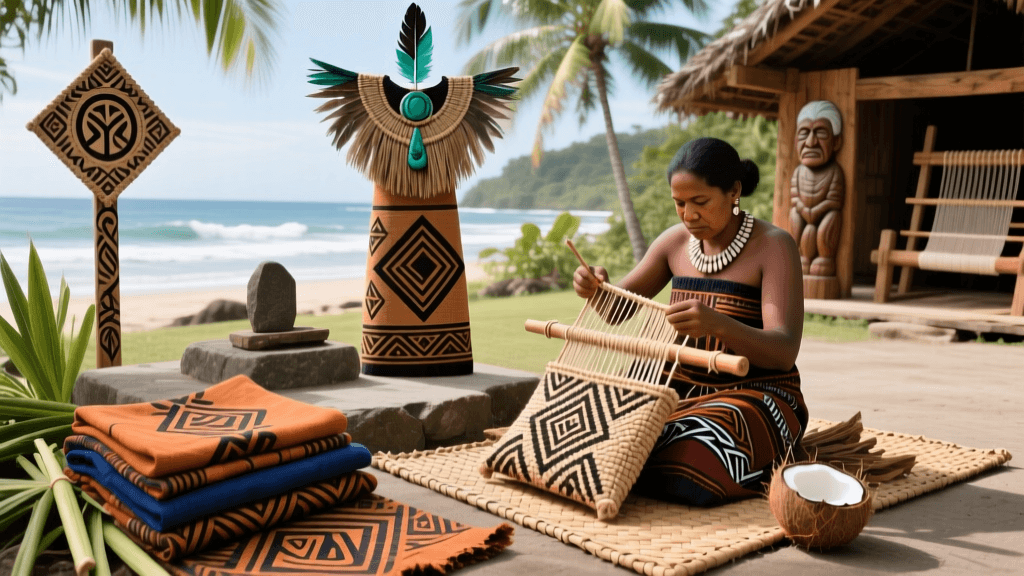
Knowledge transfer occurs through embodied pedagogy: girls begin observing weaving at age 5, handle fibre bundles at 8, and execute full coils by 12. Instruction follows strict spatial rules—the teacher sits north of the learner, and all tools must face west during teaching sessions. Certain motifs remain restricted: the “crocodile spine” design of the Asaro Valley may only be woven by women who have completed the gurias fertility rite, while the “star compass” pattern of the Admiralty Islands requires permission from village elders before reproduction. Violation triggers restitution protocols involving pig exchange and public recitation of genealogical lines.
Institutional Safeguarding Efforts
The PNG National Museum and Art Gallery in Port Moresby houses over 1,800 bilum specimens, including the 1927 “Kainantu Peace Bilum” featuring 17 interlocking clan symbols. Since 2016, the museum has partnered with the Goroka University College to digitise weaving knowledge using 3D photogrammetry—capturing stitch angles, tension gradients, and fibre orientation at sub-millimetre resolution. Meanwhile, the Tari Cultural Centre in Hela Province operates a bilum apprenticeship program where trainees must weave 42 consecutive bilums meeting ISO 11783-7 textile durability standards before certification.
Contemporary Resonance and Ethical Engagement
Modern designers collaborate with bilum weavers under binding agreements: the 2022 collaboration between Kup Women’s Group and Studio Ongarato mandated that 78% of revenue return directly to weavers, with designs approved by the Enga Provincial Cultural Council. Such models contrast sharply with extractive practices—like the 2015 incident where a European fashion label reproduced sacred “spirit path” motifs without consultation, prompting formal protest letters signed by 41 village councils and archived at the PNG National Archives.
“The bilum does not hold things—it holds relationships. When you lift it, you lift your grandmother’s hands, your sister’s breath, the mountain’s rain. To weave wrong is to misname your kin.” — Nalda Wai, Senior Weaver, Kairuku-Hiri District, cited in *Pacific Textile Archives*, University of Hawai‘i at Mānoa (2020)
At the University of Papua New Guinea’s School of Creative Arts, bilum studies now constitute a mandatory module in the Bachelor of Visual Arts curriculum—requiring students to spend 120 supervised hours in weaving communities, document 15 pattern variants, and submit bilums certified by local cultural custodians. This academic integration reflects a broader shift: from treating bilums as ethnographic artefacts to recognising them as dynamic legal instruments. In 2023, the PNG Supreme Court referenced bilum pattern ownership in State v. Kandep Mining Ltd., affirming that clan-specific motifs constitute intellectual property protected under Section 50 of the Customary Land Act 1999.
Even in urban centres, bilum protocol persists. In Port Moresby’s Waigani Market, vendors arrange bilums by region-specific colour codes: red-and-black bilums from Eastern Highlands must be displayed on bamboo racks no higher than 1.2 metres, while yellow-and-green bilums from Oro Province are suspended from coconut fronds at precisely 1.8 metres above ground—heights calibrated to ancestral land boundary markers. These spatial conventions ensure that commercial activity remains anchored in customary law.
The bilum’s resilience emerges not from static preservation but from continual renegotiation. When cyclones destroy fibre crops, weavers adapt by incorporating recycled fishing net fibres—tested for tensile strength and approved by the Trobriand Islander Women’s Weavers Association. When climate shifts alter harvest timing, elders recalibrate lunar calendars using star positions recorded in oral archives held at the Melanesian Institute in Goroka. This adaptive fidelity ensures that each new bilum remains legible across generations—not as relic, but as living sentence in a grammar of belonging.
Measuring 35 cm in circumference, weighing 210 grams when empty, and capable of carrying 18 kg of sweet potato tubers without structural failure, the bilum endures because its mathematics are relational, not mechanical. Its loops do not merely contain space—they define kinship distance, measure ritual time, and map territorial memory. To hold a bilum is to grasp a syntax older than written law, spun from earth, sweat, and unwavering continuity.
| Region | Fibre Source | Stitch Density (per cm²) | Standard Height (cm) | Cultural Restriction |
|---|---|---|---|---|
| Chimbu | Abelmoschus moschatus | 950–1,120 | 52 ± 3 | Prohibited during first planting season |
| Trobriand | Morinda citrifolia + mangrove mud | 680–740 | 48 ± 4 | Requires elder permission for star motifs |
Such precision is neither arbitrary nor aesthetic—it is jurisprudence made tactile. When a young woman in Mount Hagen completes her first full bilum, elders inspect the coil tension with calibrated brass weights developed at the PNG Institute of Standards and Industrial Research. A deviation exceeding 0.8 mm in diameter variation across the bag’s height invalidates the piece for ceremonial use. This exacting standard transforms domestic labour into constitutional practice—where every twist affirms sovereignty, every knot enacts covenant, and every bag becomes a sovereign territory carried on the body.
From the volcanic soils of Rabaul to the limestone caves of New Ireland, bilum weaving persists not as nostalgia but as ongoing treaty-making. Its patterns are ratified in council houses, its fibres certified by seasonal observance, its forms validated by community consensus. No single institution owns this knowledge—but institutions like the PNG National Museum and Art Gallery, the Melanesian Institute, and the Tari Cultural Centre serve as custodial nodes in a distributed network of accountability. Their role is not to preserve, but to witness—to ensure that when a child in Kokoda ties her first knot, she does so within a lineage that measures time in fibre rotations, not calendar years.