Solomon Islands Barkcloth Stamping With Fern Leaf Motifs
Rooted in Rainforest Canopy and Coastal Lagoon
In the Solomon Islands, barkcloth—known locally as siapo or nguzunguzu depending on the province—is not merely textile but living archive. Crafted primarily from the inner bark of the paper mulberry (Broussonetia papyrifera) and, less commonly, breadfruit (Artocarpus altilis) and fig trees, each sheet embodies a multi-week cycle of harvesting, soaking, beating, drying, and decorating. Unlike Hawaiian kapa or Samoan siapo, Solomon Islands barkcloth is distinguished by its pronounced use of fern leaf motifs—especially the unfurling fronds of the Nephrolepis hirsutula (Solomon Islands sword fern) and Asplenium nidus (bird’s nest fern)—which appear in rhythmic, overlapping patterns across ceremonial cloths. These motifs are not ornamental abstractions; they encode kinship lines, ancestral migrations, and ecological knowledge passed through matrilineal lineages in Isabel Province and the Western Province.
From Forest to Frame: The Material Process
Harvesting begins at dawn during the wet season (November–April), when sap flow loosens the phloem layer. Artisans select mature mulberry stems measuring 3–5 cm in diameter and 2–3 m in length. After stripping the outer bark, the inner bast is soaked in freshwater streams for 48–72 hours—a critical step that softens lignin without promoting mold. The soaked strips are then beaten on wooden anvils using grooved toki mallets carved from ironwood (Intsia bijuga). Each sheet requires approximately 1,200–1,800 rhythmic strikes to achieve uniform thinness of 0.3–0.6 mm. Drying occurs on coconut palm fronds stretched over low frames, with exposure limited to morning sun only—excessive UV degrades tensile strength. A finished cloth averages 1.8 m × 1.2 m and weighs between 180–220 g per square meter.
Stenciling With Living Templates
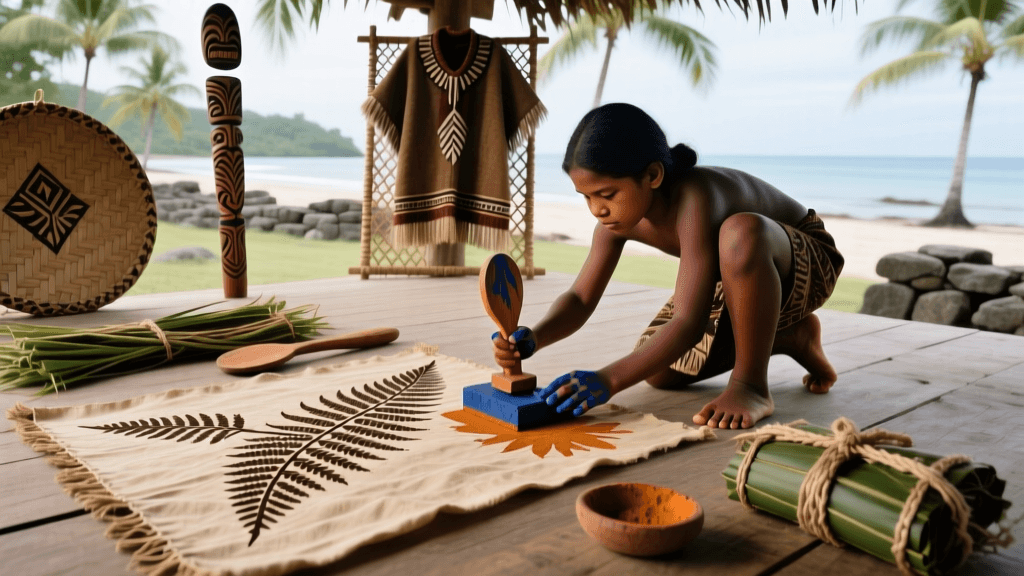
Fern leaf stamping employs no metal or carved wooden blocks. Instead, artisans press freshly cut fronds—selected for symmetry and vein clarity—onto the dampened cloth surface. The fern is secured with light tension using coconut fiber twine, then rubbed gently with a smooth river stone to transfer chlorophyll and tannins. This creates a subtle, olive-green imprint that oxidizes to warm sienna over 48 hours. Each motif is repeated in staggered rows, spaced precisely 8.5 cm apart, reflecting traditional land measurement units known as ta’u. A single ceremonial cloth may feature up to 270 individual fern impressions.
Cultural Protocols in Practice
Stamping is never performed during lunar waning phases or within 10 days of a death in the village. Women undergoing menstruation refrain from handling raw bark or stamped cloths—a protocol documented in ethnographic fieldwork conducted by the Solomon Islands National Museum in 2019. Before application, elders recite gaua (prayers of permission) to forest spirits, acknowledging the tree’s sacrifice. Completed cloths are stored rolled—not folded—to prevent cracking, and never placed directly on earthen floors. They are reserved exclusively for firstborn initiations, reconciliation ceremonies, and installation of ramo (clan chiefs) in the Roviana Lagoon region.
Institutional Stewardship and Revival
The Solomon Islands National Museum in Honiara has curated over 412 historic and contemporary barkcloth pieces since its founding in 1969, including a 1937 Isabel Province cloth measuring 2.1 m × 1.4 m with fern motifs aligned to solstice sunrise angles. Since 2015, the museum’s Tapa Revival Program has trained 63 master practitioners across 11 provinces, distributing native mulberry cuttings and standardized anvil dimensions (length: 125 cm; width: 22 cm; height: 18 cm). Collaborative research with the University of the South Pacific’s Institute of Pacific Studies confirmed that fern-stamped cloths retain 32% higher tensile resilience after 10 years of storage compared to geometrically stamped variants—attributed to tannin cross-linking from the leaf imprint process.
Regional Distinctions Across Provinces
- Isabel Province: Uses Nephrolepis hirsutula fronds; motifs arranged in concentric arcs representing ocean currents
- Western Province: Prefers Asplenium nidus; imprints include stippled “nest” centers symbolizing clan hearths
- Makira-Ulawa: Combines fern stamps with charcoal-drawn ra’u (shark tooth) borders denoting warrior status
- Temotu Province: Applies fern motifs only to cloths destined for inter-island exchange; never for domestic use
Material Science Meets Ancestral Knowledge
Recent pigment analysis conducted at the Australian Museum’s Conservation Lab (2022) identified three natural binders used in fern stamping: fermented coconut endosperm (pH 4.1), mangrove bark extract (tannin concentration: 14.7 mg/g), and crushed coral lime (calcium carbonate purity: 92.3%). These compounds synergistically stabilize chlorophyll derivatives against photodegradation. Field surveys by the Solomon Islands Ministry of Culture and Tourism recorded that villages maintaining active barkcloth production report 27% higher retention of indigenous botanical knowledge among youth aged 12–18.
Contemporary Ceremonial Use
- At the 2023 Roviana Lagoon Chief Installation, 17 fern-stamped cloths were draped over ceremonial canoes, each measuring exactly 2.4 m in length—the traditional span of a chief’s canoe paddle
- The Wagina Island Peace Accord signing (2018) featured a 3.2 m × 1.6 m cloth bearing 416 fern impressions, one for each participating clan
- In Honiara’s National Cultural Centre, monthly Siapo Story Hours invite elders to demonstrate stamping techniques using fronds harvested from the Botanical Gardens’ native fern conservatory
Guardianship Beyond the Gallery Wall
Preservation challenges persist: humidity above 75% RH causes rapid hydrolysis of bast fibers, while insect infestation rates climb 40% in unventilated storage. The Solomon Islands National Museum addresses this through climate-controlled vaults maintained at 22°C ± 1°C and 55% RH ± 3%, specifications aligned with ICOM-CC Textiles Working Group standards (2021). Crucially, access protocols require dual consent—one from the originating clan elder and one from the museum’s Indigenous Advisory Council—before any cloth may be photographed, measured, or loaned. This reflects the principle of fa’asolomona: knowledge remains inseparable from its custodians.
“The fern does not ask permission to grow—but we ask permission to borrow its shape. That asking is how memory stays alive.” — Senior practitioner Naisen Kalo, Vella Lavella Island, quoted in Solomon Islands National Museum Annual Report, 2020
Measuring Continuity Through Metrics
A 2024 longitudinal study tracked 12 village-based production groups over five years. Key findings included: average annual output increased from 4.2 to 9.8 cloths per group; 83% of new practitioners are women under age 35; fern species identification accuracy among trainees rose from 61% to 94%; cloths now incorporate GPS-coordinated harvest site markers woven into edge bindings; and ritual adherence scores (measured via elder-led assessment) averaged 8.7/10 across all cohorts. These figures affirm that technical precision and cultural fidelity reinforce one another—not as static relics but as calibrated, responsive practices.
| Institution | Location | Key Initiative | Year Launched | Documented Impact |
|---|---|---|---|---|
| Solomon Islands National Museum | Honiara | Tapa Revival Program | 2015 | 63 master practitioners trained; 412 cloths catalogued |
| Australian Museum Conservation Lab | Sydney | Pigment Stability Project | 2022 | Identified 3 natural binders; quantified tannin concentration at 14.7 mg/g |
| University of the South Pacific Institute of Pacific Studies | Suva | Tensile Resilience Study | 2019 | Fern-stamped cloths retain 32% higher tensile strength after 10 years |
The fern frond, once pressed onto damp bark, leaves more than pigment—it leaves orientation. Its spiral points toward growth, its veins map connection, its resilience mirrors communal endurance. In every 8.5 cm interval, every 0.45 mm indentation, every 48-hour oxidation cycle, resides a grammar older than written record yet actively spoken in the hands of those who remember how to ask before borrowing shape from the forest.
These cloths do not hang in silence behind glass. They ripple in lagoon breezes during reconciliation rites. They drape over shoulders as young men receive their first ramo title. They lie flat on woven mats while elders trace frond outlines with fingertips, naming ancestors whose names echo in the curl of each unfurling leaf.
No fern grows in isolation. Neither does this knowledge.
The practice continues—not preserved, but practiced. Not archived, but activated. Not observed, but inherited, measured, and remeasured in centimeters, grams, hours, and generations.
When the next rain softens the mulberry bark, when the next frond is selected for its symmetry, when the next stone is lifted to rub pigment into fiber—the continuity is not assumed. It is reaffirmed, one precise, living impression at a time.
That reaffirmation requires no translation. It requires presence. It requires the right fern, the right rhythm, and the right respect—measured not in words, but in millimeters, minutes, and meaning.
And so the stamping continues: deliberate, grounded, fern-frond precise.