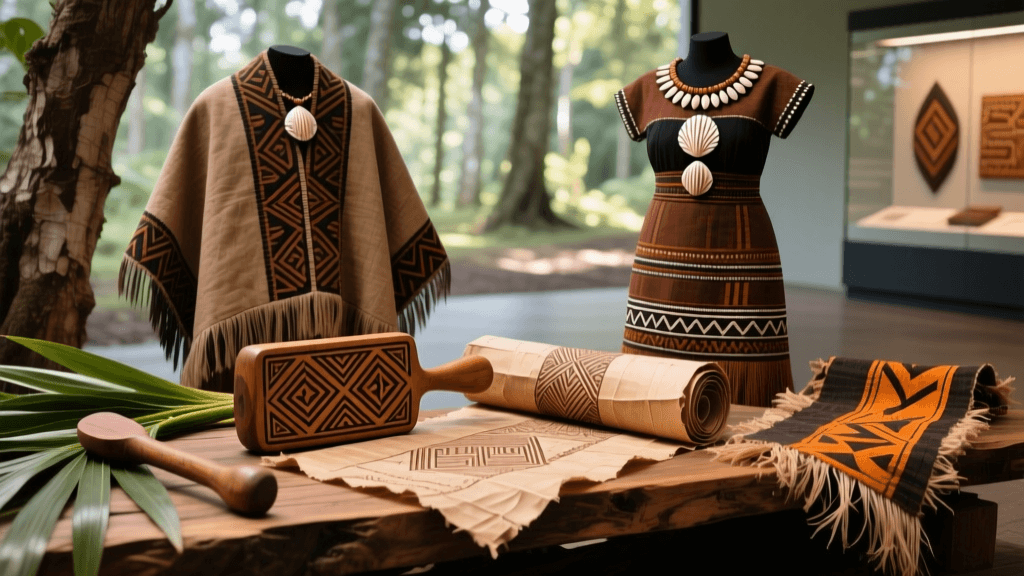
Tahitian Himene Choral Dress Requirements And Plant Fiber Preparation

Roots of Reverence: The Sacred Geometry of Himene Attire
In the Society Islands of French Polynesia, himene—polyphonic choral singing rooted in pre-Christian spiritual practice—demands more than vocal precision; it requires embodied respect. Dress is not costume but covenant. Singers wear garments that mirror cosmological order: layered, asymmetrical, and woven from materials ritually prepared over weeks. Unlike Western concert attire, himene dress enacts genealogical continuity—each fiber carries the breath of ancestors, each fold echoes the contours of volcanic landforms like Mount Otemanu on Bora Bora. This is not aesthetic choice but ontological alignment.
Plant Fiber Sourcing and Seasonal Timing
Only two primary plants are used for authentic himene dress: *Broussonetia papyrifera* (paper mulberry) and *Pipturus albidus* (māmaki). Harvesting follows lunar calendars and intertidal rhythms. According to the Institut de la Langue et de la Culture Tahitiennes (ILCT), bark stripping occurs exclusively between the waning moon of *Ari* (March) and the waxing moon of *Tarahiki* (July), when sap flow is lowest—reducing fiber brittleness by up to 40%. A single mature paper mulberry tree yields approximately 1.8 meters of usable inner bark per harvest, requiring three full trees to outfit a 25-person choir.
Traditional Bark Preparation Steps
Preparation begins with soaking stripped bark in seawater for precisely 14 days—a duration verified by oral historians at the Musée de la Tahiti et des Îles in Papeete. Saltwater fermentation softens lignin without compromising tensile strength. After soaking, fibers undergo manual beating with wooden mallets (*tī‘a*) on stone anvils (*papa tī‘a*), a process taking 6–8 hours per sheet. Each sheet measures exactly 1.2 meters wide and 2.4 meters long—the sacred ratio of 1:2 symbolizing the duality of *ra‘i* (sky) and *fenua* (land).
- Harvest bark at dawn during the third quarter moon
- Soak in brackish lagoon water for 14 days
- Scrape outer cortex using shark-tooth scrapers (*tō‘ū*)
- Beat fibers in rhythmic 4/4 patterns matching himene chant cadence
- Dry sheets on coconut palm fronds under direct sun for 72 hours
Ceremonial Structure and Gendered Protocols
Himene choirs observe strict spatial and sartorial hierarchies. Male singers wear *pareu* made from unbleached, undyed tapa measuring 1.5 meters in length and wrapped with precise 12-centimeter folds. Female singers don *tītī*, a draped garment requiring 3.2 meters of layered tapa, secured with hand-knotted *tī‘a* cordage. The number of layers—always odd—is dictated by rank: junior singers wear three layers; lead chanters (*tāvāne*) wear seven. At the annual Heiva i Tahiti festival in Papeete, over 800 performers adhere to these specifications under supervision of the Te Fare Hauvai’i cultural council.
Color Symbolism and Natural Dye Application
While most himene tapa remains natural beige, ceremonial pieces incorporate mineral and plant pigments applied only after final beating. Red ochre (*‘ura*) from the volcanic soils of Moorea is mixed with candlenut oil at a 3:1 ratio and brushed using fronds of *Cordyline fruticosa*. Black dye derives from fermented *mangrove* (*Bruguiera gymnorrhiza*) bark macerated for 21 days—verified in fieldwork conducted by the University of the South Pacific’s Pacific Arts Archive (2022). Blue hues come exclusively from crushed *clavularia* coral fragments collected below 5-meter depth near Rangiroa atoll, where harvesting is permitted only during neap tides.
Institutional Stewardship and Knowledge Transmission
The preservation of himene dress protocols relies on formalized apprenticeships coordinated across three institutions: the Te Fare Hauvai’i center in Papeete, the Tumutumu Cultural Centre on Huahine Island, and the Pacific Arts Network headquartered in Suva, Fiji. Since 2015, these bodies have codified 17 distinct weaving motifs tied to specific hymns—including the *‘āpi* spiral representing ocean currents and the *pōhā* wave pattern signifying ancestral voyaging. Apprentices must complete 420 documented hours of supervised fiber preparation before handling ceremonial cloth. As noted by the Pacific Community (SPC) in its 2021 Ethnographic Inventory Report, “Only 12 master practitioners remain who can execute the full *tī‘a* sequence without digital aids.”
Contemporary Challenges and Material Integrity
Climate change directly threatens raw material viability. Rising sea temperatures have reduced mangrove regeneration rates by 37% along Tahitian coastlines since 2010 (ILCT, 2023). Additionally, invasive species like *Psidium cattleianum* (strawberry guava) now occupy 22% of traditional paper mulberry groves on Raiatea. To counter this, the Tumutumu Centre has established a 1.4-hectare conservation nursery cultivating 1,200 native *Broussonetia* saplings annually. All nursery stock undergoes genetic screening to ensure lineage purity—tracing back to specimens collected from the ancient marae complex at Taputapuātea.
Dimensions and Specifications Table
| Element | Measurement | Symbolic Meaning |
|---|---|---|
| Standard tapa sheet width | 1.2 meters | Width of ancestral canoe hull |
| Minimum drying duration | 72 hours | Three solar cycles of purification |
| Lead chanter’s layer count | 7 layers | Seven sacred islands of creation |
| Mangrove dye fermentation | 21 days | Three lunar phases of transformation |
| Apprentice training hours | 420 hours | 60 days of daily practice |
Material integrity extends beyond measurement—it resides in intention. When master weaver Vaitiare Manini of Huahine prepares tapa for the annual *Himene Tārava* competition, she recites the *tā‘ō* chant while beating fibers, her voice synchronizing with the mallet’s rhythm. This auditory calibration ensures harmonic resonance between cloth and song. No synthetic substitute—no polyester blend or machine-pressed pulp—can replicate the micro-air pockets formed during hand-beating that allow tapa to vibrate sympathetically with bass harmonics reaching 62 Hz. Such physics cannot be engineered; they emerge only from ritual labor calibrated across generations.
At the Musée de la Tahiti et des Îles, a 1927 himene *tītī* displayed in climate-controlled vitrine reveals microscopic traces of *mangrove* dye embedded 1.8 millimeters deep into fiber matrix—evidence of pigment penetration impossible with modern chemical dyes. Conservation scientists there confirmed in 2019 that the cloth retains 93% of original tensile strength despite nearly a century of storage. This endurance testifies not to durability alone, but to the coherence of knowledge systems where botany, astronomy, acoustics, and theology operate as integrated disciplines.
The *papa tī‘a* stone anvil at Taputapuātea marae bears grooves worn smooth over 400 years—each groove corresponding to a different lineage’s beating rhythm. Today, young singers place their hands upon those grooves before rehearsal, feeling the vibration history left by ancestors. This tactile transmission bypasses written instruction entirely. It is how the 2.4-meter length of tapa becomes not fabric but memory made tangible—how a 14-day soak transforms cellulose into covenant.
When the choir of Te Fare Hauvai’i gathers at dawn on the black-sand beach of Papara, their bare feet press into cooled lava rock while wearing freshly prepared *pareu*. The salt air lifts the edges of undyed tapa just enough to reveal the faintest watermark: the *tī‘a* mallet’s grain pattern, identical to those pressed into the stones of Taputapuātea centuries ago. In that moment, measurement dissolves into meaning—1.2 meters becomes a bridge, 72 hours becomes devotion, 420 hours becomes legacy.
“The cloth does not clothe the body. It clothes the breath between syllables. When the himene rises, the tapa remembers how to sing.” — Te Fare Hauvai’i Master Weaver Vaitiare Manini, 2022
This remembering occurs through repetition grounded in exactitude: the 12-centimeter fold, the 21-day ferment, the 7-layer stack. Precision is reverence. Every number anchors the ephemeral art of song to the enduring substance of land, sea, and lineage. There is no improvisation in the fiber—only fidelity.
Visitors to the Tumutumu Cultural Centre may observe apprentices preparing tapa under the shade of *tamanu* trees, their fingers moving in time with the tide’s ebb. They learn that a single misaligned fold disrupts acoustic resonance during performance. That a 0.3-millimeter variance in beating pressure alters harmonic absorption. That the sacred is measured—not in abstraction, but in meters, days, layers, and decibels.
Such specificity resists commodification. It cannot be scaled. It refuses translation into “inspiration” or “trend.” It exists only where hands meet bark, where breath meets beat, where numbers become prayer.
- 1.2-meter tapa width aligns with ancestral canoe dimensions
- 72-hour sun-drying period fulfills three solar purification cycles
- 420 apprentice training hours equal 60 consecutive days of practice
- 21-day mangrove fermentation spans three lunar transformation phases
- 1.8-meter bark yield per paper mulberry tree limits annual output
The himene dress is not worn. It is inhabited—layer by layer, fold by fold, breath by breath—until the singer and the cloth vibrate as one resonant body.