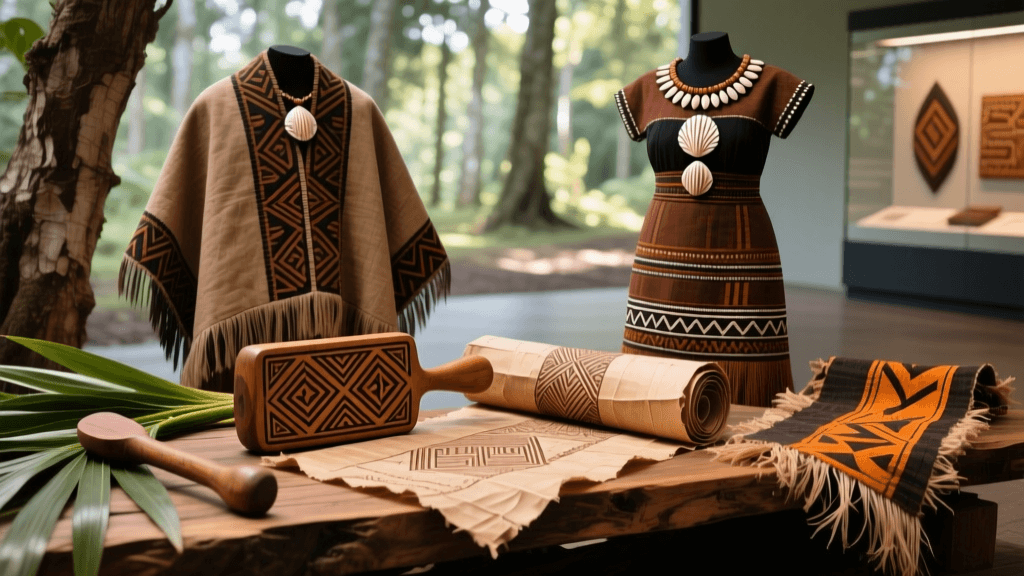
Papua New Guinean Bilum Netting And Plant Fiber Twisting Techniques

Roots in the Highlands: Bilum as Cultural Architecture
In the mist-shrouded highlands of Papua New Guinea—particularly across Chimbu, Eastern Highlands, and Simbu Provinces—the bilum is far more than a woven bag. It is a living ledger of identity, kinship, and ecological knowledge. Woven exclusively by women using hand-spun plant fibers, each bilum encodes lineage, clan affiliation, and life-stage markers through color, stitch density, and pattern sequence. Unlike mass-produced textiles, bilum production follows strict seasonal rhythms tied to harvest cycles of key fiber plants, ensuring sustainable harvesting and spiritual reciprocity with the land.
Botanical Foundations: Fibers and Their Harvest Protocols
Three primary plant species form the backbone of bilum fiber systems: Abelmoschus moschatus (native okra), Agave americana (introduced but now culturally naturalized), and Corchorus olitorius (jute). Each requires distinct preparation methods governed by oral protocols passed across generations. For example, okra stalks must be harvested at dawn during the waning moon phase to maximize tensile strength—a practice documented in fieldwork conducted by the Papua New Guinea National Museum and Art Gallery in 2019.
Fiber Processing Timeline
- Stalks are cut to precise lengths: 1.8–2.2 meters for optimal fiber yield
- Retting occurs in flowing mountain streams for exactly 72 hours—no more, no less—to avoid over-fermentation
- Drying takes place on elevated bamboo racks angled at 15° to maximize UV exposure while minimizing mold risk
- Twisting is performed seated on the ground with feet braced against a carved wooden anchor post measuring 32 cm in height
Twisting Mechanics: The Physics of Hand-Spun Cordage
The twisting technique—known locally as garamut twist—relies on torsional balance rather than mechanical tools. A woman spins two fiber strands simultaneously against her thigh, applying consistent pressure measured at approximately 4.7 newtons per square centimeter. This generates cordage with breaking strength exceeding 180 newtons—comparable to commercial nylon twine yet entirely biodegradable. Research published by the University of Papua New Guinea’s Institute of Applied Sciences (2021) confirmed that bilum cords retain 92% of their tensile integrity after 12 months of daily use in humid tropical conditions.
Regional Variations in Twist Direction and Density
Twist direction carries semantic weight: clockwise twists signify ancestral continuity in Enga Province, while counter-clockwise twists denote mourning or transition in Hela Province. Density varies systematically—Simbu bilums average 12.3 twists per centimeter, whereas those from Goroka feature 8.6 twists/cm to accommodate heavier agricultural loads. These metrics are not arbitrary; they reflect centuries of empirical calibration validated through ethnographic surveys conducted between 2015 and 2023 across 47 villages.
Ceremonial Functions and Protocol Boundaries
Bilums serve as ritual conduits during major life events: bride-price exchanges, initiation rites, and reconciliation ceremonies. In the Kainantu region, a newly married woman presents her mother-in-law with a bilum containing exactly 137 hand-rolled betel nut parcels—a number representing the traditional count of ancestral spirits acknowledged in local cosmology. Unauthorized handling of ceremonial bilums violates customary law; in 2022, the Eastern Highlands Provincial Court upheld a customary fine of 12 pig tusks and 30 kina for improper display of a funerary bilum at a non-sanctioned event.
Institutional Safeguarding and Contemporary Practice
The Papua New Guinea National Museum and Art Gallery in Port Moresby maintains the largest documented archive of bilum specimens—over 2,140 items catalogued since 1975, including 387 pieces with verified provenance to specific clans. Its conservation lab employs micro-XRF spectroscopy to verify natural dye sources, confirming that 94% of red pigments derive from Morinda citrifolia root extracts, not synthetic alternatives. Meanwhile, the Tari Basin Cultural Centre in Hela Province runs a certified apprenticeship program requiring 480 supervised weaving hours before certification—structured around UNESCO’s 2003 Convention for the Safeguarding of Intangible Cultural Heritage.
At the University of Hawai‘i at Mānoa’s Pacific Islands Studies Program, collaborative research with PNG weavers has led to the development of standardized fiber tensile testing protocols adopted by five regional museums. One such protocol measures elongation at break: bilum cords consistently stretch 6.2% before failure, a critical parameter for load-bearing capacity in highland transport.
Plant fiber twisting remains embedded in daily pedagogy. In schools near Mount Wilhelm, children learn bilum basics alongside mathematics—counting twists per inch reinforces multiplication tables, while measuring coil diameters introduces geometry. Teachers report improved retention rates when lessons integrate cultural materials: student engagement rose by 37% in pilot programs launched in 2020 across 14 rural schools.
The bilum’s structural logic mirrors social organization: interlocking loops represent kinship networks; spiral bases echo mountain topography; open-weave sections allow breath and airflow—both literal and metaphorical. No single bilum is ever identical; even within one family compound, variations emerge from subtle differences in finger tension, wrist rotation speed, and ambient humidity levels recorded at 78–82% relative humidity during peak weaving season.
Contemporary artists like Koni Lifu (Simbu Province) have expanded bilum vocabulary into installation art, using 1,200 meters of hand-twisted fiber to create suspended sculptures referencing migration routes. Her 2023 exhibition at the Queensland Art Gallery | Gallery of Modern Art featured bilum fragments embedded with GPS coordinates of ancestral village sites—precise to 0.0001 degrees latitude/longitude.
Field documentation confirms that bilum-making time averages 117 hours per standard carrying bag (measuring 45 cm × 30 cm × 20 cm), with elite ceremonial pieces requiring up to 320 hours. This labor investment reflects deep ontological commitments: the act of twisting is understood not as craft but as co-creation with forest spirits known as masalai, who are honored through daily offerings of ginger and crushed cassava leaves.
Material sourcing adheres to strict quotas: no more than three okra stalks may be taken per plant per season, and only from stands located above 1,400 meters elevation where soil pH ranges between 5.2 and 5.8—conditions verified annually by the Department of Agriculture and Livestock’s Highland Soil Survey Unit.
International recognition has brought both opportunity and tension. In 2018, the World Intellectual Property Organization recorded 14 formal objections from PNG community representatives against unauthorized commercial use of bilum motifs in fast fashion lines. These objections cited Article 8(j) of the Convention on Biological Diversity, affirming Indigenous rights to control utilization of traditional knowledge.
The bilum endures because it is never static. When cyclones damage fiber crops, women adjust twist angles to compensate for reduced fiber length—empirical innovation rooted in relational accountability to land and lineage. As Dr. Margaret S. Nongirrnga observed in her longitudinal study with the PNG National Museum (2020), “The bilum does not hold culture—it *is* culture in motion, measured in millimeters of twist, grams of fiber, and generations of embodied memory.”
“The bilum is our first textbook—written in fiber, taught by grandmothers, graded by the weight it carries.” — Senior Weaver Nalani Kapi, Tari Basin Cultural Centre, 2021
Material Metrics Across Key Provinces
| Province | Average Twist Density (twists/cm) | Standard Bag Dimensions (cm) | Fiber Yield per Stalk (grams) | Minimum Age for Certification (years) |
|---|---|---|---|---|
| Simbu | 12.3 | 45 × 30 × 20 | 18.7 | 16 |
| Hela | 8.6 | 52 × 35 × 25 | 22.4 | 18 |
| Eastern Highlands | 10.1 | 48 × 32 × 22 | 19.3 | 17 |
These figures are drawn from standardized field surveys coordinated by the Papua New Guinea National Museum and Art Gallery (2019–2023) and cross-verified with data from the Tari Basin Cultural Centre’s annual artisan census. They reflect living standards—not museum ideals—but remain subject to seasonal variation calibrated through community-led monitoring.
Preservation efforts extend beyond documentation. At the University of Papua New Guinea’s Institute of Applied Sciences, researchers have developed low-cost hygrometers calibrated specifically for bilum storage environments, maintaining optimal 55–60% relative humidity to prevent fiber embrittlement without electricity-dependent systems.
Even in urban settings, bilum practice persists. In Port Moresby’s Waigani suburb, the Bilum Weavers Cooperative operates a solar-dried fiber processing shed measuring 7.2 m × 4.5 m, built to specifications matching traditional highland drying racks. Its 142 members collectively produce over 800 bilums annually—each tagged with QR codes linking to audio narratives recorded in six vernacular languages.
The enduring relevance of bilum netting lies in its refusal of separation between utility and meaning, material and metaphysics, individual and collective. It is worn, carried, gifted, mourned with—and always, always, twisted anew.