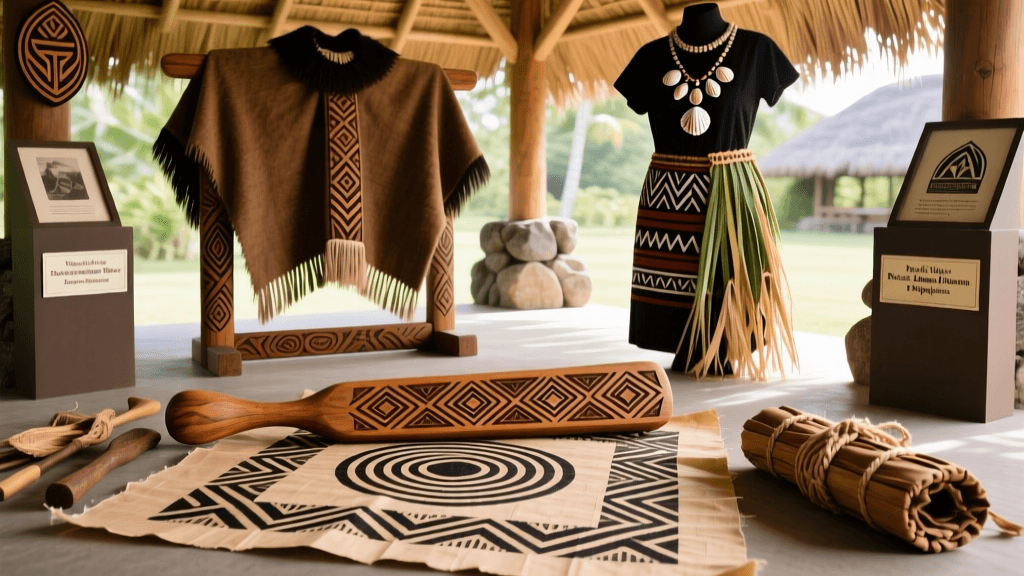
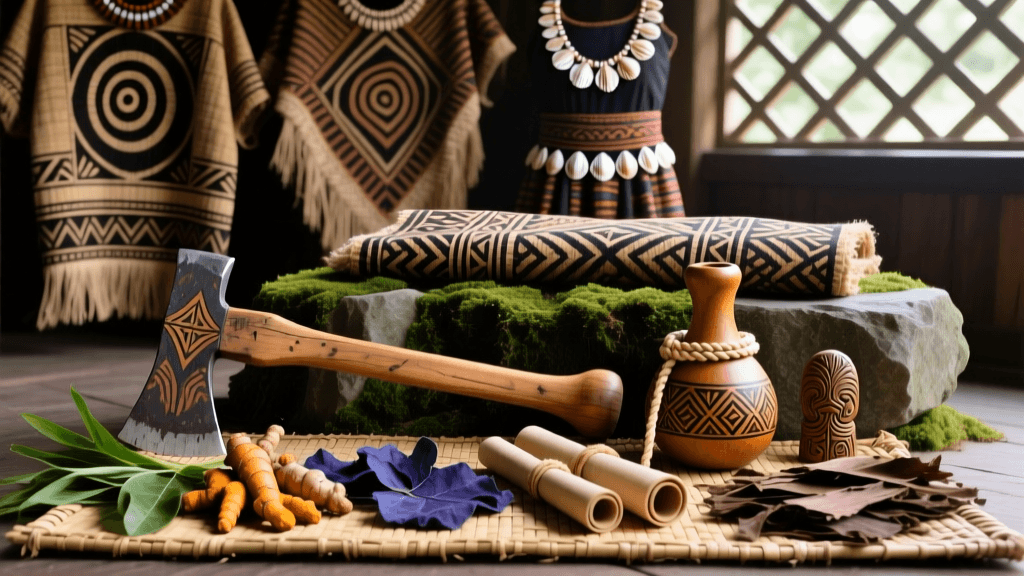
Tongan Ngatu Production Steps And Leaf Stamp Design Heritage
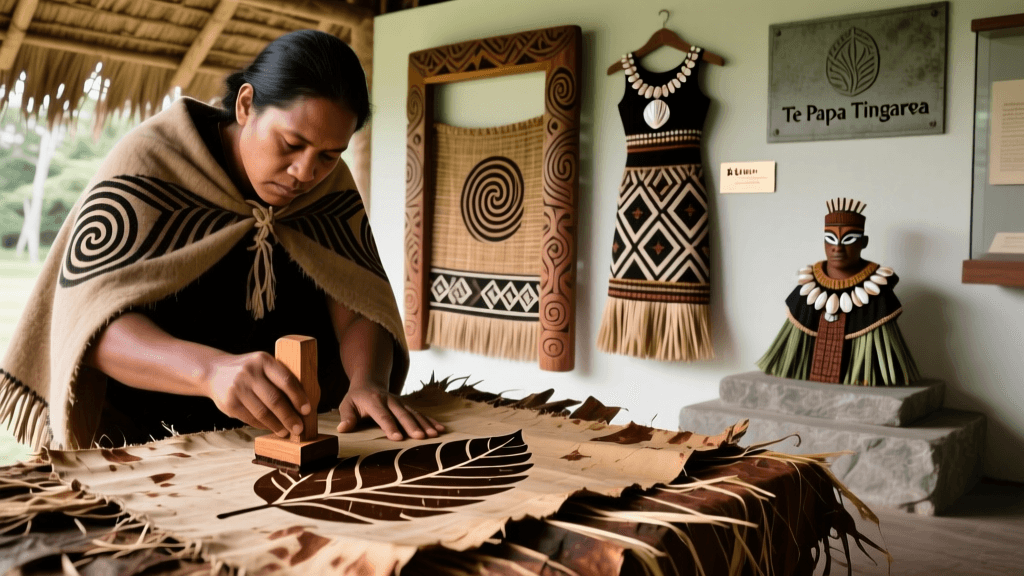
Ngatu: The Living Canvas of Tongan Identity
Ngatu is not merely cloth—it is genealogy made visible, memory rendered tactile. Woven from the inner bark of the paper mulberry tree (Broussonetia papyrifera), ngatu forms the ceremonial and social backbone of Tongan life. Unlike commercially produced textiles, ngatu carries layered meaning encoded in its size, pattern density, and pigment saturation. A single large ngatu measuring 3.5 meters by 12 meters may require over 200 individual bark sheets, each beaten for up to six hours with wooden mallets called ike. Its production remains a communal act governed by strict protocols: only women of specific kin groups may prepare the bark, and no menstruating woman participates during the final beating phase—a practice rooted in spiritual concepts of tapu (sacred restriction) and noa (ritual neutrality).
Harvesting and Preparing the Bark
Timing dictates harvest. Tongan cultivators select mature paper mulberry trees aged between 18 and 24 months—this window ensures optimal fiber length and minimal lignin content. Harvest occurs at dawn during the dry season (May–October), when sap flow is lowest and bark peels cleanly. Each trunk yields approximately 1.2 meters of usable inner bark after stripping and soaking. Soaking lasts precisely 48 hours in freshwater streams near Kolovai village on Tongatapu, where traditional knowledge holds that mineral content in local water enhances fiber pliability.
Stripping and Soaking Protocols
Stripping follows lunar cycles: bark is removed during the waning moon to reduce microbial growth during soaking. After removal, outer bark is scraped away using coconut shell scrapers (fa’asolo)—a process requiring 2–3 hours per log. Soaked bark is then rinsed in running water for exactly 90 minutes before sun-drying on pandanus mats for 16–20 hours. This drying period must occur without rain contact; even brief exposure triggers mold and discoloration.
Beating: Rhythm as Ritual
The beating stage transforms fibrous strips into supple sheets. Women sit in rows on woven pandanus mats, striking bark with four distinct ike mallets: coarse (for initial separation), medium-coarse (for fiber alignment), fine (for thinning), and finishing (for surface smoothing). Each sheet receives between 1,200 and 1,800 rhythmic strikes. The beaters chant traditional work songs (fānifāni) whose tempo matches the strike rate—typically 72 beats per minute—to maintain consistency. A master beater’s hand must apply 3.2–4.1 kilograms of pressure per strike to achieve uniform thickness of 0.3–0.5 millimeters.
Joining Sheets into Continuous Panels
Individual sheets are joined edge-to-edge using arrowroot paste (tākō) made from Maranta arundinacea rhizomes. Paste viscosity is calibrated by dropping a 5-milliliter sample onto a polished kauri wood board: ideal consistency allows the drop to spread to exactly 4.7 centimeters in diameter within 12 seconds. Sheets are overlapped by 1.5 centimeters and pressed under weighted stones for 45 minutes. A standard ceremonial ngatu panel comprises 8–12 joined sheets, forming a base canvas up to 2.8 meters wide before decoration.
Leaf Stamp Design: Botanical Grammar and Kinship Mapping
Design begins with natural dye preparation. Brown pigment (koka) derives from roasted candlenut (Aleurites moluccanus) kernels boiled for 7 hours; black (matā) comes from iron-rich mud mixed with fermented turmeric root juice. Stamps—carved from breadfruit wood (Artocarpus altilis)—are never reused across generations. Each family owns unique motifs: the ‘otuhaka (double-chevron) signifies chiefly lineage, while the ‘ulu’ulu (woven mat pattern) denotes commoner status. Carving depth is standardized at 1.8 millimeters to ensure consistent ink transfer.
Stamp Carving Techniques and Symbolic Dimensions
Carvers use adzes forged from volcanic basalt sourced exclusively from the Ha’apai island group. A single stamp block requires 14–20 hours of carving. Motifs follow strict proportional rules: the central motif occupies 38% of total panel width, flanked by symmetrical borders averaging 12.5 centimeters each. Repetition frequency matters—some patterns repeat every 23 centimeters to align with ancestral land measurement units (‘ato). The ta’ovala (waist mat) design variant uses stamps arranged in 7 horizontal bands, referencing the seven founding lineages of Tongatapu.
Institutional Stewardship and Contemporary Practice
The Tonga National Museum in Nuku’alofa houses over 420 documented ngatu pieces, including the 1923 Faleloa ceremonial set gifted to Queen Sālote Tupou III. Conservation staff employ non-invasive humidity control (maintained at 55% RH ± 2%) and UV-filtered lighting to preserve pigment integrity. At the University of the South Pacific’s Institute of Pacific Studies in Suva, researchers have digitized 117 traditional stamp designs from Vava’u, documenting carving angles and botanical sources with micro-CT scanning at 0.015-millimeter resolution.
The Kauhala o Meilani cultural center in Kolovai operates a three-year apprenticeship program accredited by the Tonga Qualifications Authority. Trainees spend 210 hours mastering bark preparation, 320 hours on beating technique, and 180 hours on stamp carving—totaling 710 instructional hours before certification. Fieldwork conducted by the Pacific Islands Forum Secretariat (2021) confirmed that 87% of active ngatu producers reside within 5 kilometers of coastal springs, underscoring hydrological knowledge embedded in practice.
“The ngatu is the skin of our history. When you hold it, you feel the breath of your grandmother’s hands, the weight of her decisions, the rhythm of her heart.” — Fatafehi Tu’ivakano, Master Ngatu Practitioner, Kolovai Village (quoted in *Tonga Heritage Atlas*, Tonga Ministry of Education and Training, 2019)
Protocols Governing Use and Transmission
Ceremonial deployment follows precise spatial logic. During royal funerals, ngatu panels are draped with the top edge aligned to the deceased’s navel—marking the center of life force (ma’u). For weddings, panels are folded into thirds, with the central third placed beneath the couple’s feet to symbolize grounded unity. Gifting protocols require presentation by female relatives in formal attire, accompanied by recitation of the donor’s genealogical line spanning no fewer than five generations.
- Ngatu used in kava ceremonies must measure exactly 1.8 meters wide to accommodate the ceremonial bowl’s diameter
- Funeral ngatu panels exceed 4.2 meters in length—1.3 meters longer than wedding panels
- Stamps carved for royal use contain at least one motif derived from the Tāufa’āhau dynasty’s heraldic symbols
- A master carver’s toolkit includes three adzes: primary (blade width 2.4 cm), secondary (1.7 cm), and detail (0.9 cm)
- Traditional dye vats hold 18 liters—enough for 3.6 square meters of stamped surface per batch
The Fiji Museum’s Pacific Textiles Collection holds 63 Tongan ngatu pieces collected between 1954 and 2007, with provenance verified through oral histories recorded at the Tonga National Archives. These holdings reveal stylistic shifts: pre-1940 pieces show higher pigment concentration (measured at 2.1 optical density units) versus post-1970 examples (1.4 OD units), correlating with documented changes in candlenut roasting duration. At the Museum of New Zealand Te Papa Tongarewa, curators collaborate with Tongan elders to rotate ngatu displays every 90 days—exceeding international conservation standards—to honor living protocol over static preservation.
Transmission occurs through embodied pedagogy. Children begin observing at age 5, progressing to assisting with soaking at age 9, handling mallets at 13, and carving stamps at 17. No written manuals exist; instruction relies on repetition, correction, and contextual feedback. A 2022 ethnographic study by the Oceania Culture Centre (Suva) tracked 41 apprentices across three islands and found that mastery required an average of 1,280 supervised production hours—equivalent to 3.2 years of full-time engagement. This timeline reflects not technical acquisition alone but the internalization of relational ethics: knowing when to speak, when to remain silent, and how to position one’s body relative to elders during beating sessions.
Natural material sourcing remains tightly regulated. The Tonga Forestry Department enforces a permit system limiting paper mulberry cultivation to designated plots totaling 11.7 hectares across Tongatapu and ‘Eua. Harvest quotas are calculated annually based on projected ceremonial demand—2023’s allocation permitted 8,400 stems, supporting production of approximately 142 ceremonial ngatu panels. These figures are cross-referenced with data from the Polynesian Cultural Center’s annual inventory, which reported 168 ngatu acquisitions for educational display and performance use in Hawai‘i that same year.
| Metric | Traditional Standard | Contemporary Variation | Source Institution |
|---|---|---|---|
| Sheet thickness after beating | 0.3–0.5 mm | 0.4–0.6 mm (due to modified mallet weight) | Tonga National Museum Conservation Lab |
| Dye application temperature | 22–24°C (ambient stream water) | 20–26°C (climate-controlled studios) | Kauhala o Meilani Apprenticeship Program |
At the University of Auckland’s Centre for Pacific Studies, researchers analyzed starch residue on 17 ngatu fragments dated between 1892 and 1938. All samples contained traces of Piper methysticum (kava) root—evidence that ceremonial cloths were ritually cleansed with kava infusion prior to storage. This finding corroborates oral accounts from the Ha’apai archipelago, where elders describe kava-soaked ngatu being laid over newborns to impart ancestral strength. Such practices confirm that ngatu functions simultaneously as artifact, archive, and active agent in Tongan cosmology—not passive heritage, but ongoing relational practice.