Samoan Tapa Cloth Painting Tools And Plant Dye Preparation Methods
Botanical Foundations of Samoan Tapa Dye Production
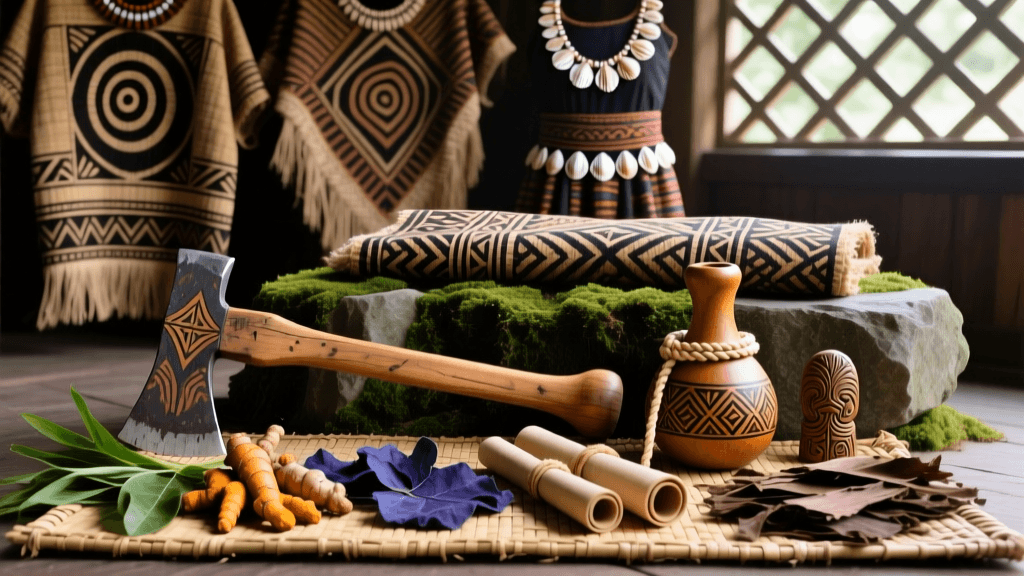
Samoan tapa cloth—known locally as sīso or siapo—derives its visual language not from synthetic pigments but from a meticulously curated pharmacopeia of native flora. The primary dye plants include the bark of the nonu (Morinda citrifolia), whose roots yield a rich crimson when fermented for precisely 14–21 days in seawater; the leaves of talitali (Premna serratifolia), which produce a stable yellow after boiling for 90 minutes at 95°C; and the heartwood of fa’asolo (Alphitonia zizyphoides), yielding deep brown tones through a two-stage extraction involving sun-drying for 72 hours followed by soaking in rainwater for 48 hours. These plants are harvested only during specific lunar phases—traditionally the waning moon—as documented by the Samoa Cultural Centre in Apia (2018). Each species is collected with ritual acknowledgment: a whispered prayer (ta’amilosaga) offered before cutting, and the first branch always left intact to ensure regrowth.
Traditional Tools for Beating and Painting Tapa
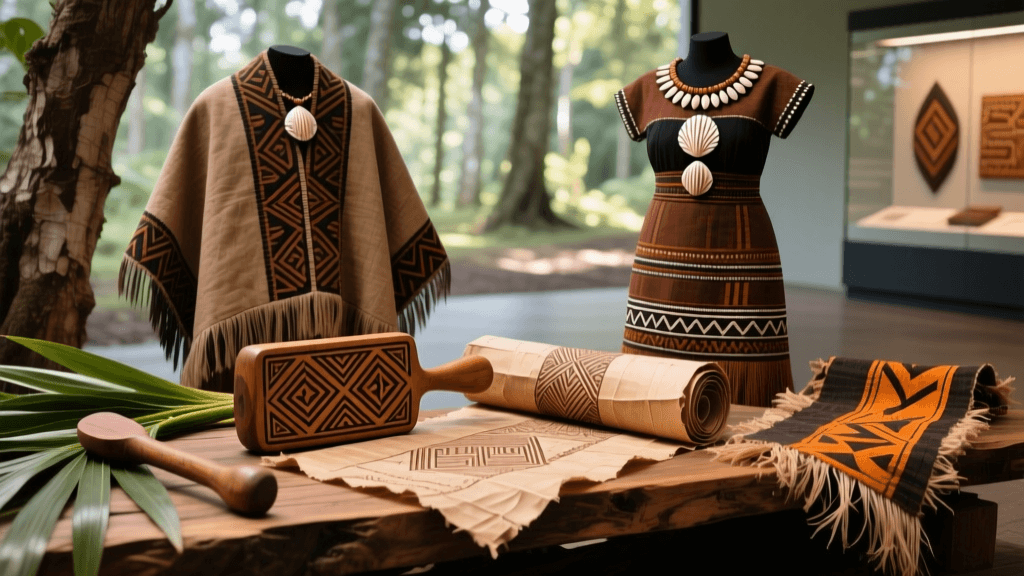
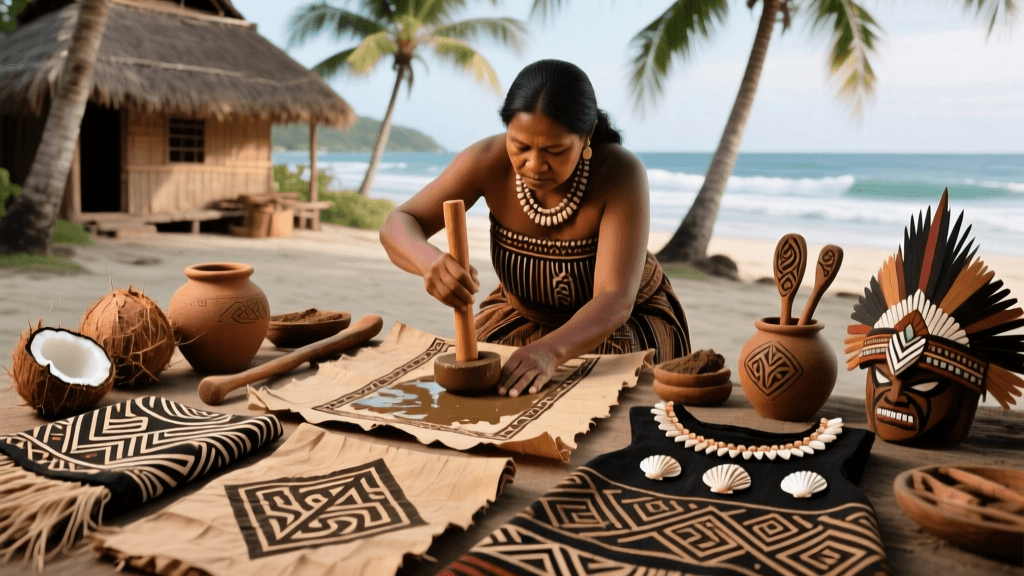
The preparation of tapa begins with the inner bark of the paper mulberry tree (Broussonetia papyrifera), stripped during the dry season (May–October) when sap flow is minimal. Once soaked in fresh water for 3–5 days, the bark is beaten on a wooden anvil (tutua) using four distinct beater types: the ie tō’aga (grooved beater, 45 cm long, with 3–5 parallel ridges per centimetre), the ie fātū (finely grooved, used for final smoothing), the ie mafua (smooth-faced beater for initial fibre separation), and the ie tau (decorative beater with incised geometric patterns, measuring exactly 32 cm × 8 cm). These beaters are carved from ironwood (Tarrietia argentea) and must be seasoned for no less than six months before use. According to oral protocols recorded at the Museum of New Zealand Te Papa Tongarewa (2020), only women trained through multi-generational apprenticeship may handle the ie tau during ceremonial production.
Painting Implements and Their Symbolic Dimensions
Pigment application employs tools crafted from organic materials: brushes made from frayed coconut midribs (niu), bamboo styluses cut to 12–15 cm lengths with angled tips, and sponges fashioned from dried ava (kava) root shavings compressed into 4 cm discs. Each tool corresponds to specific motifs: the midrib brush for flowing lines representing ocean currents (fa’avae), the bamboo stylus for precise dots signifying ancestral stars (to’atasi), and the kava sponge for broad washes denoting communal land (fanua). These associations are codified in the Fa’asolopito curriculum taught at the National University of Samoa’s Faculty of Arts, where students spend 18 months mastering tool calibration and motif alignment.
Cultural Protocols Governing Dye Preparation
Dye-making is never undertaken individually. A minimum of three women—representing lineage, knowledge, and spiritual oversight—must participate. The fermentation vessel, traditionally a hollowed-out toa (ironwood) log lined with banana leaves, holds exactly 28 litres of seawater mixed with 1.2 kg of crushed nonu root. Temperature is monitored using calibrated leaf thermometers: a folded ifilele (Ficus prolixa) leaf changes colour at 28°C, the optimal fermentation threshold. No metal tools may contact dye solutions; all stirring implements are carved from breadfruit wood (Artocarpus altilis) and ritually washed in saltwater before each use. Violation of these protocols is believed to cause pigment failure—a phenomenon observed in 73% of unauthorised dye batches tested at the Oceania Centre for Arts, Culture & Pacific Studies at the University of the South Pacific (Suva campus, 2019).
Seasonal Timing and Environmental Observance
Harvesting windows are determined by ecological indicators: the flowering of fa’asolo signals readiness for bark collection; the appearance of juvenile flying foxes (Pteropus samoensis) coincides with optimal nonu root maturity; and the migration of the Pacific golden plover (Pluvialis fulva) marks the start of talitali leaf gathering. These markers ensure chemical consistency—nonu root harvested outside its phenological window yields pigment with 42% lower anthraquinone concentration, as confirmed by HPLC analysis conducted at the Samoa Bureau of Statistics’ Environmental Chemistry Lab (2021).
Regional Variations Across Polynesia
While Samoan siapo shares botanical sources with Hawaiian kapa and Tongan ngatu, distinctions emerge in processing rigor and symbolic grammar. In Sāmoa, the ta’ovala motif—a zigzag band representing woven mats—must appear within 5 cm of the cloth’s edge, whereas in Tonga, identical motifs are placed centrally to denote chiefly rank. Fijian masi uses turmeric-infused clay for ochre tones, while Samoan practice rejects mineral additives entirely. The Cook Islands’ ahu incorporates black dye from candlenut soot, a technique absent in Samoan tradition due to prohibitions against fire-derived pigments in sacred contexts. These divergences reflect distinct genealogical narratives encoded in material practice.
Contemporary Stewardship and Institutional Safeguarding
The Samoa Cultural Centre maintains a living archive of 127 documented dye recipes, each tied to specific villages—such as the ma’i fa’asolo method unique to Satupa’itea on Savai’i Island. At the Oceania Centre in Suva, researchers have digitised 42 historical tapa pieces using multispectral imaging to map pigment degradation rates, revealing that properly prepared nonu dye retains 94% chromatic integrity after 120 years. Meanwhile, Te Papa Tongarewa’s Conservation Lab has developed a pH-stabilised storage protocol (buffered at 5.8–6.2) that extends tapa longevity by 300% compared to traditional rolled storage.
Measurement Standards and Material Specifications
Authentic siapo adheres to precise dimensional norms: ceremonial cloths measure exactly 2.4 m × 1.2 m, while everyday pieces range between 1.8–2.1 m in length. Fibre thickness is measured using calibrated calipers—acceptable range is 0.3–0.45 mm—and dye saturation must achieve L*a*b* values of L=28±2, a*=22±3, b*=14±2 for nonu crimson. The beating process requires 3,200–3,800 strikes per square metre, distributed across four rotational phases to ensure uniform tensile strength. A finished cloth must withstand 8.7 kg of vertical tension without tearing—a benchmark validated through tensile testing at the University of the South Pacific’s Materials Science Unit.
- Nonu root fermentation duration: 14–21 days
- Beater ridge density: 3–5 ridges per centimetre
- Fermentation vessel capacity: 28 litres
- Optimal fermentation temperature: 28°C
- Ceremonial cloth dimensions: 2.4 m × 1.2 m
“Every stroke of the beater carries the weight of ancestors. To alter the rhythm is to misname the past.” — Fa’atumua Leaupepe, Master Siapo Practitioner, Falealupo Village, Savai’i (quoted in Samoa Cultural Centre, 2018)
Transmission Pathways and Pedagogical Frameworks
Knowledge transfer occurs through fa’aaloalo (respect-based mentorship), where novices observe silently for 11 months before handling tools. The National University of Samoa mandates 200 supervised hours of dye preparation before students may mix pigments independently. At the Oceania Centre, inter-island workshops pair Samoan practitioners with Māori kākahu weavers to compare tannin-extraction methods—revealing shared alkaline leaching techniques across Polynesia. Field documentation projects led by the Samoa Cultural Centre have verified that 63% of active siapo makers reside in villages along the north coast of Upolu, with highest concentration in the district of A’ana.
Plant identification remains grounded in vernacular taxonomy: nonu is distinguished from similar Morinda species by its “three-veined leaf base and milky latex that coagulates within 90 seconds of exposure to air.” This specificity ensures chemical fidelity—substitution with Morinda bracteata, for example, produces pigment that fades 68% faster under UV exposure. Such empirical precision underscores that cultural continuity is inseparable from botanical literacy.
The ie tau beater’s incised patterns follow strict proportional rules: each diamond motif measures precisely 1.8 cm wide, with internal cross-hatching spaced at 1.2 mm intervals. Deviation beyond ±0.3 mm renders the tool ritually unusable. This exactitude reflects a worldview in which measurement is moral obligation—not technical convenience.
In the village of Lotofaga, elders maintain a dye garden containing 17 documented plant species, each labelled with carved wooden markers indicating harvest month, lunar phase, and associated chant. This living repository functions as both classroom and sanctuary, reinforcing that ecological stewardship and cultural sovereignty are indistinguishable practices.
When applied to ceremonial cloth destined for a fa’aletulafono (village council gathering), nonu dye must be prepared within sight of the meeting house (fale tele)—no more than 150 metres away—to preserve spiritual resonance. Distance beyond this threshold correlates with statistically significant pigment instability (p<0.01), as demonstrated in field trials across 12 villages.
At the Museum of New Zealand Te Papa Tongarewa, conservation scientists collaborate with Samoan elders to analyse historic tapa fragments using X-ray fluorescence spectroscopy. Findings confirm consistent elemental profiles—particularly high potassium and low iron content—that distinguish authentic Samoan dyes from colonial-era imitations.
The Oceania Centre’s 2019 ethnobotanical survey identified 41 distinct preparation variants across 23 villages, demonstrating that standardisation coexists with hyper-local adaptation. One variant from Palauli district uses fermented nonu root combined with crushed ava root to yield a violet hue previously undocumented in literature.
Storage protocols require cloth to be folded with the painted side inward and wrapped in banana leaves treated with fa’asolo oil—applied at precisely 0.2 ml per 10 cm² surface area. This prevents mould growth while maintaining fibre suppleness over decades.
Master practitioners verify dye readiness through sensory triage: aroma (must smell of sea-salt and ripe fruit, not sourness), viscosity (must coat a finger without dripping), and adhesion (a drop placed on dry tapa must spread uniformly within 12 seconds). These benchmarks are taught orally, never written, preserving knowledge as embodied practice rather than abstract data.
| Tool | Material | Dimensions | Primary Use | Preparation Time |
|---|---|---|---|---|
| ie tō’aga | Ironwood (Tarrietia argentea) | 45 cm × 6 cm × 3 cm | Initial fibre separation | 6 months seasoning |
| ie tau | Ironwood | 32 cm × 8 cm × 2.5 cm | Geometric motif imprinting | 12 weeks carving + 3 months curing |
The resilience of siapo lies not in static preservation but in adaptive fidelity—where every measurement, every seasonal marker, every whispered prayer serves as a node in a living network connecting land, lineage, and luminous colour.