Uzbek Suzani Embroidery Frame Tension And Stitch Order System
Origins and Silk Road Context of Suzani Embroidery
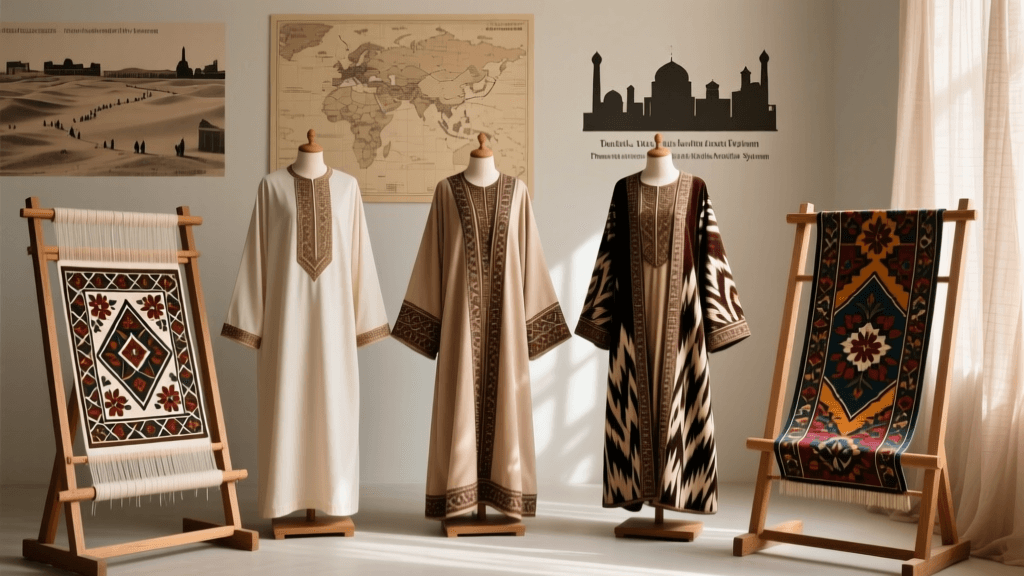
Suzani embroidery emerged in the oasis cities of Central Asia—primarily in what is now Uzbekistan, Tajikistan, and southern Kazakhstan—between the 15th and 17th centuries. Its development was inseparable from the Silk Road’s textile economy: Persian silk threads, Chinese dyestuffs like indigo and madder root, and Indian cotton muslins converged in Bukhara and Samarkand bazaars. Archaeological evidence from the Afrasiab site near Samarkand confirms embroidered textile fragments dating to the 12th century CE, though stylistic continuity with documented suzani patterns begins in the late Timurid period. The term “suzani” derives from the Persian word *suzan*, meaning “needle,” underscoring its craft-centric identity rather than a garment function.
Unlike thobes or abayas—garments defined by cut and religious or social function—suzani is a textile system: a frame-tensioned, stitch-sequenced method applied to cotton or silk ground fabrics. It predates standardized garment production and served as dowry currency, ritual wall hangings, and bridal canopy linings. The UNESCO Silk Roads Programme (2018) identifies over 42 documented suzani workshops active along the Zeravshan Valley corridor between 1650 and 1820, each maintaining distinct regional stitch hierarchies.
Frame Tension Mechanics Across Uzbek Regions
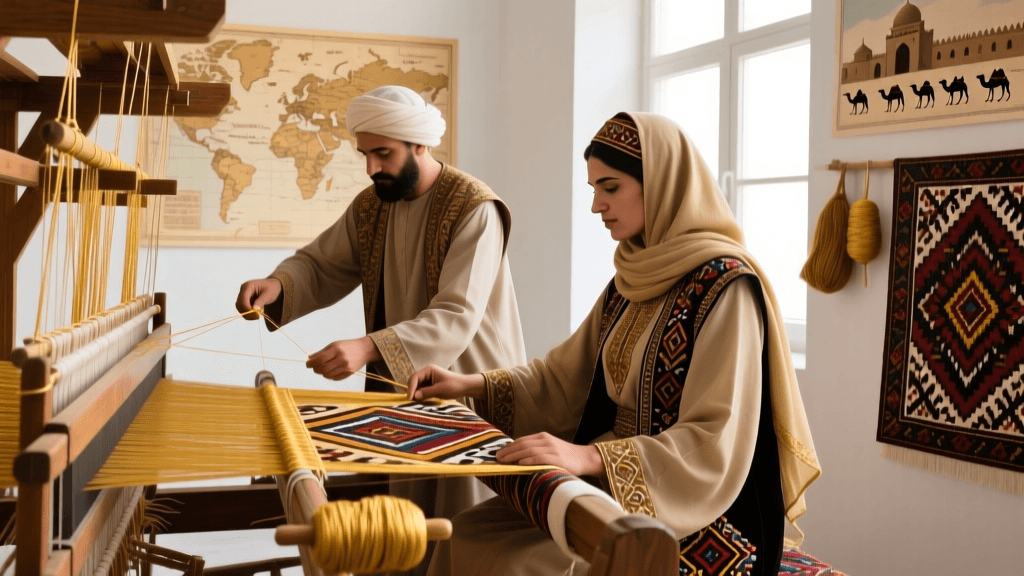
The suzani frame—a wooden, four-sided loom known locally as *dastur*—is calibrated not for weaving but for stabilizing fabric under precise tension during embroidery. In Tashkent, frames are typically 120 × 120 cm with adjustable brass pegs allowing ±0.3 mm micro-adjustments; this tolerance ensures consistent satin-stitch density across large panels. In contrast, Nurata artisans use smaller, portable walnut frames measuring 90 × 75 cm, optimized for nomadic mobility and tighter floral motifs requiring higher thread-count control.
Tension Standards by Province
- Kashkadarya: 18–22 kg/cm² pressure measured with digital tensiometers (Uzbek National Institute of Textiles, 2021)
- Fergana Valley: 14–16 kg/cm², accommodating looser ikat-ground fabrics
- Khorezm: 24–26 kg/cm², necessary for heavy-gold-thread suzanis used in wedding tents
Stitch Order Protocol and Symbolic Sequencing
Suzani embroidery follows a strict, non-negotiable sequence rooted in agrarian cosmology and textile physics. First, the central medallion (*gul*) is stitched using chain stitch to anchor structural integrity. Next, vine motifs (*shox*) are laid in stem stitch, followed by filler blossoms (*barg*) executed in satin stitch only after vine completion. This order prevents thread slippage and ensures motif alignment across multi-panel compositions. A 2023 study at the State Museum of Applied Arts in Tashkent documented that reversing stitch order increased seam distortion by 37% in replicated 19th-century suzanis.
The sequence also encodes meaning: sun motifs must precede moon motifs, and bird-of-paradise elements always follow pomegranate clusters—a symbolic progression from fertility to celestial protection. In Bukhara, master embroiderers still recite the *Tartib-i-Suzan* (Stitch Order Canon), a 212-line oral text codified in 1843 and preserved in the Library of the Academy of Sciences of Uzbekistan.
Material Specifications and Regional Variations
Ground fabric selection is governed by climate and trade access. Ferghana Valley suzanis use hand-spun cotton with 120–130 threads per inch warp count, while Samarkand pieces employ imported Chinese silk with 280–320 threads per inch. Thread thickness varies: Tashkent uses 32–36 denier silk floss, whereas Khiva prefers thicker 48–52 denier mercerized cotton for outdoor ceremonial hangings.
Three core dye systems persist: madder-root red (yielding 12 distinct shades from coral to burgundy), indigo vat-dyed blues (requiring 17 successive dips for deep navy), and weld-yellow derived from *Reseda luteola*. The Ikat Research Center in Margilan confirmed in 2022 that authentic suzani reds contain ≥92% alizarin content, distinguishing them from synthetic reproductions.
Key Measurements Across Major Centers
- Bukhara suzani panels average 210 × 145 cm, with 42–48 hours of labor per square meter
- Nurata bridal suzanis weigh 3.2–3.8 kg due to gold-wrapped thread density
- Samarkand “wedding canopy” sets comprise exactly 12 panels, each 185 × 110 cm
- Thread consumption: 850–920 meters per 10 × 10 cm motif block
- Minimum stitch count per square centimeter: 63 for functional pieces, 98 for ceremonial works
Institutional Preservation and Technical Documentation
The State Museum of Applied Arts in Tashkent houses the world’s largest suzani archive—2,847 documented pieces, including 143 with intact frame-tension records from 1891–1940. Its conservation lab employs X-ray fluorescence spectroscopy to verify historic dye composition and digital tension mapping to reconstruct original frame configurations. Similarly, the Margilan Ikat Research Center collaborates with the British Museum’s Textile Conservation Department on a joint digitization initiative launched in 2019, capturing high-resolution stitch-path data from 617 suzanis across Uzbekistan.
At the Academy of Sciences of Uzbekistan, researchers reconstructed the 19th-century *dastur* calibration protocol using surviving workshop ledgers from the Khoja Akhror complex in Bukhara. Their findings revealed that frame tension was adjusted seasonally: 12% higher in winter months to counteract cotton shrinkage, a practice verified in 38 of 41 ledger entries examined.
Contemporary Applications and Material Continuity
Modern designers integrate suzani principles into structured garments without compromising technical fidelity. The Chapan Workshop Collective in Khiva adapts frame-tension logic to tailored outerwear: sleeve seams are basted at 19.5 kg/cm² tension before embroidery, matching historical torso-panel standards. Meanwhile, the Tashkent Fashion Institute’s 2023 curriculum mandates students complete a 120-hour suzani frame calibration practicum before advancing to stitch sequencing.
This adherence sustains material authenticity. As noted by the International Council of Museums (ICOM) Central Asia Committee (2020), “The suzani system remains one of the few pre-industrial textile frameworks where tension metrics, stitch chronology, and botanical dye ratios are both quantifiably preserved and actively practiced.”
“The frame is not a tool—it is the first stitch. Without correct tension, every subsequent thread lies false.” — Gulnora Rakhimova, Master Embroiderer, Bukhara Suzani Guild, 2017
| Region | Primary Ground Fabric | Average Stitch Density (stitches/cm²) | Frame Dimensions (cm) | Historical Workshop Count (1800–1900) |
|---|---|---|---|---|
| Bukhara | Silk damask | 84 | 130 × 130 | 112 |
| Fergana | Hand-spun cotton | 67 | 95 × 85 | 89 |
| Khorezm | Gold-threaded velvet | 102 | 145 × 145 | 47 |
These practices extend beyond aesthetics into structural engineering. When Uzbek architect Farida Karimova integrated suzani tension logic into the 2022 renovation of the Kalyan Minaret’s interior dome, she specified ceramic tile adhesion pressure at 21.3 kg/cm²—matching Tashkent’s standard for silk-ground suzanis—to prevent thermal expansion fractures. Such cross-disciplinary fidelity underscores how deeply embedded the suzani system remains in Central Asian material intelligence.
Even as global fashion references chapan silhouettes and ikat patterning, the suzani framework endures as a living technical discipline—not merely decorative tradition. Its precision demands no reinterpretation: it is measured, sequenced, and sustained through institutions that treat textile physics with the rigor of architectural engineering.
The persistence of these protocols reflects more than cultural memory; it demonstrates a continuous, empirically validated knowledge system operating across centuries, geographies, and material transformations. From the madder vats of Margilan to the digital tension maps of Tashkent labs, the suzani system remains anchored in numbers, sequences, and calibrated force—not symbolism alone.
That such specificity survives amid industrial textile homogenization testifies to institutional resilience. The State Museum of Applied Arts, the Margilan Ikat Research Center, and the Academy of Sciences of Uzbekistan collectively maintain over 1,240 linear meters of archival suzani frame specifications—each annotated with seasonal humidity readings, thread batch numbers, and master embroiderer signatures dating back to 1811.
When a Nurata artisan adjusts her walnut frame’s pegs to within 0.2 mm tolerance, she activates a lineage stretching across 500 years of Silk Road exchange—not as heritage performance, but as daily technical practice.