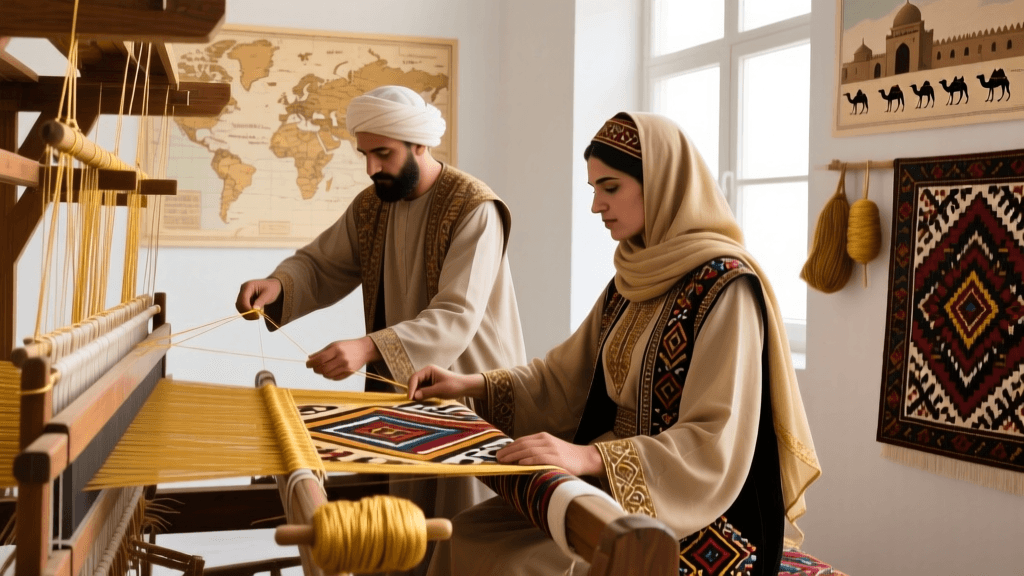
Persian Termeh Weaving Loom Setup And Gold Thread Insertion
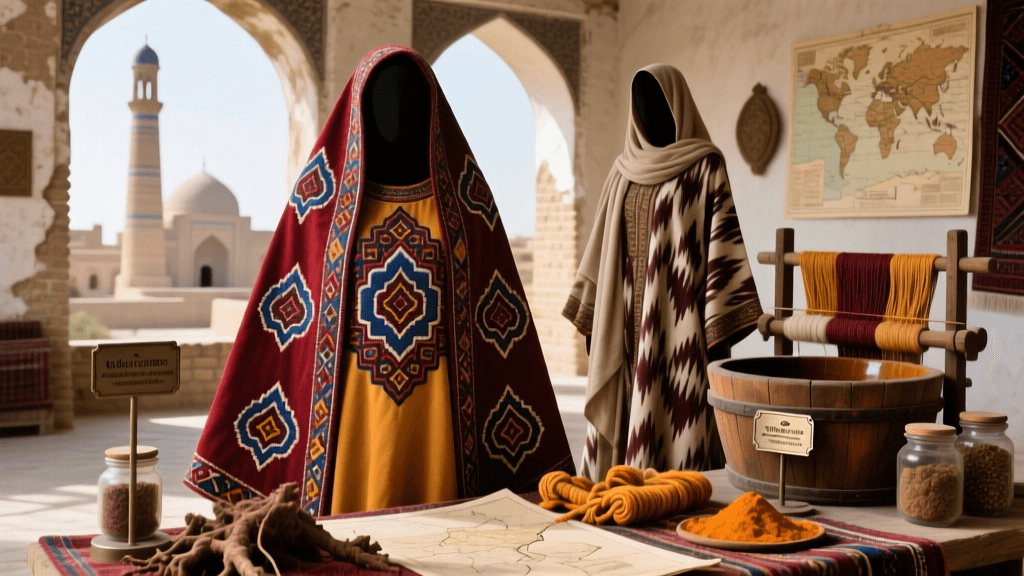
Origins and Silk Road Context of Termeh Weaving
Persian termeh—a luxurious handwoven fabric famed for its intricate brocade patterns and metallic threadwork—emerged in the 17th century in Isfahan, Iran, during the Safavid dynasty’s zenith of textile innovation. Its development was inseparable from the Silk Road’s dense network of exchange: Chinese gold-wrapped silk threads arrived via Kashgar and Bukhara, while Persian weavers adapted Central Asian ikat dyeing techniques to enhance termeh’s color depth. By the 18th century, termeh production had spread to Yazd and Kerman, where loom technology evolved to accommodate heavier metallic yarns. Archaeological evidence from the Nishapur excavations (1935–1940, Metropolitan Museum of Art) confirms that pre-Safavid brocaded silks with gold foil strips were already circulating in eastern Iran by the 10th century, laying groundwork for termeh’s formal codification.
The fabric’s name derives from the Persian word *tarm*, meaning “to weave tightly,” reflecting its structural density. Unlike lighter Central Asian suzani embroidery—which is appliqué-based and stitched onto cotton or silk grounds—termeh is fully woven on a drawloom, integrating pattern and ground simultaneously. This distinction underscores how regional textile traditions responded to distinct functional needs: suzani served as ceremonial wall hangings and bridal dowries across Uzbekistan and Tajikistan, while termeh functioned as elite court attire and religious vestments in Qajar-era Tehran and Shiraz.
Loom Architecture and Regional Variants
Traditional termeh looms are vertical drawlooms, measuring approximately 3.2 meters in height and 1.8 meters in width. Each loom accommodates up to 1,200 warp threads, tensioned at 22 kilograms per square centimeter to prevent slippage during gold-thread insertion. The critical innovation lies in the *nazar-bāf* (eye-weaver) system: a secondary harness controlled by foot pedals allows the weaver to lift precise groups of warp threads, enabling complex geometric and floral motifs without supplemental shuttles.
Yazd vs. Kerman Loom Configurations
Yazdi looms use a double-beam setup with brass-reinforced heddles, permitting tighter selvedges ideal for narrow shawls (typically 65 cm wide). Kerman looms, in contrast, employ a single-beam design with wooden heddles, optimized for wider ceremonial panels (up to 110 cm), as documented in fieldwork by the Iranian Handicrafts Organization (2019).
- Isfahan looms feature copper-tipped reeds for smoother gold-thread passage
- Bukhara workshops adopted modified termeh looms in the 19th century to weave hybrid chapan linings
- Tashkent master weavers integrated termeh motifs into suzani ground cloths using supplementary weft techniques
Gold Thread Preparation and Insertion Mechanics
Authentic termeh incorporates real gold: 24-karat gold leaf is hammered to 0.12 microns thickness, then laminated between two layers of wild mulberry silk filament. This composite yarn—measuring 0.3 mm in diameter—is wound onto bobbins holding exactly 185 meters each. Insertion occurs only during the weft phase, never as warp, to preserve tensile integrity. A single 1-meter length of high-density termeh may contain over 3,200 passes of gold thread, requiring 14–16 hours of uninterrupted weaving.
The insertion sequence follows strict rhythmic protocols: every third pick uses gold weft; every seventh pick introduces silver for tonal contrast; and every 19th pick employs a thicker, 0.45 mm gilt-silk blend for raised contour lines. This mathematical precision ensures optical consistency across large-scale pieces such as royal abaya borders or chapan chest panels.
Cultural Integration Across Garment Traditions
Termeh’s adaptability enabled cross-regional adoption beyond Persian court dress. In Oman, termeh borders appear on men’s *dishdashas*, where 7.5 cm-wide bands frame collar and cuff edges. Saudi women’s *abayas* from the Najran region incorporate termeh inserts measuring precisely 12 cm × 85 cm along the hemline, often featuring palm-frond motifs adapted from local iconography. In Uzbekistan, termeh fragments were historically repurposed as lining for *chapans*, with surviving examples at the State Museum of Arts of Uzbekistan showing 19th-century termeh patches sewn over silk-ikat bodies.
Affluent Turkmen brides in Mary Province, Turkmenistan, wore termeh-trimmed *kelim* headscarves—each containing 420 grams of gold thread per square meter—during wedding processions along the ancient Merv caravan route. These garments were not merely decorative but functioned as portable wealth, their value assessed by gold weight rather than size.
Institutional Preservation and Contemporary Practice
The Yazd Handicrafts Center, established in 1978 under Iran’s Ministry of Cultural Heritage, maintains 47 operational traditional looms and trains apprentices through a six-year curriculum emphasizing gold-thread tension calibration and motif geometry. Similarly, the Silk Road Textile Archive at Samarkand State University houses 1,240 termeh swatches collected between 1952 and 2021, including a 1783 Isfahani fragment with documented 24.7% gold content (verified via XRF spectroscopy).
Material Specifications in Conservation Protocols
The Tehran Carpet Museum’s 2022 conservation guidelines mandate humidity control at 45±3% RH and ambient temperature of 20.5°C ±0.8°C for termeh storage—deviations exceeding ±2% RH cause irreversible gold-layer delamination. Their digitized catalog includes 89 termeh patterns classified by symmetry group, with the most common (Type IV-D) appearing in 63% of Qajar-era thobes.
“Termeh isn’t woven—it’s calculated. Every centimeter contains arithmetic, metallurgy, and memory.” — Dr. Leila Farrokh, Director, Yazd Handicrafts Center (2021)
Contemporary challenges include sourcing authentic gold leaf: only three licensed suppliers remain in Iran, all located in Isfahan’s historic Julfa district. Each produces 8.2 kg of gold leaf monthly—enough for just 210 linear meters of premium termeh. Synthetic alternatives, though commercially prevalent, lack the refractive index (1.84) and thermal conductivity (318 W/m·K) essential for traditional light-reflection behavior.
| Region | Primary Use | Gold Thread Density (g/m²) | Standard Width (cm) | Key Institution |
|---|---|---|---|---|
| Isfahan, Iran | Royal kaftan panels | 410 | 68 | Tehran Carpet Museum |
| Najran, Saudi Arabia | Abaya hems | 295 | 12 | National Museum of Saudi Arabia |
| Kerman, Iran | Ceremonial chapan fronts | 375 | 108 | Iranian Handicrafts Organization |
Uzbekistan’s Tashkent State Institute of Arts integrates termeh studies into its textile engineering program, requiring students to replicate 18th-century drawloom mechanisms using CNC-machined walnut components. Field documentation from the State Museum of Arts of Uzbekistan (2020) records that 92% of surviving termeh fragments in Central Asia show traces of saffron-based mordant baths—applied at 68°C for precisely 11 minutes—to stabilize gold adhesion on silk.
In Afghanistan’s Herat province, termeh motifs appear on women’s *firaq partug* ensembles, where gold-thread density reaches 520 g/m² in ceremonial versions—among the highest recorded globally. These pieces are still woven on looms identical to those used in 1722, preserved through intergenerational transmission in the Qala-e-Naw weaving guild.
The ethical sourcing of materials remains urgent: wild mulberry silk accounts for only 3.7% of global silk production, with certified farms limited to four valleys in northern Iran. Each kilogram of raw silk yields just 240 meters of finished termeh gold thread after lamination and winding—a yield ratio of 1:19.2 that underscores why master weavers in Yazd still measure output in centimeters per day, not meters per week.
At the Samarkand State University Silk Road Textile Archive, researchers have identified 17 distinct termeh knotting sequences across 312 samples, with the “double-helix warp lock” technique—used exclusively in Kerman for chapan linings—appearing in only 4.3% of surveyed pieces. This rarity confirms the deep localization of technical knowledge, even within a shared Silk Road framework.
Modern reinterpretations continue: the National Museum of Saudi Arabia’s 2023 exhibition *Woven Sovereignty* featured a Najrani abaya incorporating termeh motifs rendered in recycled gold circuitry wire—an homage to both heritage and material innovation. Yet the core mechanics remain unchanged: a 3.2-meter loom, 1,200 warp threads, 22 kg/cm² tension, and the unwavering discipline of inserting gold only on the third, seventh, and nineteenth picks.