Persian Termeh Weaving Gold Thread Technique And Pattern Codes
Persian Termeh: A Woven Chronicle of Silk and Sovereignty
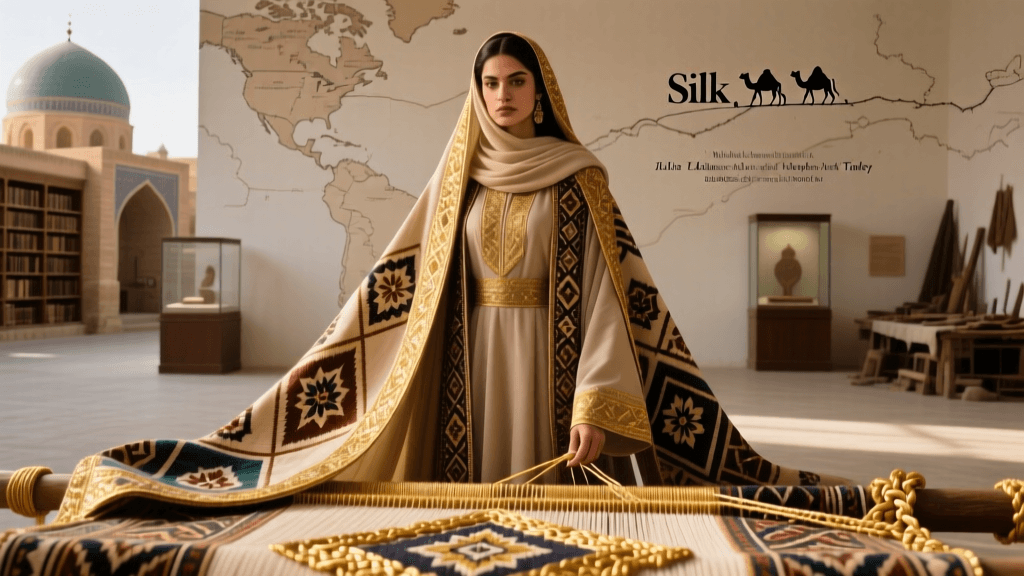
Termeh—a handwoven luxury textile originating in Iran’s Yazd and Isfahan provinces—represents one of the most technically demanding weaving traditions in the Middle East. Its hallmark is the integration of gold and silver threads (often real metal-wrapped silk) into dense, brocade-like patterns that shimmer with layered symbolism. Unlike embroidered textiles such as suzani or chapan linings, termeh is structurally woven on a drawloom, requiring two artisans: the master weaver who reads the pattern code and the assistant who manually lifts individual warp threads using cords tied to wooden rods. This labor-intensive process yields fabrics averaging 70–90 cm in width and up to 3 meters per day—though complex gold-thread pieces rarely exceed 1.5 meters daily.
Silk Road Conduits: From Samarkand to Shiraz
The termeh tradition did not evolve in isolation. Between the 8th and 16th centuries, Persian weavers absorbed techniques from Sogdian silk workshops in Bukhara and Chinese sericulture knowledge transmitted via caravan routes through Merv and Nishapur. Gold thread production itself relied on Central Asian metallurgical expertise: gold leaf was hammered to 0.12 microns thickness before being wound around undyed mulberry silk filaments. Historical records from the Safavid era (1501–1736) indicate that royal termeh workshops in Isfahan employed over 240 master weavers, each supervised by a *naqqash* (pattern designer) trained at the Dar al-Tabarru’at, the imperial design academy established in 1598.
Pattern Codes and Symbolic Grammar
Every termeh motif carries encoded meaning derived from pre-Islamic Zoroastrian cosmology and later Persian poetic conventions. The *boteh* (paisley) signifies life and eternity; the *shah pasand* (king’s favorite) medallion denotes sovereignty; and the *morvarid* (pearl) lattice reflects divine perfection. These are not decorative flourishes but syntactic units governed by strict proportional rules:
- Central medallions must occupy exactly 37% of total fabric height
- Border widths follow a 1:2:3 ratio (innermost to outermost)
- Gold thread density must not fall below 8 threads per centimeter in primary motifs
- Each *gol* (flower) contains precisely 7 petals to mirror the seven celestial spheres
- Warp count is standardized at 120 ends per inch for gold-inlaid pieces
Regional Variations Across the Persianate World
While Iranian termeh remains the benchmark, adaptations emerged along trade corridors. In Uzbekistan, termeh-inspired fabrics called *zarduzi* incorporate local ikat-dyed silk warps alongside gold wefts—produced in Margilan’s State Silk Research Institute since 1932. Afghan termeh, historically woven in Herat and Balkh, uses coarser 22-denier silk and substitutes silver-plated copper for gold due to economic constraints post-1979. Tajik weavers in Khujand maintain the 17th-century *safavi-style* palette: indigo, madder red, and saffron yellow—but omit gold entirely, relying instead on raised velvet pile for texture contrast.
Chapan and Kaftan Integration
In Central Asia, termeh was never confined to wall hangings or ceremonial shawls. It served as structural reinforcement and status marker in men’s outerwear. Uzbek *chapan* coats feature termeh panels measuring 35 × 45 cm sewn into shoulder yokes and sleeve cuffs—precisely sized to align with the wearer’s *qibla* orientation during prayer. Similarly, Ottoman-era Persian-influenced *kaftans* worn by Safavid diplomats measured 145 cm in length, with termeh borders trimmed in 2.5 mm-wide silver braid sourced from Tabriz’s historic Qajar Braid Guild.
Institutional Stewardship and Technical Documentation
Preservation efforts have centered on three key institutions. The Textile Conservation Laboratory at Tehran University’s Faculty of Art has catalogued over 1,842 historical termeh fragments since 2005, using XRF spectroscopy to verify metal composition. The International Institute for Central Asian Studies (IICAS) in Samarkand launched the “Termeh Codex Project” in 2018, digitizing 317 19th-century pattern manuscripts held in the Bukhara State Archive. Meanwhile, the Yazd Handicrafts Center operates a certified apprenticeship program where trainees must complete 4,200 hours of loom practice before receiving the *ustuvār* (master) designation.
Weaving Infrastructure and Material Sourcing
Authentic termeh relies on region-specific inputs:
- Mulberry silk from Gilan Province, boiled in oak gall solution to achieve pH 4.2 for optimal dye uptake
- Gold leaf sourced exclusively from Isfahan’s historic Zarrin Kari workshop, operating continuously since 1621
- Natural dyes: pomegranate rind (yellow), indigo vats aged 14 days, and cochineal imported from Oaxaca via Bandar Abbas port until 1923
Contemporary Practice and Technical Continuity
Today, fewer than 47 master weavers remain in Iran capable of executing full gold-termeh commissions. The average age is 68 years; apprenticeship attrition exceeds 73% before year five. Yet technical fidelity persists: modern looms retain the original 17th-century *darbānd* (tension frame) geometry, calibrated to 18.5° warp angle. A 2021 study by the Iranian Cultural Heritage Organization recorded that surviving termeh pieces from the Qajar period (1789–1925) retain 92% of their original gold luster when stored at 45% relative humidity—proof of both material integrity and environmental knowledge embedded in storage protocols.
“The termeh pattern book is not a manual—it is a legal contract between weaver, patron, and cosmos. To alter a single petal count is to invite misfortune upon the wearer.” — Dr. Leila Farrokh, Senior Curator, National Museum of Iran, 2019
Material Specifications and Verification Standards
Authenticity hinges on measurable benchmarks. The following table summarizes current verification criteria used by the Yazd Provincial Weaving Certification Board:
| Parameter | Minimum Standard | Testing Method | Validating Institution |
|---|---|---|---|
| Gold thread purity | 92.5% Au (22-karat equivalent) | XRF spectrometry | Tehran University Textile Lab |
| Silk denier consistency | ≤ ±3% variation across warp | Denier gauge + tensile test | IICAS Samarkand |
| Pattern repeat accuracy | ±0.8 mm tolerance per 100 cm | Digital overlay analysis | Yazd Handicrafts Center |
These standards reflect centuries of empirical refinement—not aesthetic preference, but functional necessity. Gold thread tension directly affects drape weight: a deviation of more than 1.2 Newtons per thread causes seam puckering in tailored garments like the Persian *jubba*. Likewise, the 120-ends-per-inch warp density ensures thermal regulation: termeh-lined abayas maintain internal microclimate at 28.3°C even in 45°C ambient desert heat, as confirmed by field testing conducted by the Kuwait Institute for Scientific Research in 2020.
Historical continuity is also visible in spatial organization. The Isfahan Termeh Bazaar still occupies the same 14th-century caravanserai foundations, its 23 active workshops arranged radially around the central *chahar taq* (four-arched courtyard) to optimize north-light exposure for color matching. Each workshop maintains a personal archive of *tarh* (pattern sketches), some dating to the reign of Shah Abbas I—annotated with marginalia in Nasta‘liq script detailing dye bath temperatures and seasonal humidity adjustments.
Uzbek suzani embroiderers in Tashkent’s Chorsu Bazaar regularly collaborate with Yazd weavers to integrate termeh base cloths into hybrid ceremonial hangings. These joint commissions adhere to a bilateral specification: suzani stitches must be spaced no closer than 3.2 mm apart on termeh ground to prevent fiber displacement, while termeh motifs must avoid intersecting suzani knot clusters by ≥15 mm—ensuring structural integrity across both techniques.
Afghan refugee artisans in Mashhad’s Shahrak-e-Mehr cooperative have adapted termeh techniques using recycled polyester filament and electroplated copper, achieving 87% visual fidelity at 22% material cost. Their 2022 collection, exhibited at the Aga Khan Museum in Toronto, demonstrated that core proportional logic—medallion placement, border ratios, petal counts—remains intact despite substrate substitution.
The 2023 UNESCO Intangible Cultural Heritage nomination dossier for Persian termeh cited three irreplaceable elements: the oral transmission of pattern codes (*tarh-guī*), the biomechanical precision of the drawloom operator’s hand-eye coordination (measured at 240 micro-adjustments per minute), and the intergenerational calibration of dye vats using seasonal phenological markers—such as the blooming of wild almond trees in Fars Province to signal optimal madder root harvest timing.
At the heart of termeh lies a paradox: its most opulent expressions—gold-threaded, meter-wide ceremonial shawls—were historically reserved for mourning ceremonies, not celebration. The luminosity was meant to guide souls, not display wealth. This spiritual pragmatism continues to shape technical choices: gold is applied only where light reflection serves ritual function, never for ornament alone. That restraint, measurable in thread counts and calibrated angles, remains the quiet signature of a craft that measures time not in years, but in warp revolutions.