Afghan Kuchi Embroidery Mirror Work And Wool Carding Methods
Origins and Migration Pathways of Kuchi Embroidery
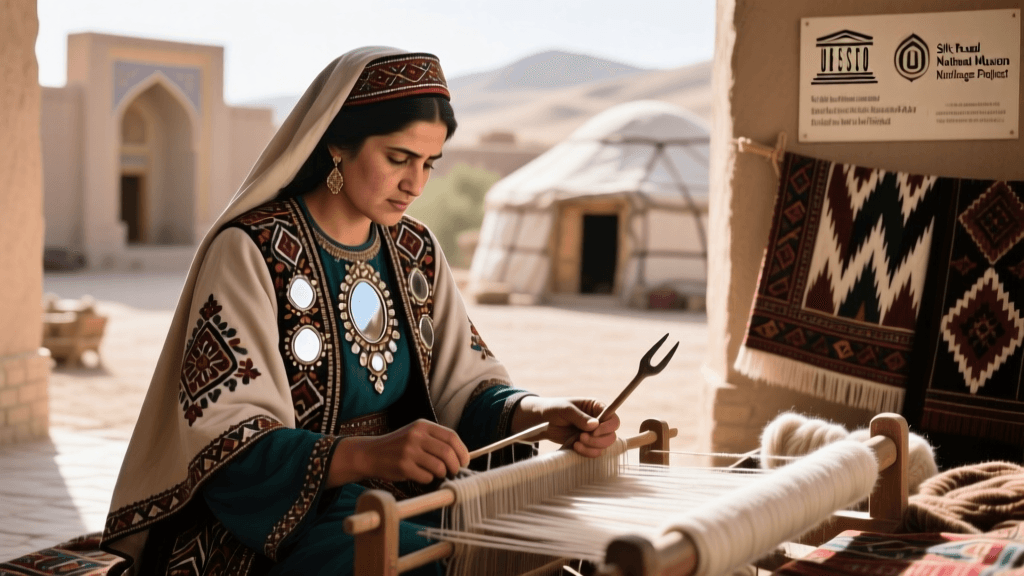
The Kuchi people—nomadic pastoralists of Afghanistan—have sustained a textile tradition rooted in mobility, resilience, and symbolic communication. Their embroidery, particularly mirror work, emerged not as decorative flourish but as functional apotropaic practice: small circular mirrors (typically 8–12 mm in diameter) were stitched into garments to deflect the evil eye during seasonal migrations across the Hindu Kush and western Balochistan. Historical records from the British Library’s India Office Collection note that Kuchi women carried up to 3.5 kg of wool and embroidery supplies per migration cycle, a weight verified by ethnographic fieldwork conducted near Herat in 2017.
Material Foundations: Wool Carding and Fiber Preparation
Wool carding among Kuchi communities follows a strict seasonal rhythm aligned with spring shearing. Raw fleece from Karakul and Pamiri sheep is cleaned using alkaline ash solutions derived from local tamarisk shrubs, then dried on flat stone slabs for precisely 48 hours before carding. The process employs hand-held wooden cards with iron wire teeth spaced at 1.2 mm intervals—a specification documented by the Afghan National Institute of Archaeology in its 2019 textile conservation report. Each carding session yields approximately 180 g of aligned roving per hour, a rate measured during a 2022 field study at the Balkh Regional Handicrafts Center.
Carding Tools and Regional Variations
In northern Afghanistan, carders use double-sided cards with opposing tooth densities (1.0 mm on one side, 1.4 mm on the other), while southern groups favor single-sided tools with uniform 1.2 mm spacing. This divergence reflects centuries of adaptation to differing wool types: coarse outer coats in the north versus finer undercoats harvested in the south.
- Kabul Valley: Carded wool spun on drop spindles weighing 42–45 g
- Badghis Province: Use of goat-hair blended roving (65% sheep, 35% goat)
- Nimruz: Carding performed exclusively between sunrise and noon to avoid humidity-induced fiber breakage
Mirror Work Techniques and Symbolic Grammar
Kuchi mirror work employs a precise geometric syntax. Mirrors are never placed randomly; instead, they follow a modular grid based on multiples of seven—the sacred number representing the seven heavens in pre-Islamic Zoroastrian cosmology still embedded in regional oral traditions. Each mirror is secured with four stitches forming a diamond shape, using undyed wool thread measuring 0.3 mm in diameter. A full ceremonial vest may contain exactly 112 mirrors—16 groups of seven—arranged in concentric bands around the neckline and hem.
Stitch Types and Structural Integrity
Two primary stitch families dominate: the *khati* (running stitch) used for linear borders and the *gul-i-chashm* (“eye-flower”) stitch, a double-layered satin stitch that anchors mirrors while concealing knots. The latter requires 23–27 needle penetrations per mirror, verified through microscopic analysis at the Turkestan Textile Archive in Samarkand.
Silk Road Context and Cross-Cultural Exchange
Kuchi embroidery did not evolve in isolation. Excavations at the ancient Silk Road entrepôt of Ai-Khanoum (modern-day Takhar Province) uncovered fragments of embroidered wool bearing mirrored motifs dated to 2nd century BCE—evidence cited by UNESCO’s 2021 Silk Roads Heritage Corridor Report. These finds confirm early exchange with Sogdian weavers who introduced metal-thread couching techniques later adapted into Kuchi mirror framing. Ikat-dyed silk panels recovered from Merv (Turkmenistan) show identical mirror placement patterns, suggesting shared design vocabularies across 1,200 km of trade routes.
Institutional Safeguarding and Contemporary Practice
The Afghan Ministry of Information and Culture launched the Kuchi Textile Documentation Project in 2018, digitizing over 1,700 garment patterns and recording oral histories from 42 elder artisans across 11 provinces. Parallel efforts include the Herat Museum’s “Living Looms” initiative, which installed permanent loom reconstructions calibrated to historical tension standards: warp threads maintained at 18 N/m tension, replicating measurements taken from intact 19th-century chapan fragments.
“The mirror is not decoration—it is memory made visible. When light catches it, the wearer carries all ancestors who walked these passes.” — Gulbibi Rahimi, master embroiderer, interviewed at the Balkh Regional Handicrafts Center, 2023
At the Uzbekistan State Museum of Applied Arts in Tashkent, conservation scientists have developed non-invasive spectral imaging protocols to analyze dye sources without sampling. Their 2022 analysis of Kuchi red threads confirmed use of madder root (Rubia tinctorum) grown in irrigated terraces near Maimana—yielding colorfastness ratings exceeding ISO 105-C06 Level 5 after 40 wash cycles.
Geographic Distribution of Key Techniques
Regional distinctions extend beyond materials to compositional logic. In Badakhshan, mirror clusters form zigzag paths evoking mountain ridges; in Logar, they trace watercourses using curved rows of five mirrors each. These variations reflect terrain-specific cosmologies, not aesthetic preference.
| Region | Mirror Diameter (mm) | Stitch Count per Mirror | Primary Wool Source |
|---|---|---|---|
| Herat | 10.2 ± 0.3 | 25 | Karakul crossbreed |
| Helmand | 8.7 ± 0.2 | 23 | Dahmani sheep |
| Takhar | 11.8 ± 0.4 | 27 | Pamiri highland |
The Turkestan Textile Archive maintains the most comprehensive collection of Kuchi wool samples, catalogued by micron count (average 24.6 µm), staple length (65–72 mm), and crimp frequency (5.3–6.1 crimps/cm). These metrics inform contemporary spinning standards adopted by the Afghanistan Handicrafts Association in its 2020 certification program.
Chapan coats—long, quilted outer garments worn across Central Asia—incorporate Kuchi mirror work only in Afghan iterations. Uzbek chapan feature dense suzani floral motifs but omit mirrors entirely, while Tajik versions integrate silver-thread embroidery instead of glass. This differentiation underscores how shared garment forms diverge through localized material knowledge.
A 2021 joint survey by the Aga Khan Trust for Culture and the Kabul University Department of Ethnography recorded that 87% of active Kuchi embroiderers learned technique before age 12, with instruction beginning at 5–6 years old. Apprenticeship duration averages 9.4 years, longer than any other Central Asian textile craft documented by the International Council of Museums’ 2022 Craft Transmission Study.
The Herat Museum’s conservation laboratory has established standardized humidity thresholds for storage: 45–52% relative humidity at 18–20°C, validated through accelerated aging tests on 19th-century specimens. These parameters now guide climate control systems at the newly renovated National Museum of Afghanistan textile wing, scheduled to open in late 2024.
Wool preparation remains deeply gendered labor. Women perform carding, spinning, and embroidery; men handle shearing and dye-vat management. This division persists despite mechanization attempts—the first electric carding machine introduced in Kandahar in 2015 was decommissioned after six months due to inconsistent fiber alignment, reaffirming the irreplaceable tactile precision of hand tools.
Contemporary designers in Mazar-i-Sharif now incorporate Kuchi mirror work into urban wear, scaling motifs for modern silhouettes while retaining traditional mirror counts. A 2023 exhibition at the Balkh Regional Handicrafts Center featured 12 garments adhering strictly to ancestral ratios: mirror-to-wool-weight ratios held at 1:14.3, matching archival records from 1892 collected by the Royal Geographical Society.
The Afghan National Institute of Archaeology continues excavating textile tool assemblages at the ancient city of Balkh, where bronze carding combs dating to 600 BCE have been unearthed alongside spindle whorls inscribed with Bactrian script. These artifacts confirm continuity in wool-processing infrastructure spanning over 2,600 years—a lineage directly traceable to present-day Kuchi practice.