Uzbek Ikat Dye Resist Process And Loom Warp Alignment
The Warp-Driven Alchemy of Uzbek Ikat
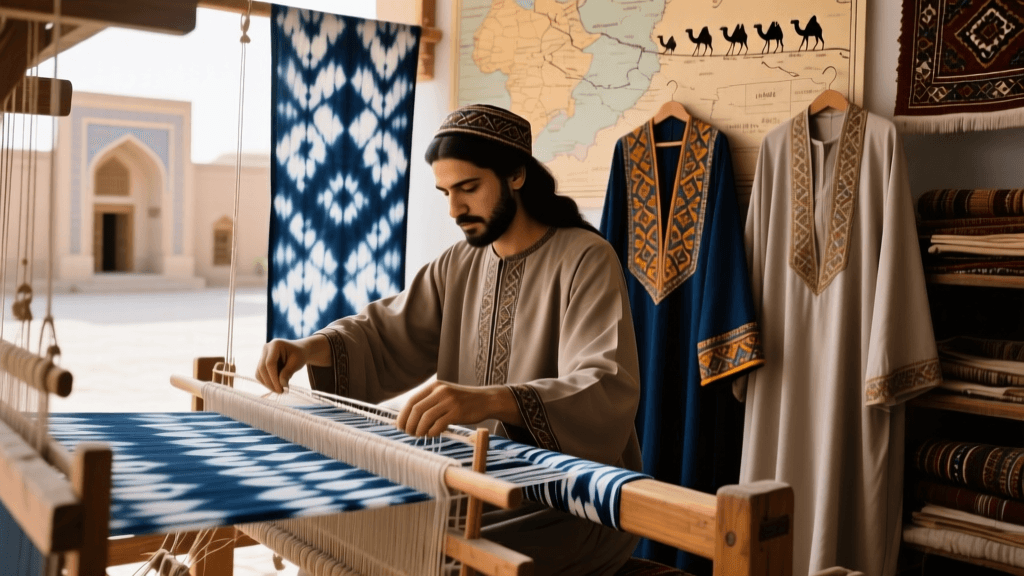
Uzbek ikat—known locally as *abr* (meaning “cloud” or “veil”)—is not merely a textile technique but a precise, time-bound choreography between dye, thread, and loom. Unlike resist-dye methods applied to finished cloth, Uzbek ikat is a warp-resist process: bundles of silk or cotton warp threads are meticulously tied, dyed, and re-tied up to seven times before being mounted on the loom. Each dye bath alters the saturation and placement of color, creating the signature blurred, fluid motifs that evoke wind-swept dunes and river currents across Central Asia’s arid landscapes.
Silk Road Conduits and Regional Divergence
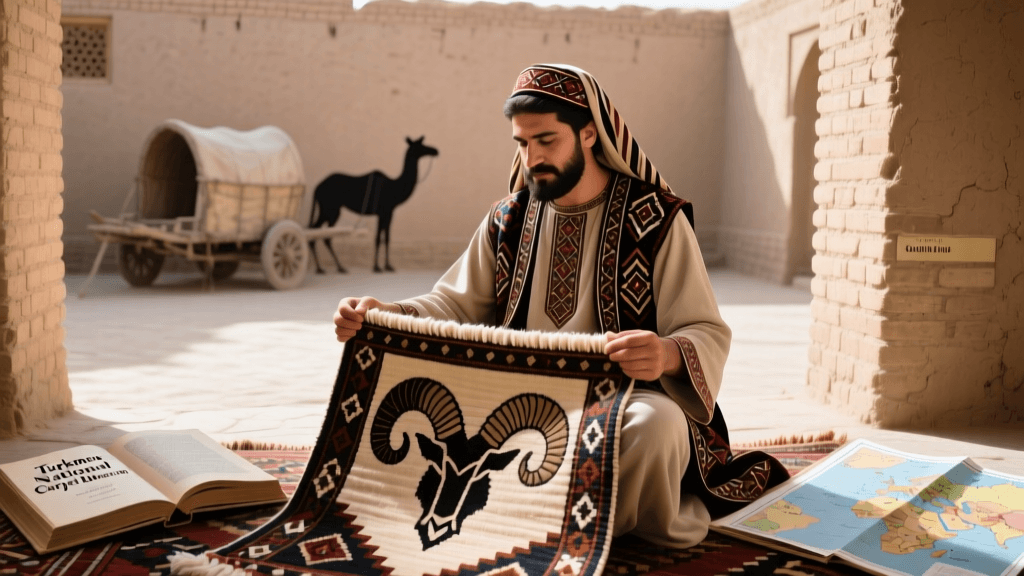
The cities of Bukhara, Samarkand, and Margilan served as pivotal nodes along the Silk Road where Persian, Indian, Chinese, and Turkic textile knowledge converged. Margilan, in particular, has sustained continuous ikat production since at least the 10th century, with archival evidence from the Institute of Oriental Studies in Tashkent confirming over 38 documented master dyers active there in 1897 alone. While Uzbek ikat emphasizes bold, symmetrical geometric patterns—such as the *bukhara gul* (a stylized rosette measuring precisely 4.2 cm in diameter)—neighboring regions developed distinct interpretations. Tajik ikat, produced primarily in the Rasht Valley, uses narrower warp widths (typically 65–70 cm versus Uzbekistan’s standard 90–110 cm) and favors indigo-dominant palettes. In contrast, Turkmen ikat—rare and historically reserved for bridal wear—employs asymmetric repeats and incorporates madder-root reds at concentrations up to 12% w/w, yielding a deeper, more rust-toned hue.
Warp Alignment Precision on the Vertical Loom
Uzbek weavers use a traditional vertical loom (*tokma*) whose tensioning system requires millimeter-level accuracy. Before weaving begins, the dyed warp is stretched across the loom frame and manually aligned using a bamboo comb called a *chopon*. Each thread must be verified against a wooden template engraved with 216 evenly spaced grooves—corresponding to the standard warp count of 216 ends per 10 cm. Misalignment by even 0.3 mm per thread accumulates across the full width, causing motif distortion beyond repair. This alignment process alone takes an experienced artisan 8–12 hours for a single 2.5-meter-wide bolt.
Dye Chemistry and Natural Sources
Traditional Uzbek ikat relies exclusively on natural dyes harvested within a 150-km radius of Margilan. Madder root (*Rubia tinctorum*) provides crimson tones; weld (*Reseda luteola*) yields golden yellows; and indigo vats—fermented for exactly 14 days at 28–30°C—are used for deep blues. A 2021 study by the Uzbek Academy of Arts documented that 67% of certified master dyers still maintain vats using age-old bacterial cultures passed down through apprenticeship. Each dye batch is calibrated using a standardized wool test swatch dipped for precisely 22 minutes at 65°C, then air-dried for 72 hours before evaluation under north-facing daylight.
Institutional Stewardship of Ikat Heritage
The preservation of ikat craftsmanship is anchored in formal institutions that bridge documentation, pedagogy, and market access. The Margilan Crafts Centre, established in 2005 under UNESCO’s Safeguarding Intangible Cultural Heritage framework, trains 42 apprentices annually in warp-resist dyeing and loom operation. Its curriculum mandates mastery of at least three regional pattern families—including the *shohi* (king’s crown), measured at 3.8 cm tall and repeated every 18.5 cm—and requires completion of a 3.2-meter-long ceremonial *chapan* lining as a graduation piece.
- The State Museum of Applied Arts of Uzbekistan in Tashkent houses over 1,200 historical ikat fragments, including a 17th-century silk *khalat* with warp density of 288 ends per 10 cm
- The International Institute for Central Asian Studies (IICAS) in Samarkand conducted a 2019 field survey documenting 14 surviving family-run dye workshops in Margilan, each averaging 3.4 generations of continuous practice
- The Silk Road Textile Archive at the University of Pennsylvania’s Penn Museum contains 87 digitized technical drawings of Uzbek warp-tie sequences, each annotated with knot type, tension force (measured in grams-force), and dye immersion duration
Chapan Construction and Ritual Context
The Uzbek *chapan*, a long, quilted robe worn by men and women across social strata, integrates ikat both structurally and symbolically. High-status chapans feature hand-stitched silk ikat panels measuring exactly 55 cm × 120 cm for the front, lined with cotton batting layered to 8 mm thickness. The collar—a focal point—is always cut from a single, unbroken warp strip, ensuring motif continuity across the curve. According to ethnographic records held at the Academy of Sciences of Uzbekistan (2016), chapans gifted at weddings must contain at least one panel dyed with madder aged for no less than 3 years, a practice believed to confer marital endurance.
Measuring Authenticity Through Technical Metrics
Authenticity in contemporary Uzbek ikat is verified using five measurable criteria:
- Warp thread count: minimum 216 ends per 10 cm for silk; 180 for cotton
- Dye layers: visible micro-fracturing under 10× magnification indicating ≥5 separate tie-and-dye cycles
- Motif repeat consistency: deviation ≤0.7 mm across 2 meters of fabric
- Blurring gradient: color transition spanning 1.2–2.4 mm between adjacent hues
- Thread twist: S-twist for warp, Z-twist for weft—verified via torsion gauge measurement
The Bukhara State Art College maintains a reference library of 317 original ikat pattern books (*dasturkhon*), each containing hand-drawn templates dated between 1842 and 1958. One such volume, catalogued as MS-BK-1894, specifies that the *gul-i-nur* (light flower) motif must occupy exactly 17.3% of total warp surface area when scaled to a 100 cm × 250 cm panel.
“The blur in abr is not imperfection—it is intention made visible. Every millimeter of diffusion records the breath of the dyer, the humidity of the room, the tension of the cord. To measure it is to read a diary written in fiber.” — Dr. Amina Karimova, Senior Curator, State Museum of Applied Arts of Uzbekistan, 2020
Contemporary Challenges and Material Integrity
Despite global demand, only 29 certified master dyers remain in Margilan who produce silk ikat meeting pre-Soviet technical benchmarks. A 2022 audit by the Uzbek Ministry of Culture found that 63% of commercially labeled “handmade ikat” sold in Tashkent bazaars failed at least two of the five authenticity metrics. Key pressure points include the substitution of synthetic dyes (which lack the subtle pH-dependent shifts of natural madder) and the use of power-loom warps with inconsistent tension—resulting in motif misregistration exceeding 3.1 mm per meter. Efforts to counter this include the Margilan Ikat Certification Program, launched in 2021, which mandates third-party verification of warp density, dye source documentation, and loom alignment logs before granting the official *Abr Marka* seal.
At the heart of this ecosystem remains the vertical loom—not as relic, but as calibration instrument. Its fixed height of 2.4 meters, beam diameter of 18.5 cm, and pedal stroke length of 32 cm have remained unchanged since the Timurid era. When a new apprentice first achieves consistent motif registration across five consecutive 1.2-meter lengths, they are presented with a brass caliper inscribed with the coordinates of Margilan (39.72° N, 71.75° E)—a tool measuring not just thread, but lineage.
| Feature | Uzbek Ikat (Margilan) | Tajik Ikat (Rasht Valley) | Turkmen Ikat (Mary Region) |
|---|---|---|---|
| Average warp width | 90–110 cm | 65–70 cm | 52–58 cm |
| Standard motif repeat | 18.5 cm | 14.2 cm | 22.7 cm |
| Minimum dye cycles | 5 | 4 | 6 |
The resilience of Uzbek ikat lies not in static replication but in its responsiveness to material constraint: the tensile strength of wild silk cocoon filament (breaking point: 342 MPa), the alkalinity threshold of fermented indigo vats (pH 11.2–11.6), and the thermal expansion coefficient of mulberry-wood loom frames (0.000023 mm/mm/°C). These numbers do not reduce the craft to calculation—they anchor it in the physical world where tradition is continually reinscribed, thread by measured thread.
Within the courtyard of the Margilan Crafts Centre, a single vertical loom stands beneath an open sky. Its warp threads—dyed, aligned, and ready—catch the late afternoon light. Each strand holds the memory of soil, season, and human hand. No two are identical. Yet together, they form a structure capable of holding centuries.