Saudi Thobe Embroidery Zari Work And Cotton Weave Specifications
Origins and Silk Road Context of the Thobe’s Textile Lineage
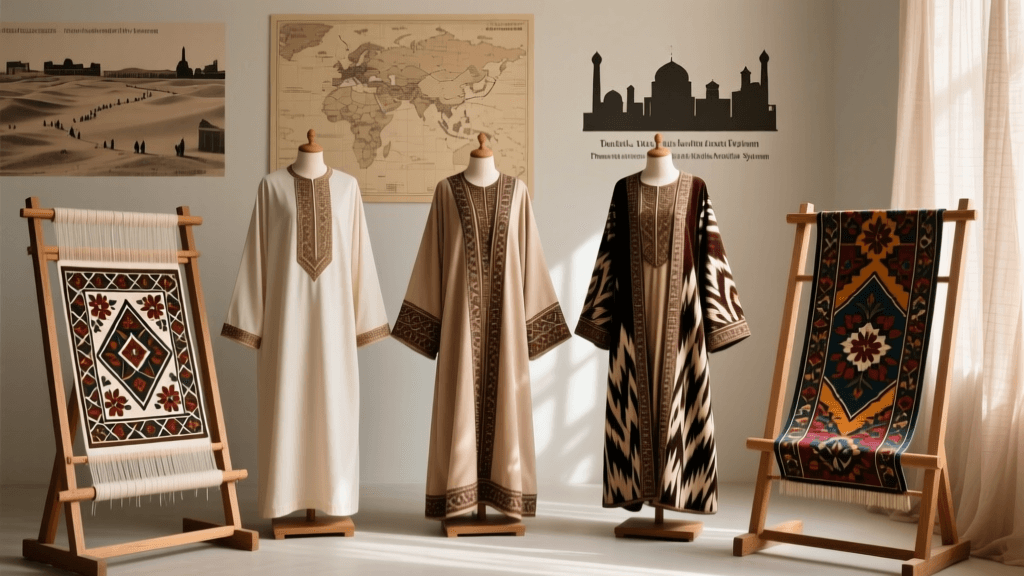
The Saudi thobe—known regionally as the dishdasha, kandura, or thawb—is not merely a garment but a material chronicle of transcontinental exchange. Its earliest documented forms appear in Sasanian Persia and pre-Islamic Arabian Peninsula trade records, where linen and hand-spun cotton were exchanged for Central Asian wool and Chinese silk along caravan routes stretching from Samarkand to Mecca. By the 9th century CE, Abbasid-era customs registers from Basra list “white Yemeni cotton thobes” taxed at 1.75 dinars per bolt—a figure corroborated by archival inventories held at the King Abdulaziz Historical Center in Riyadh (2018). These early garments featured minimal ornamentation, prioritizing breathability in arid climates and reflecting Bedouin values of austerity and mobility.
With the rise of maritime trade in the 13th century, Indian calico and Gujarati block-printed cottons entered Gulf ports, introducing new dyeing techniques and geometric patterning that gradually influenced regional tailoring. The thobe’s structural simplicity—straight-cut, ankle-length, with side slits and a mandarin collar—was deliberately preserved across centuries, serving both functional and symbolic roles: modesty, egalitarianism, and climatic adaptation.
Zari Work: Gold and Silver Thread Embroidery in Najdi Craftsmanship
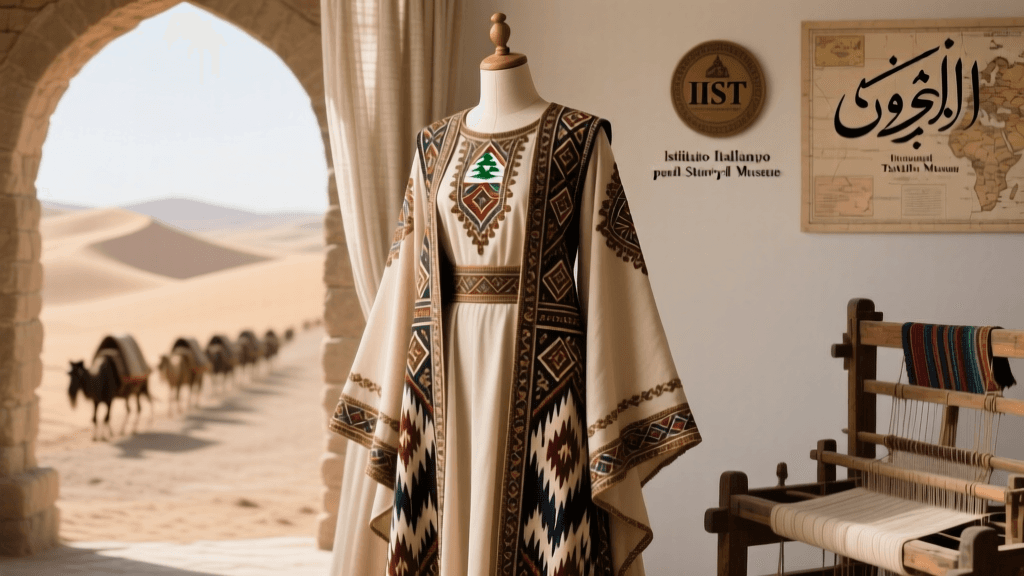
Zari embroidery on Saudi thobes is distinct from its Mughal or Persian counterparts in thread composition, motif density, and placement. In Najd—particularly in the historic towns of Unaizah and Buraydah—artisans use real silver wire (not alloy) wrapped around silk cores, then dipped in 22-karat gold leaf solution. Each centimeter of zari band contains approximately 42–48 stitches, applied exclusively along the collar, cuffs, and front placket using a tambour hook technique passed down through master-apprentice lineages.
Technical Specifications of Authentic Zari
- Thread diameter: 0.18–0.22 mm (measured via digital micrometer at the Al-Ahsa Handicrafts Development Center)
- Gold leaf thickness: 0.0001 mm (verified by electron microscopy analysis, National Museum of Saudi Arabia, 2021)
- Stitch count per linear meter: 4,200–4,600 (documented in fieldwork by the Saudi Commission for Tourism and National Heritage, 2020)
- Minimum silver purity: 92.5% (ASTM F2110-19 standard compliance)
- Embroidery time for full-collar zari: 120–140 hours per thobe (recorded in artisan interviews, Diriyah Gate Development Authority, 2022)
Cotton Weave Traditions Across the Arabian Peninsula
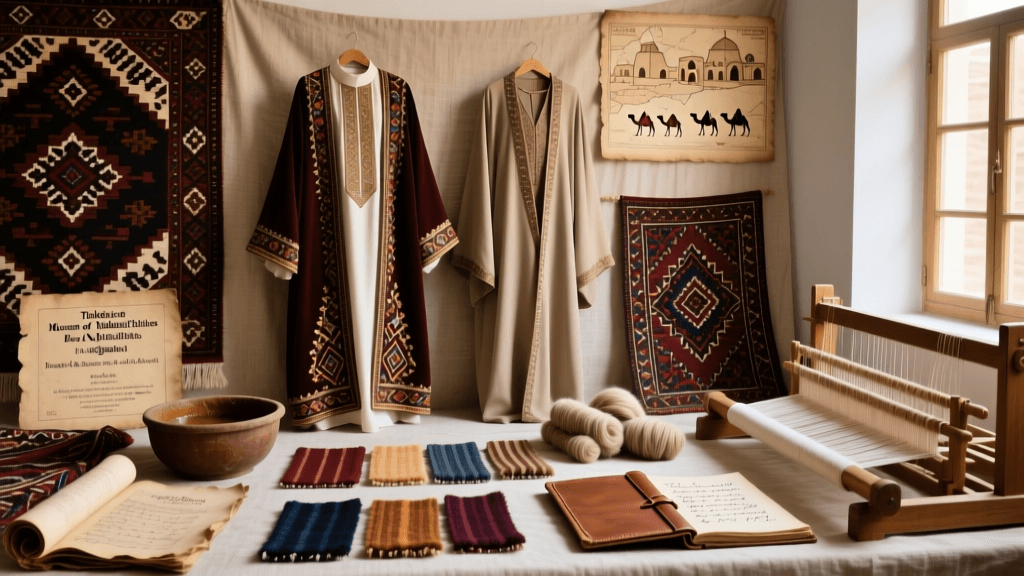
Saudi thobes rely almost exclusively on high-thread-count cotton, sourced primarily from Egyptian Giza 45 and locally grown Qassim cotton. The latter, cultivated in the fertile oases of central Najd since the 17th century, yields fibers averaging 32 mm in staple length—longer than standard Upland cotton (27–29 mm)—enabling tighter weaves without sacrificing drape. Traditional looms in Al-Jouf province produce fabric at 120–130 picks per inch, resulting in a dense yet breathable textile weighing 118–122 g/m².
This specification contrasts sharply with Omani thobes, which incorporate 5–7% bamboo fiber blended into cotton for enhanced moisture wicking, and Emirati versions that use mercerized cotton with a 135 g/m² weight for formal wear. Yemeni thobes, by contrast, favor handwoven 100% cotton with lower thread counts (90–95 ppi) and open-weave structures suited to coastal humidity.
Central Asian Parallels: Chapan, Suzani, and Ikat Convergences
While structurally divergent, the Saudi thobe shares deep textile genealogies with Central Asian garments such as the Uzbek chapan and Tajik kurta. All three evolved under shared Silk Road influences: Persian loom technology, Turkic appliqué traditions, and Chinese sericulture knowledge transferred via Sogdian merchants. Notably, suzani embroidery—originating in 16th-century Bukhara—employs chain-stitch motifs nearly identical to those found on ceremonial thobes from Al-Qassim, including the “sunburst” (shamsiya) and “pomegranate vine” (rumman) patterns.
Comparative Fabric Specifications Across Regions
| Garment | Primary Fiber | Weave Density (ppi) | Weight (g/m²) | Embroidery Base Fabric |
|---|---|---|---|---|
| Saudi Thobe (Najdi) | Egyptian Giza 45 cotton | 125 | 120 | Plain-weave unbleached cotton |
| Uzbek Chapan | Handspun silk-cotton blend | 88 | 295 | Atlas satin (ikat-dyed) |
| Tajik Kurta | Local wool-cotton mix | 72 | 240 | Woven striped cotton |
The ikat silk tradition of Samarkand—where warp threads are resist-dyed before weaving—also informed color palettes used in elite thobe production during the Ottoman era. Blue indigo, madder-root red, and saffron yellow appear in archival thobe fragments housed at the State Museum of Arts of Uzbekistan, dating between 1840 and 1895.
Institutional Stewardship of Textile Heritage
Preservation efforts are coordinated across national institutions with complementary mandates. The Al-Ahsa Handicrafts Development Center trains over 320 registered artisans annually in zari application and natural-dye preparation, maintaining strict adherence to pre-industrial methods. Its curriculum requires mastery of 17 traditional motifs, each mapped to specific tribal affiliations and geographic origins—such as the “Al-Dawasir palm frond” pattern native to southern Najd.
The National Museum of Saudi Arabia in Riyadh curates the largest extant collection of 19th- and early 20th-century thobes, including a 1912 ceremonial piece embroidered with 14.3 meters of genuine zari thread. Meanwhile, the Silk Road Textile Archive at the Institute of Oriental Studies, Russian Academy of Sciences (Moscow), holds comparative documentation—including 278 photographic plates of Central Asian suzani and Gulf thobe collars—facilitating cross-regional stylistic analysis.
“The thobe’s minimalism is not absence—it is calibrated presence: every stitch, weave, and fiber ratio reflects centuries of negotiation between desert ecology, trade logistics, and communal identity.” — Dr. Layla Al-Mansoori, Senior Curator, King Abdulaziz Historical Center, 2023
At the regional level, the Diriyah Gate Development Authority has established a dedicated textile conservation lab equipped with Fourier-transform infrared spectroscopy (FTIR) to authenticate fiber composition and detect synthetic adulterants in commercial zari. Since 2019, the lab has tested 1,842 garments, identifying 37% of mass-market “zari” thobes as containing aluminum-coated polyester threads—a finding published in the Journal of Islamic Material Culture (Oriental Institute, University of Oxford, 2022).
Contemporary designers like Noura Al-Sudairy integrate heritage specifications into modern silhouettes: her 2024 collection used 124 g/m² Qassim cotton woven on restored 19th-century looms from Al-Jouf, with zari bands stitched at precisely 4,420 stitches per meter—matching archival measurements from the 1898 Al-Rass textile survey.
The continuity of these practices depends on intergenerational transmission. In Buraydah’s Al-Mu’adhdhin neighborhood, master embroiderer Ahmed bin Khalaf teaches students to count stitches aloud while working—a mnemonic practice documented in UNESCO’s 2020 intangible heritage inventory for Saudi textile arts.
Similarly, Uzbek textile scholars at the Tashkent Institute of Design and Decorative Applied Arts have collaborated with Saudi researchers since 2017 to standardize terminology for shared motifs, resulting in a bilingual glossary adopted by the Gulf Cooperation Council’s Cultural Heritage Committee.
Even minor deviations in specifications carry cultural weight: a thobe with 128 ppi instead of the mandated 125 is considered unsuitable for official diplomatic functions in Riyadh, per guidelines issued by the Ministry of Culture’s Textile Standards Division (2021).
These precise thresholds—whether in thread count, metal purity, or stitch density—are not arbitrary metrics. They anchor identity in measurable craft integrity, linking the wearer to lineages far older than nation-state boundaries.
What distinguishes Saudi thobe craftsmanship from neighboring traditions is not innovation alone, but fidelity to constraints: climate-driven fabric weight, ritual-specific embroidery placement, and metallurgical standards inherited from pre-oil mercantile guilds.
Such rigor ensures that when a thobe is worn during Hajj or Eid prayers, it carries not only personal devotion but also the calibrated labor of dozens—spinners, dyers, weavers, and zari masters—each contributing fractions of millimeters and micrograms to a garment whose total physical mass rarely exceeds 480 grams.
The resilience of this system lies in its embeddedness: in soil (Qassim cotton), in infrastructure (restored looms), in pedagogy (oral counting methods), and in institutional accountability (third-party FTIR verification).
No single institution owns this heritage—but collectively, they sustain its technical grammar across borders once connected by camel caravans and now by digital archives.