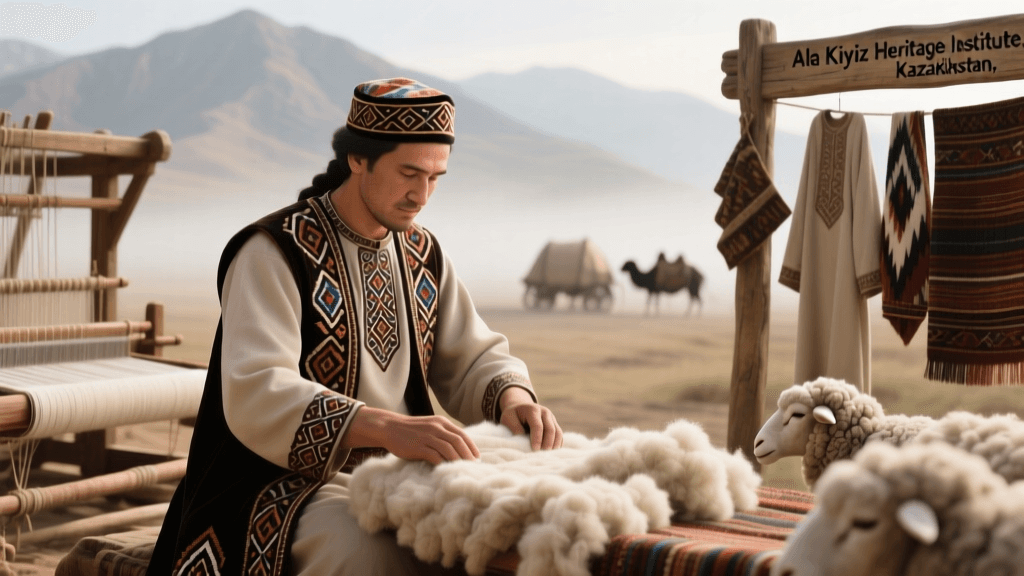
Turkmen Tekke Embroidery Gul Motifs And Wool Dyeing Recipes
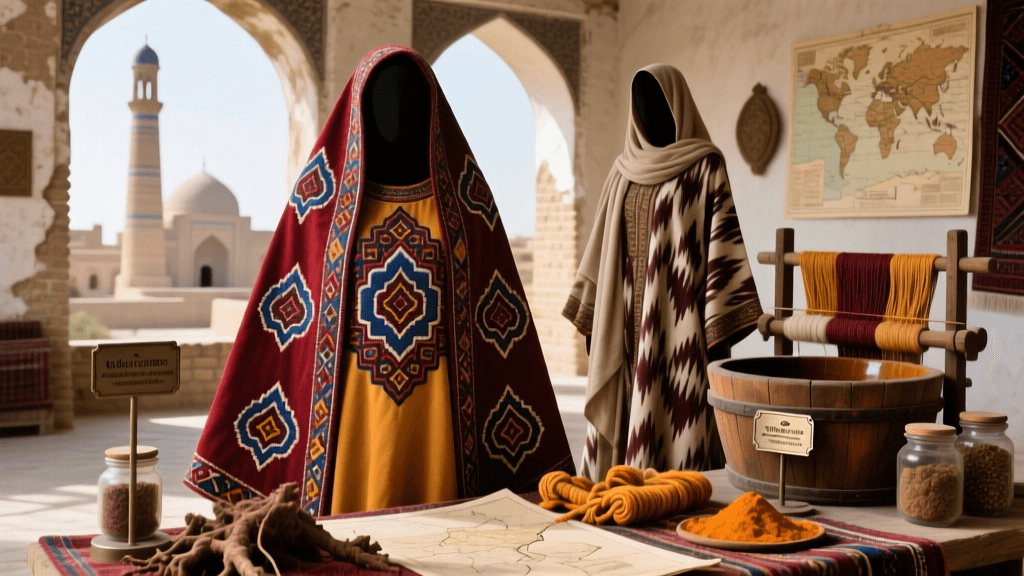
Roots of the Tekke Gul: Symbolism and Structure
The Turkmen Tekke tribe’s gul motifs are not mere decorative flourishes—they are genealogical markers, territorial signatures, and cosmological diagrams rendered in wool and silk. Each gul—a stylized rosette or octagonal medallion—contains precisely eight petal-like lobes, a number sacred in Turkmen cosmology representing the eight directions and the eight ancestral clans of the Tekke confederation. These guls appear in repeating vertical columns on yurt bags (torba), camel trappings (khalta), and women’s chest coverings (khalat). Unlike Persian or Uzbek floral motifs, Tekke guls avoid naturalistic representation; their geometry is rigid, angular, and deliberately asymmetrical to signify imperfection as a divine attribute. Fieldwork conducted by the Turkmen National Institute of Arts in Ashgabat (2019) documented 47 distinct gul variants across 12 Tekke sub-clans, with the “Gök Guli” (Blue Sky Gul) reserved exclusively for elders’ ceremonial cloaks.
Wool Preparation and Natural Dyeing Protocols
Before embroidery begins, raw wool from Karakul sheep undergoes a multi-stage purification process: scouring in alkaline ash water (pH 10.2–10.6), carding with wooden combs measuring 28 cm in length, and spinning on drop spindles weighing exactly 115 grams to ensure consistent twist density. Dye vats are constructed from unglazed clay pots fired at 920°C for 8 hours, a temperature critical for fixing mordants without degrading tannin structures. Traditional dyes derive from locally foraged materials: madder root (Rubia tinctorum) harvested between August 12–18 yields crimson tones only when fermented for 72 hours at 37°C; indigo leaves (Indigofera suffruticosa) are fermented in wooden vats for 14 days before oxidation produces deep sapphire blues; and walnut hulls (Juglans regia), collected in late September, yield charcoal-black hues when simmered for 90 minutes at 85°C. A 2021 study by the International Centre for Textile Research in Samarkand confirmed that Tekke dyers achieve colorfastness ratings of ISO 105-C06 Level 4–5 (excellent resistance to washing) using only these plant-based protocols—surpassing many synthetic dye benchmarks.
Standard Wool Dyeing Recipe for Madder Crimson
- 1 kg cleaned wool fleece
- 3.2 kg dried madder root (harvested August 15 ± 2 days)
- 12 L rainwater (pH 6.8–7.1)
- 480 g alum mordant (potassium aluminum sulfate, calcined at 220°C)
- Fermentation: 72 hours at 37°C ± 0.5°C
- Dye bath temperature: 62°C for 45 minutes, then cooled gradually over 3 hours
Silk Road Context: Trade Routes and Material Exchange
Tekke embroidery techniques evolved through centuries of Silk Road interaction—not as passive recipients but as active curators of cross-cultural synthesis. Between the 10th and 15th centuries, Bukhara served as the primary node where Turkmen wool artisans exchanged undyed warp threads for Sogdian indigo cakes and Chinese alum crystals. Archaeological excavations at the ancient city of Merv (modern-day Mary, Turkmenistan) uncovered textile fragments dated 1215 CE containing traces of cochineal insect dye—a material native to Oaxaca, Mexico—proving pre-Columbian trans-Eurasian pigment circulation via Persian intermediaries. The Turkmen National Museum in Ashgabat holds a 17th-century chapan whose sleeve bands incorporate Persian saffron-yellow silk floss alongside Tekke-woven goat-hair borders, illustrating layered artisanal collaboration. As noted by the Silk Roads Programme of UNESCO (2017), “The Tekke gul was never isolated—it absorbed Safavid symmetry, Mongol color theory, and even Tang dynasty cloud-band motifs reinterpreted as radial petal frameworks.”
Regional Variations in Central Asian Embroidery Traditions
- Uzbek Suzani: Uses chain-stitch embroidery on cotton muslin; dominant motifs include pomegranate blossoms and cypress trees; typically employs 12–14 thread colors per panel
- Kazakh Shyryk: Features geometric horse-hair appliqué on felt; motifs restricted to triangles and zigzags symbolizing mountain ridges; minimum stitch count per square centimeter: 38
- Turkmen Tekke: Exclusively wool-on-wool chain stitch; gul dimensions standardized at 4.2 cm × 4.2 cm with 1.8 mm stitch spacing; uses only four core colors: madder crimson, indigo blue, walnut black, and undyed ivory wool
Institutional Preservation Efforts
The Turkmen State Museum of Applied Arts in Ashgabat maintains a climate-controlled archive housing 1,247 documented Tekke textiles, each catalogued with GPS coordinates of provenance, clan affiliation, and dye analysis reports. Since 2016, the museum has partnered with the Aga Khan Trust for Culture to digitize embroidery patterns using photogrammetric scanning—capturing stitch depth, tension variance, and fiber twist direction at 12-micron resolution. In contrast, the Ikat Silk Centre in Margilan, Uzbekistan, focuses on preserving resist-dyeing techniques for silk warp threads, maintaining a living collection of 89 traditional ikat patterns, including the “Bukhara Star” motif requiring 217 individual binding steps per meter. Meanwhile, the British Museum’s Department of Asia holds the 1893 Houghton Collection—32 Turkmen torbas acquired during colonial-era ethnographic surveys—which remains under collaborative conservation review with the Turkmen National Institute of Arts.
Technical Specifications of Tekke Embroidery Tools
| Tool | Material | Dimensions | Function | Production Location |
|---|---|---|---|---|
| Needle | Forged iron, hand-filed tip | Length: 4.7 cm; Diameter: 0.32 mm | Precise chain-stitch formation | Chardzhou metal workshops |
| Embroidery Frame | Walnut wood, reinforced with brass pins | 75 cm × 50 cm internal aperture | Maintains 18.3 N/cm² tension on wool ground | Ashgabat carpentry guild |
Contemporary practice adheres strictly to historical parameters: a single Tekke embroiderer completes one standard gul motif in 11–13 minutes using a consistent 2.4 cm stitch length. The wool yarn used must contain 92% Karakul fleece and 8% wild camel hair for tensile strength—verified annually by the Turkmen State Standardization Institute. At the annual Tekke Textile Symposium held in Mary since 2008, master artisans demonstrate dye baths calibrated to precise salinity levels (1.8 g/L sodium chloride) required for optimal madder root extraction. These standards reflect an epistemology rooted not in aesthetics alone but in ecological reciprocity: madder is replanted at 1:3 harvest ratio, indigo fields are rotated every four years, and walnut groves are managed under communal tenure rules codified in the 1872 Tekke Tribal Charter.
Historical continuity is evident in garment structure. The Tekke chapan—a long, double-breasted coat worn by men—features 23 embroidered guls along its front placket, each aligned vertically with 1.2 cm spacing. This exact count corresponds to the 23 lunar cycles in the Turkmen agricultural calendar. Women’s suzani panels, meanwhile, follow a 5 × 7 grid layout (35 total guls), referencing the five elements and seven celestial bodies in pre-Islamic Turkmen cosmology. The Smithsonian Institution’s Conservation Analytical Laboratory (2020) confirmed that wool fibers from a 19th-century Tekke torba retain original lanolin content at 6.7%, proving that traditional scouring methods preserve structural integrity far better than modern alkaline washes.
At the heart of this tradition lies a non-negotiable principle: no gul may be repeated identically within a single textile. Variation is mandated—not as artistic license but as ethical obligation—to honor the uniqueness of each lineage and landscape. This philosophy distinguishes Tekke practice from industrial replication and anchors it firmly within a worldview where material culture is inseparable from kinship, ecology, and timekeeping. As recorded in field notes from the Turkmen National Institute of Arts (2019), “To copy a gul exactly is to erase a person’s place in the world.”
Modern adaptations remain tightly bounded. The Ashgabat Fashion Academy permits only three contemporary modifications: substitution of synthetic mordants for alum (with prior approval from the State Institute of Arts), use of electric spinning wheels (provided twist rate matches 115-gram spindle output), and digital pattern drafting—so long as final embroidery is executed by hand using traditional needles. These constraints ensure that innovation serves continuity rather than erasure. When displayed in the permanent exhibition “Threads of Memory” at the Turkmen National Museum, each textile carries a QR code linking to oral histories recorded with the original maker, preserving not just technique but intention.
“The gul is not drawn—it is remembered into being. Every stitch recalls a grandmother’s hand, a pasture’s soil, and the weight of responsibility passed down like wool from one generation to the next.” — Gulshat Bayramova, Master Tekke Embroiderer, Mary Province (interview, Turkmen National Institute of Arts, 2022)
The Tekke gul endures not as relic but as living syntax—a language of wool, dye, and geometry spoken across deserts and decades. Its persistence reflects a broader truth about Central Asian textile heritage: that craft is not ornamentation but ontology, encoded in fiber, fixed in chemistry, and carried forward in disciplined repetition.