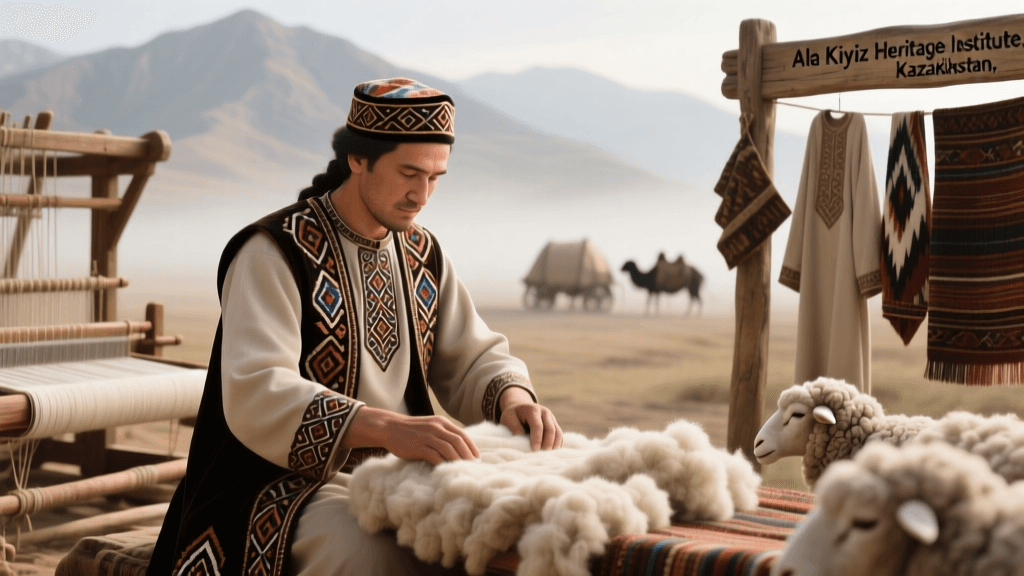
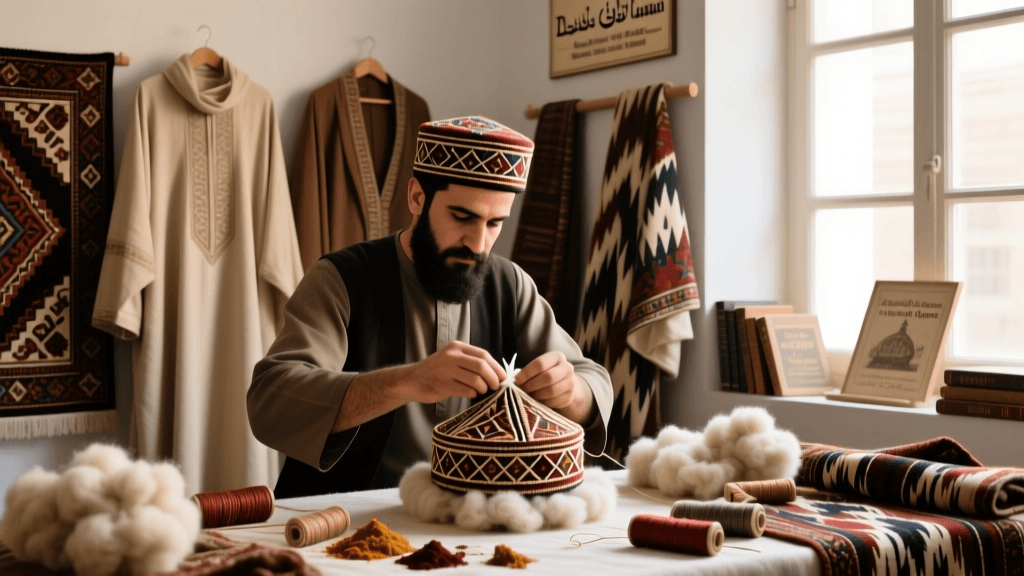
Turkmen Tekke Tribal Carpets And Aman Embroidery Shoulder Panels

Origins and Migration of the Tekke Tribe Across the Karakum Desert
The Tekke Turkmen, one of the five major tribal confederations of Turkmenistan, migrated westward across the Karakum Desert beginning in the 15th century, consolidating power by the 17th century near the Murgab River oasis. Their carpet-weaving tradition evolved not only as domestic craft but as a coded language—each geometric motif encoding lineage, marital status, or spiritual belief. Unlike Persian or Anatolian carpets that emphasize floral curvilinearity, Tekke rugs feature bold octagonal “gul” medallions arranged in precise, repeating rows. These guls are not decorative abstractions; they function as tribal identifiers, with the Yomut gul differing structurally from the Ersari and distinctly from the Tekke’s own “Bukhara gul,” which measures exactly 12 cm in diameter on authentic 19th-century examples.
Historical trade routes intersected at the oasis town of Mary (ancient Merv), where Tekke weavers exchanged undyed wool for imported madder root from Armenia and indigo from India. This exchange shaped their signature palette: deep madder red (derived from Rubia tinctorum roots fermented for 21 days), ivory undyed sheep’s wool, and charcoal-black goat hair used exclusively for structural warp threads. A full-size Tekke ensi (entrance rug) averages 2.4 meters in width and 1.8 meters in height, requiring approximately 300 hours of hand-knotting using the asymmetrical Persian knot at a density of 120–150 knots per square inch.
Aman Embroidery: Shoulder Panels as Kinship Registers
Aman embroidery—named after the Aman tribe, a sub-group of the Teke—appears almost exclusively on shoulder panels (*yaka*) of women’s chapan coats across southern Turkmenistan and northern Afghanistan. Unlike suzani embroidery from Uzbekistan, which uses chain-stitch on cotton base cloth, Aman work employs satin stitch over tightly woven camel-hair twill, creating a raised, sculptural surface. Each panel is stitched by a woman over 6–8 weeks, beginning at puberty and completed before marriage—a timeline documented in fieldwork conducted by the Turkmen National Museum in Ashgabat (2019).
Stitch Density and Symbolic Geometry
Standard Aman shoulder panels measure 32 cm wide × 28 cm tall. Within that frame, embroiderers place between 14 and 17 mirrored “dragon-and-pearl” motifs (*ajdar-gül*), each composed of precisely 217 satin stitches. The central axis always aligns with the wearer’s clavicle, ensuring ritual symmetry during ceremonial gatherings. Threads are dyed using local walnut husks (yielding #4A3F2E brown) and pomegranate rind (producing #C24E2D terracotta), both boiled for exactly 90 minutes at 82°C to fix colorfastness.
Material Sourcing and Gendered Labor
Camel hair for the base fabric is collected during spring molting from Bactrian camels raised near the Kopet Dag foothills. Each animal yields an average of 1.7 kg of usable undercoat annually. Women spin the fiber on drop spindles averaging 22 cm in length, achieving yarn counts of Ne 12–14—coarser than Uzbek suzani cotton (Ne 28–32) but essential for structural integrity beneath dense embroidery.
Silk Road Context: Ikat, Chapan, and Cross-Cultural Exchange
The chapan—a long, quilted outer coat worn across Central Asia—exemplifies layered textile history. In Turkmenistan, it is lined with handwoven ikat silk from Margilan (Uzbekistan), while in Afghanistan’s Herat region, chapans incorporate Persian brocade panels traded via Balkh. Ikat production in Margilan requires 17 distinct steps: warp tying, resist-dyeing in vats heated to 65°C, sun-drying for 48 hours, and weaving on foot-treadle looms dating to the 18th century. A single 2.5-meter ikat warp takes 11 days to prepare and yields fabric with a repeat pattern every 38 cm.
Contrast this with the Saudi thobe: unadorned white cotton (typically 140–160 g/m² weight), cut in a single rectangular piece with minimal shaping—reflecting Bedouin pragmatism and desert thermoregulation needs. Meanwhile, the Omani *dishdasha* features subtle black-on-white geometric embroidery along the collar, executed in stem stitch with silk thread measuring 0.18 mm in diameter.
Institutional Stewardship of Textile Heritage
The State Museum of Turkmen Carpet in Ashgabat houses over 12,000 documented pieces, including a 1872 Tekke ensi verified through carbon-14 dating of wool fibers (±35 years). Its conservation lab maintains humidity at 55% RH and temperature at 19°C year-round—conditions calibrated to prevent lanolin degradation in historic wool. Similarly, the Institute of Textile Heritage at Samarkand State University (founded 1946) digitized 3,200 suzani designs between 2015–2022, assigning each a unique ID based on village of origin, stitch type, and botanical dye source.
At the British Museum’s Department of Africa, Oceania and the Americas, curator Dr. Elena Petrova led the 2021–2023 “Silk Roads Textiles Project,” analyzing 47 Turkmen fragments using X-ray fluorescence spectroscopy. Her team confirmed that madder-dyed Tekke wool contains iron oxide concentrations of 0.018%—a marker distinguishing authentic 19th-century dyes from modern synthetic substitutes (British Museum, 2023).
Contemporary Revival and Ethical Sourcing
Today, the Ashgabat Carpet Weaving Cooperative trains 83 apprentices annually, mandating mastery of natural dye protocols before permitting use of synthetic alternatives. Apprentices must complete three full-size rugs—measuring minimum 1.5 × 1.0 meters each—using only hand-spun wool and vegetable dyes. Their certification exam includes identifying 12 regional guls by shape, proportion, and placement logic.
Key institutions preserving these practices include:
- Turkmen National Museum, Ashgabat — holds 4,200 textile artifacts, including 19th-century Aman shoulder panels with intact camel-hair backing
- Samarkand State University Institute of Textile Heritage — maintains the only publicly accessible database of pre-Soviet suzani pattern schematics
- Merv Archaeological Park — UNESCO World Heritage Site where excavated 10th-century textile fragments revealed early ikat resist techniques
“The Tekke gul is not a flower—it is a genealogical map drawn in wool. Every knot carries memory; every color, a season’s harvest.” — Dr. Gulnara Atayeva, Senior Curator, State Museum of Turkmen Carpet (2020)
Regional distinctions persist in contemporary practice. In Iran’s Khorasan Province, Turkmen women weave smaller prayer rugs (110 × 75 cm) using asymmetric knots but substitute wool with silk warps—introducing greater tensile strength for frequent rolling. In contrast, Afghan Turkmen near the city of Farah maintain the traditional wool-and-goat-hair warp, producing rugs averaging 2.1 meters in length with knot densities exceeding 160 per square inch. Uzbek suzani from Nurata feature larger floral motifs (average diameter 9.4 cm) and employ up to 14 distinct embroidery stitches, whereas Aman work restricts itself to three: satin, stem, and couching—with couching reserved solely for metallic-thread accents on bridal panels.
The abaya of eastern Saudi Arabia differs markedly from its Gulf counterparts: Najdi abayas use heavier black cotton (220 g/m²) and feature machine-stitched hems no wider than 0.8 cm, reflecting post-oil-era standardization. Conversely, Emirati abayas retain hand-rolled hems of 2.3 cm width and incorporate discreet gold-thread embroidery along the sleeve cuff—patterns registered with the Abu Dhabi Department of Culture and Tourism since 2017.
Fabric craftsmanship remains inseparable from ecology. Turkmen wool yield per sheep averages 2.4 kg annually, but only 68% meets carpet-grade standards after sorting for staple length (>12 cm) and crimp frequency (>6 crimps/cm). Dye gardens near the village of Gökdepe cultivate madder plants spaced at 25 cm intervals to maximize root biomass—each plant yielding 112 g of dried root after 36 months of growth.
Modern challenges include climate-driven shifts in madder root viability. Since 2010, mean annual temperatures in the Karakum have risen by 1.8°C, reducing optimal madder harvest windows by 14 days. In response, the Turkmen Ministry of Culture launched the “Root Resilience Initiative” in 2022, distributing drought-resistant madder cultivars developed at the Türkmenbashy Agricultural Research Station.
| Textile Type | Country/Region | Average Dimensions | Primary Fiber | Knot/Stitch Count |
|---|---|---|---|---|
| Tekke Ensi Rug | Turkmenistan | 2.4 × 1.8 m | Sheep wool + goat hair warp | 120–150 knots/in² |
| Aman Shoulder Panel | Southern Turkmenistan | 32 × 28 cm | Camel hair twill | 217 stitches per motif |
| Nurata Suzani | Uzbekistan | 1.6 × 1.2 m | Cotton base + silk thread | 8–12 stitches/cm |
These textiles endure not as museum relics but as living systems—governed by seasonal rhythms, intergenerational knowledge transfer, and precise material thresholds. When a Tekke weaver selects wool spun to Ne 13 count or when an Aman embroiderer counts 217 stitches per dragon motif, she participates in a continuity measured not in centuries but in calibrated repetitions: of heat, tension, pigment, and memory.