Silk Road Fashion: Uyghur Atlas Silk History & Sourcing
The Cross-Cultural Loom: Silk Road Influences on Atlas Patterns
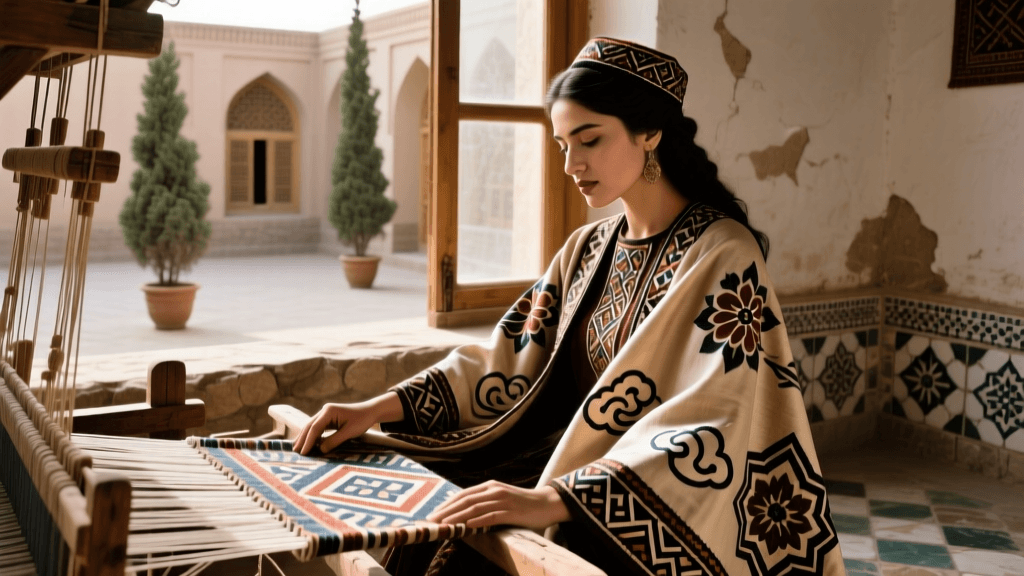
Uyghur Atlas silk is one of the most visually striking and culturally significant textiles to emerge from the historic Silk Road. Characterized by its vibrant colors and distinctive blurred, feathered edges, Atlas silk is a masterclass in warp-ikat weaving. The Tarim Basin in Xinjiang, China, served as a vital artery of the ancient Silk Road, where merchants, monks, and artisans from East and West converged. According to The Metropolitan Museum of Art's Heilbrunn Timeline of Art History, these trade routes facilitated not just the exchange of raw materials, but a profound cross-pollination of weaving techniques, dyeing methods, and aesthetic motifs.
The patterns found in traditional Atlas silk are a living archive of this cross-cultural exchange. Motifs such as the pomegranate, almond, and comb trace their lineage to Persian and Sogdian artistic traditions, brought by merchants traveling through Central Asia. Meanwhile, floral patterns like the lotus and peony reflect the deep historical integration with Han Chinese textile traditions. The UNESCO Silk Roads Programme highlights how the Tarim Basin served as a crucible for these diverse influences, resulting in a sartorial language that is uniquely Uyghur yet universally connected to the broader Asian and Middle Eastern trade networks.
The Anatomy of Warp-Ikat Mastery
The creation of Atlas silk relies on the warp-ikat technique, a painstaking process where the warp threads (the longitudinal threads on the loom) are tightly bound and resist-dyed before weaving begins. Artisans traditionally use corn husks, reeds, or tight cotton thread to bind sections of the silk bundles, preventing the dye from penetrating those areas. Because the threads shift slightly during the weaving process, the edges of the colored patterns blur, creating the signature 'halo' or 'feathered' effect that gives Atlas its name (derived from the Arabic word for 'loose' or 'unbound').
Historically, dyes were extracted from local flora and minerals: walnut husks for deep browns, pomegranate rinds for vibrant yellows, and madder root for rich reds. Today, while synthetic dyes are common for commercial production, master weavers in Hotan and Kashgar still produce limited batches using traditional organic dyes, highly sought after by textile collectors and haute couture designers.
Decoding Atlas Silk: Regional Variations
Atlas silk is not a monolith; its patterns, color palettes, and weights vary significantly by region, reflecting local micro-climates, historical trade partners, and cultural preferences. Below is a comparison of the three primary regional styles of Uyghur Atlas silk.
| Region | Color Palette | Pattern Characteristics | Best Use |
|---|---|---|---|
| Hotan | High contrast: Black, white, deep indigo, and crimson. | Bold, large-scale geometric and almond motifs. Heavy visual weight. | Winter garments, formal outerwear, upholstery. |
| Kashgar | Vibrant and multi-colored: Emerald, fuchsia, bright yellow, sapphire. | Intricate, dense patterns featuring pomegranates, flowers, and musical instruments. | Festive dresses (Köynek), dance costumes, summer wear. |
| Kucha | Soft pastels: Pale pink, mint green, lavender, soft gold. | Subtle, flowing motifs with wider blurred edges. Elegant and understated. | Modern fashion, scarves, lightweight blouses, bridal wear. |
Practical Guide: Sourcing Authentic Uyghur Atlas Silk
For designers, collectors, and cultural enthusiasts, sourcing genuine Atlas silk requires an understanding of local markets, timing, and material verification. The influx of mass-produced, synthetic imitations means buyers must be highly discerning.
Where and When to Buy
- Physical Markets: The Xinjiang International Grand Bazaar in Urumqi is the most accessible retail hub for tourists and international buyers. For wholesale fabric rolls and direct-from-weaver prices, visit the Hua Ling Trade City (Hua Ling Market) in Urumqi.
- Timing: The best time to source fresh, high-quality silk is during the late summer harvest festivals (August to September), such as the Turpan Grape Festival. During this period, rural weavers from the southern oases travel to urban centers, bringing premium, naturally dyed batches to the Sunday livestock and textile bazaars.
- Online Sourcing: If you cannot travel to Xinjiang, platforms like Taobao and Etsy offer direct shipping. Use specific search terms such as 'Xinjiang Atlas silk', 'Uyghur Ikat', or the Chinese term '艾德莱斯绸' (Aidelaisi chou) to filter out generic imitation prints.
Cost and Material Verification
Authentic, pure silk Atlas typically costs between $15 and $45 USD per meter, depending on the complexity of the pattern and the use of natural dyes. Synthetic blends (polyester or viscose) are widely available for $5 to $8 USD per meter. To verify the material, perform a simple burn test on a fringe thread: genuine silk will burn slowly, smell like burning hair, and crush into a fine, powdery ash. Synthetic blends will melt, smell like sweet plastic, and form a hard, uncrushable bead.
Tailoring Measurements for a Traditional Köynek
Transforming your sourced Atlas silk into a traditional Uyghur dress, known as a Köynek, requires specific tailoring considerations, primarily due to the fabric's unique loom width. Traditional Atlas silk is woven on narrow handlooms, resulting in a fabric width of only 40 to 50 centimeters (approx. 16 to 20 inches). This narrow width dictates how the garment must be cut and seamed.
To sew a standard adult-sized Köynek, you will need to purchase 5.5 to 6.5 meters of fabric. Here are the actionable tailoring measurements and construction tips:
- Bodice Construction: Because of the narrow fabric width, the bodice is typically constructed using multiple vertical panels (princess seams). This allows the tailor to align the ikat patterns symmetrically across the center front while hiding the necessary seams within the blurred edges of the design.
- Skirt Gathering: The traditional silhouette features a fitted bodice that flares into a heavily gathered skirt. To achieve the required hem circumference of 140 to 160 cm, the tailor must join 3 to 4 full widths of the fabric. Ensure the pattern direction runs vertically, matching the warp threads.
- Sleeve Measurements: Traditional Köynek sleeves are voluminous 'balloon' or puff sleeves. Cut the sleeve pattern to allow for a 60 cm circumference at the bicep, tapering down to a tight, buttoned cuff of 20 cm at the wrist. This requires joining two narrow fabric widths per sleeve.
- Lining: Atlas silk is lightweight and slightly sheer. Always line the bodice and skirt with a breathable, solid-colored cotton or silk habotai to provide structure and opacity.
Styling, Care, and Heritage Preservation
Styling an Atlas silk garment is an exercise in honoring its cultural roots. A Köynek is traditionally paired with a Doppa, the iconic Uyghur skullcap, often embroidered with floral or geometric motifs that complement the dress. For a modern, cross-cultural aesthetic, Atlas silk skirts and blouses can be paired with minimalist, solid-colored contemporary pieces—such as a black turtleneck or a tailored denim jacket—allowing the vibrant ikat patterns to serve as the focal point of the outfit.
Caring for Atlas silk requires gentle handling to preserve the integrity of the warp threads and the vibrancy of the dyes. Always hand wash in cold water using a pH-neutral silk detergent, or opt for professional dry cleaning for heavily structured garments. Never wring the fabric; instead, roll it in a clean, dry towel to absorb excess moisture, and iron on a low-heat setting using a cotton pressing cloth to prevent scorching.
The enduring legacy of these ancient trade routes and their sartorial contributions is formally recognized on a global scale. The UNESCO World Heritage Centre inscribed the Silk Roads: Chang'an-Tianshan Corridor as a World Heritage site, acknowledging the profound cultural exchanges that shaped regions like Xinjiang. By sourcing ethically, understanding the historical context, and wearing these garments with respect, modern enthusiasts play a vital role in preserving the living heritage of the Silk Road's most vibrant textile tradition.