Silk Road Threads: Uyghur Atlas Silk and Cross-Cultural Style
The Crossroads of Couture: Xinjiang's Sartorial Melting Pot
For millennia, the Taklamakan Desert was not merely a geographic barrier, but a vibrant crucible of global exchange. As the northern and southern branches of the ancient Silk Road skirted its unforgiving edges, oasis cities like Kashgar, Hotan, and Turpan became bustling hubs where Han Chinese, Persian, Sogdian, and Turkic cultures collided. This historical trade route network did far more than facilitate the exchange of commodities and spices; it wove a complex tapestry of cross-cultural sartorial influences that culminate today in the breathtaking traditional garments of the Uyghur people.
According to The Metropolitan Museum of Art's Heilbrunn Timeline of Art History, the Silk Road was not a single thoroughfare but a shifting network of trade routes that allowed for profound cultural syncretism. Sogdian merchants, the ancient Iranian people who served as the primary middlemen of the Silk Road, brought Persian weaving techniques and Zoroastrian motifs to the Tarim Basin. Simultaneously, Han Chinese silk workers introduced advanced sericulture and draw-loom technology. The resulting synthesis is a uniquely Uyghur aesthetic, most famously embodied in their vibrant Atlas silk and intricately embroidered Doppa skullcaps.
What is Atlas Silk? The Tie-Dye Legacy of the Silk Road
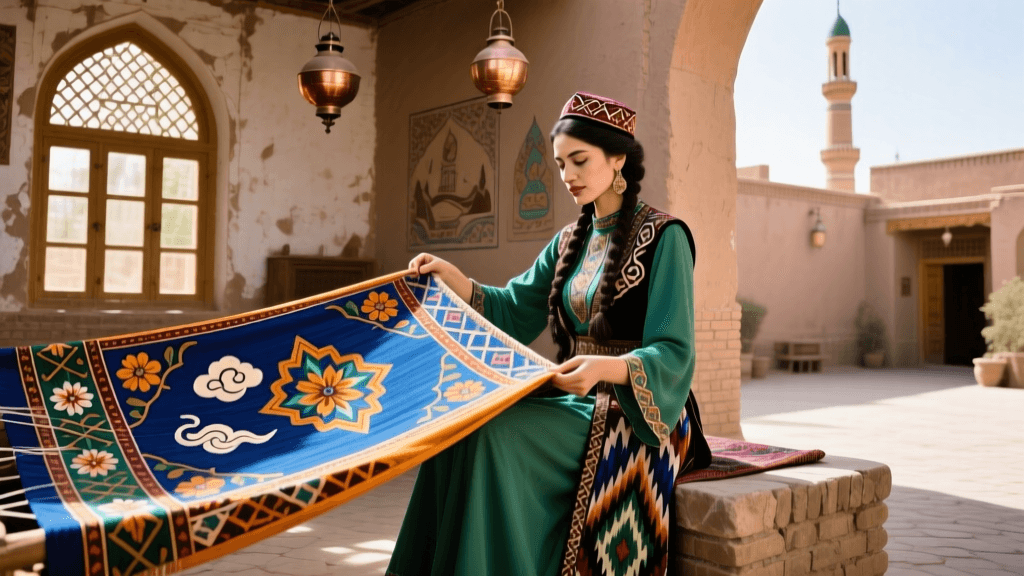
Atlas silk (often referred to as Adras or Khan-Atlas depending on the fiber blend) is a traditional warp-ikat textile native to the Xinjiang Uyghur Autonomous Region. The term 'ikat' derives from the Malay-Indonesian word for 'to tie,' but in Central Asia, the technique is deeply intertwined with Persian heritage, where the blurred, cloud-like edges of the dyed patterns are known as 'abr' (cloud). The threads are meticulously bound and resist-dyed before they are ever placed on the loom, requiring a masterful understanding of mathematics and spatial geometry to ensure the patterns align perfectly during weaving.
Cross-Cultural Motifs: Persian, Turkic, and Han Influences
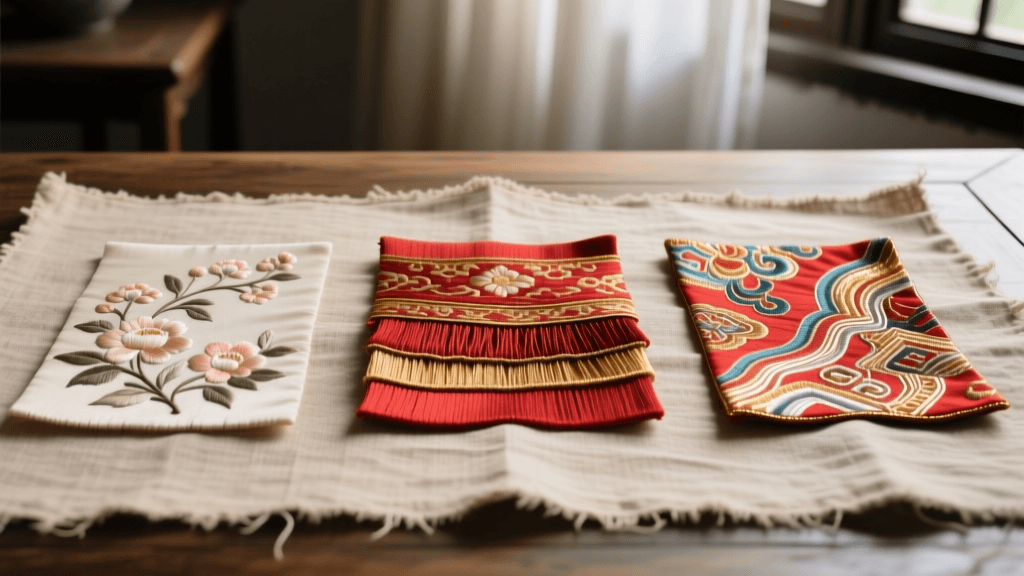
The visual language of Atlas silk is a direct archive of Silk Road migration. The most prominent motifs include the pomegranate, the almond (bodom), and the comb. The almond motif has deep roots in early Buddhist and Zoroastrian art, traveling westward via Sogdian caravans before being adopted into Islamic geometric traditions. Meanwhile, the use of stylized floral medallions and cloud-collar patterns reflects the enduring influence of Han Chinese textile design, adapted by Uyghur weavers into their own vibrant, high-contrast color palettes.
The Art of Ikat: Traditional Weaving and Dyeing Techniques
The creation of authentic Atlas silk is a labor-intensive process that relies entirely on natural, locally sourced dyes. Historical textile fragments documented by The International Dunhuang Project at the British Library reveal that Central Asian dyers have utilized the same botanical sources for over a thousand years. Madder root provides deep, enduring reds; walnut husks yield rich browns and blacks; pomegranate rinds create brilliant yellows; and indigo, imported via southern trade routes, provides the foundational blues. The mordanting process, traditionally using alum and tannins from local oak galls, ensures these vibrant hues remain fast against the harsh desert sun.
Practical Guide: Sourcing and Styling Authentic Atlas Silk
For collectors, fashion designers, and cultural enthusiasts, sourcing genuine Uyghur Atlas silk requires an understanding of the textile grades and regional markets. The most famous production centers remain the cities of Hotan and Kashgar. Below is a comparative guide to the primary types of Atlas textiles available in the region.
| Silk Type | Material Composition | Average Cost (per meter) | Best Garment Use |
|---|---|---|---|
| Khan-Atlas | 100% Silk (Warp and Weft) | 250 - 400 CNY ($35 - $55 USD) | Formal dresses, luxury Chapan linings |
| Adras | Silk Warp, Cotton Weft | 120 - 180 CNY ($17 - $25 USD) | Everyday dresses, skirts, lightweight coats |
| Bakhmal | Silk Velvet (Pile weave) | 300 - 500 CNY ($40 - $70 USD) | Winter Chapan, ceremonial caps (Doppa) |
Actionable Advice: Commissioning a Traditional Chapan
To commission or purchase an authentic Uyghur Chapan (a traditional quilted coat worn by both men and women) made from Atlas silk, precise measurements and timing are crucial for the best results.
- Timing Your Visit: Travel to Hotan or Kashgar between April and May, or September and October. This avoids the extreme summer heat and the freezing winter, and perfectly coincides with the peak silk-reeling season when fresh, high-quality threads are most abundant in the local bazaars.
- Measurements for a Chapan:
- Shoulder width: Measure seam to seam (typically 45-50 cm for men, 40-45 cm for women).
- Sleeve length: From the shoulder edge to the wrist bone (approx. 60-65 cm).
- Coat length: Traditionally falls below the knee or mid-calf (110-120 cm).
- Sourcing the Doppa: The four-sided embroidered skullcap is essential to the ensemble. Measure your head circumference just above the ears (usually 56-60 cm). Seek out caps from the Yengisar region, famous for intricate needlework. Expect to pay 150-300 CNY ($20-$40 USD) for a hand-embroidered piece.
- Negotiation and Costs: At the Kashgar Sunday Market, bargaining is expected. Start at 60% of the asking price. A fully tailored, quilted Chapan using 3 to 4 meters of Adras silk, plus cotton batting and artisanal labor, typically costs between 1,200 and 2,500 CNY ($170–$350 USD).
Garment Care and Maintenance
Because authentic Atlas silk utilizes natural botanical dyes, it requires specialized care. Dry cleaning is highly recommended for quilted Chapans. If you must wash an unquilted Adras dress, hand wash it in cold water using a pH-neutral silk detergent, such as Eucalan. Never wring the fabric; instead, roll it gently in a dry cotton towel to absorb excess moisture and lay it flat in the shade. Direct sunlight will rapidly degrade the natural indigo and madder dyes.
Preserving the Loom: Modern Revivals and Ethical Sourcing
Today, the survival of traditional Atlas weaving is a focal point for cultural preservation. As noted by the UNESCO Silk Roads Programme, the transmission of sericulture and weaving techniques remains a vital link to our shared human heritage. Modern initiatives in Xinjiang are increasingly focusing on ethical sourcing, ensuring that the artisans—predominantly women who operate the traditional wooden looms—receive fair compensation for their painstaking labor.
'The loom is the memory of the oasis, weaving the dust of Persia with the water of Han China into a single, unbroken thread.'
— Central Asian Textile Proverb
When you drape yourself in a garment crafted from Uyghur Atlas silk, you are not merely wearing a piece of fabric. You are wearing a living, breathing archive of the Silk Road—a testament to an era when the world was connected not by fiber-optic cables, but by the shared, enduring language of the loom. By choosing ethically sourced, hand-loomed textiles, collectors and fashion enthusiasts alike play a vital role in ensuring that these cross-cultural threads continue to be woven for generations to come.