Silk Road Threads: Uyghur Atlas Silk & Cross-Cultural Ikat
The Silk Road's Living Textile: Introduction to Atlas Silk
Deep in the Tarim Basin of Xinjiang, China, the oasis towns of Hotan, Kashgar, and Turpan have served as vital nodes on the ancient Silk Road for millennia. Among the most vibrant cultural artifacts to emerge from this crossroads is Uyghur Atlas silk, a stunning warp-faced ikat textile that encapsulates the very essence of historical trade routes and cross-cultural exchange. The word 'Atlas' translates roughly to 'smooth' or 'patterned' in the Uyghur language, and the fabric is renowned for its bold, blurred geometric and botanical motifs that seem to vibrate with color and movement.
Unlike the heavy brocades of Han Chinese imperial courts or the intricate tapestries of Tibet, Atlas silk is characterized by its lightweight, breathable quality and its distinctive 'abra' (the Persian word for cloud, referring to the soft, bleeding edges of ikat patterns). Today, Atlas remains a cornerstone of Uyghur cultural identity, worn during festivals, weddings, and daily life, while simultaneously serving as a living museum of Central Asian textile history.
Cross-Cultural Influences in Ikat Weaving
The Silk Road was never merely a conduit for the exchange of physical goods; it was a superhighway for ideas, technologies, and aesthetics. According to the Metropolitan Museum of Art, the transmission of textile technologies across Eurasia fundamentally altered regional dress, as merchants and artisans blended local traditions with foreign innovations. Uyghur Atlas silk is a prime manifestation of this synthesis.
The ikat technique itself—where warp threads are tightly bound and resist-dyed before weaving—has roots that stretch across Central Asia, Persia, and the Indian subcontinent. However, the specific execution of Uyghur Atlas incorporates a unique blend of cultural motifs. You will frequently find the anar (pomegranate) and badam (almond or paisley), which are deeply rooted in Persian and Islamic artistic traditions, symbolizing fertility and life. Interspersed among these are stylized lotus flowers, cloud bands, and peonies, reflecting centuries of cultural osmosis with Han Chinese aesthetics.
The Silk Road was not merely a conduit for silk, but a vital artery of cross-cultural pollination, where the loom became a canvas for the diverse empires of Eurasia to share their visual languages.
Furthermore, the vibrant color palettes of Atlas silk were historically made possible by trade. Indigo from India, madder root from the Middle East, and local pomegranate rinds and walnut husks from the Tarim Basin oases were combined to create the striking yellows, deep reds, and rich blacks that define the textile.
The Craftsmanship of Atlas: Tie-Dyeing the Warp
Creating authentic Atlas silk is a painstaking, multi-generational craft recognized as a National Intangible Cultural Heritage in China. The process begins with the warp threads, which are stretched on a frame and meticulously bound with cotton thread according to the desired pattern. The bound sections resist the dye, creating the negative space of the design.
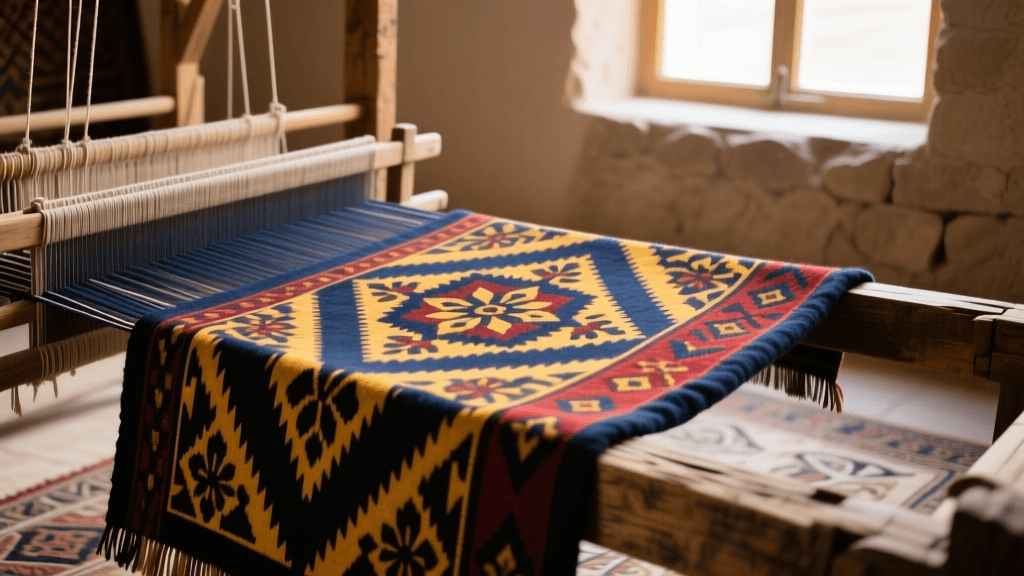
Because the pattern must be dyed into the warp before it is placed on the loom, the weaver must possess an extraordinary mental map of the final design. Traditional Uyghur weavers use narrow, wooden pit looms, which dictate the fabric's dimensions. The weaver throws the shuttle carrying the weft thread (often a solid, contrasting color) back and forth, gradually bringing the blurred, cloud-like patterns of the warp into sharp, albeit soft-edged, focus.
Regional Variations: Hotan, Kashgar, and Turpan
While Atlas silk is produced across southern Xinjiang, regional variations are distinct and highly prized by collectors. Hotan is famous for its traditional black-and-white or deep red-and-black patterns, often favored by older women and considered the most classical. Kashgar Atlas is renowned for its explosive use of color, particularly vibrant yellows, greens, and pinks, reflecting the city's history as a bustling international market. Turpan weavers are noted for their exceptionally fine, tight weaves and more intricate, smaller-scale geometric motifs, adapted to the region's intensely hot climate.
Buyer's Guide: Sourcing Authentic Uyghur Atlas Silk
For textile collectors, fashion designers, and cultural enthusiasts, sourcing authentic Atlas silk requires an understanding of traditional measurements, material compositions, and market pricing. The rise of digital printing has flooded tourist markets with synthetic 'fake' Atlas, making it crucial to know what to look for.
Atlas Silk Classification & Pricing Table
| Fabric Type | Material Composition | Traditional Width | Est. Cost (USD/m) | Primary Use |
|---|---|---|---|---|
| Khan-Atlas | 100% Pure Silk (Warp & Weft) | 40-50 cm (15-19 in) | $40 - $85 | High-end dresses, heirloom garments |
| Adras | Silk Warp, Cotton Weft | 40-50 cm (15-19 in) | $15 - $30 | Everyday wear, skirts, linings |
| Bakhmal | Silk Velvet Ikat | 40-50 cm (15-19 in) | $60 - $120 | Winter coats, ceremonial vests |
| Bekasab | Cotton or Linen Blend | 50-60 cm (19-23 in) | $8 - $15 | Men's robes (Chapan), home textiles |
How to Authenticate and Measure
When purchasing Atlas, keep in mind that traditional pit looms produce narrow fabric, typically between 40 and 50 centimeters (15 to 19 inches) wide. To make a standard women's dress, you will need to purchase at least 4 to 5 meters of fabric and seam the panels together. This narrow width is actually a hallmark of authenticity; mass-produced, digitally printed fakes are usually sold in standard 115 cm or 150 cm widths.
To authenticate the ikat technique, examine the reverse side of the fabric. In genuine warp-faced ikat, the dye penetrates the warp threads, so the pattern will be visible, albeit slightly faded, on the back. Digital prints will show a crisp pattern on the front and a completely blank, white reverse side. Additionally, look for the 'abra'—the slight blurriness at the edges of the motifs. If the lines are razor-sharp, it is likely a modern screen print or digital reproduction.
For the best sourcing experience, visit the Hotan Sunday Bazaar or the Kashgar Old City textile markets. If buying online, seek out vendors certified by the Xinjiang Intangible Cultural Heritage protection offices, expecting to pay a premium for genuine hand-dyed Khan-Atlas.
Styling and Caring for Atlas Garments
Because of its rich history and vibrant dyes, Atlas silk requires specific care to maintain its structural integrity and colorfastness. The Victoria and Albert Museum emphasizes that historic and traditionally dyed ikats are highly sensitive to pH changes and mechanical agitation.
- Washing: Pure Khan-Atlas should strictly be dry-cleaned. Adras (silk-cotton blends) can be hand-washed in cold water (below 20°C or 68°F) using a pH-neutral silk detergent. Never wring or twist the fabric, as this will distort the warp alignment and ruin the pattern.
- Drying: Roll the garment in a clean, dry towel to absorb excess moisture, then lay it flat in the shade. Direct sunlight will rapidly fade the natural dyes, particularly the madder reds and indigo blues.
- Ironing: Iron on the reverse side using a low-heat silk setting. Place a cotton pressing cloth between the iron and the fabric to prevent scorching and to preserve the slight texture of the hand-woven weft.
Preserving a Woven Legacy
Uyghur Atlas silk is far more than a beautiful fabric; it is a woven manuscript of the Silk Road. Every pomegranate motif, every blurred edge of indigo, and every narrow panel tells a story of Persian merchants, Han Chinese silk growers, and Central Asian artisans who met in the oases of the Taklamakan Desert. As highlighted by the UNESCO Silk Roads Programme, preserving these shared cultural heritages is vital for understanding our interconnected history. By learning to identify, source, and care for authentic Atlas silk, collectors and enthusiasts play a direct role in keeping this ancient, cross-cultural craftsmanship alive for future generations.