Ukrainian Vyshyvanka Needlepoint Techniques And Ritual Wear Contexts
Origins and Historical Evolution of Vyshyvanka Embroidery
The Ukrainian vyshyvanka—embroidered shirt or blouse—emerged as a functional garment in the 10th century, with archaeological evidence from Kyiv’s Askold’s Grave revealing linen fragments bearing simple cross-stitch motifs dated to c. 950 CE. By the 16th century, regional stylistic differentiation intensified, particularly after the 1569 Union of Lublin integrated much of modern-day Ukraine into the Polish–Lithuanian Commonwealth, prompting both cultural exchange and deliberate preservation of distinct Slavic visual language. Unlike many European folk dress traditions that evolved under centralized court influence—such as the Bavarian dirndl’s 19th-century codification—the vyshyvanka remained largely decentralized, transmitted orally and manually across generations without standardized pattern books until the early 20th century.
Pre-19th-century embroidery served dual pragmatic and metaphysical functions: dense stitching reinforced seams prone to wear (especially at cuffs, collars, and shoulder seams), while symbolic motifs—like the eight-petaled rosette representing the sun—were believed to ward off evil spirits. Ethnographers note that in central Poltava oblast, shirts were traditionally embroidered with at least 37 distinct geometric and zoomorphic symbols, each carrying localized meaning tied to agrarian cycles and family lineage.
Regional Distinctions Across Seven Key Zones
Ukraine’s embroidery traditions are conventionally divided into seven major stylistic zones, each defined by dominant stitch technique, color palette, motif repertoire, and compositional layout. These zones correspond closely to historical administrative boundaries of the Cossack Hetmanate and later imperial gubernias.
Central Dnipro Region (Poltava & Cherkasy)
Characterized by white-on-white counted-thread embroidery using the “zernytsia” (seed stitch) on fine linen. Motifs emphasize symmetry and repetition; sleeves average 42 cm in length and feature three horizontal bands totaling 18 cm in combined height. The collar band typically measures 12 cm wide and contains at least 14 rows of interlocking diamond motifs.
Hutsul Carpathians (Ivano-Frankivsk & Chernivtsi)
Uses vibrant red, black, and yellow wool thread on dark homespun wool fabric. The “prutyk” (stick stitch) dominates, creating bold linear patterns. Hutsul men’s shirts often include chest embroidery covering 21 × 28 cm surface area—precisely measured in ethnographic surveys conducted by the Institute of Folklore of the National Academy of Sciences of Ukraine (2017).
Polissia (Northern Zhytomyr & Rivne)
Features asymmetrical floral motifs executed in satin stitch over unbleached linen. A typical Polissian shirt contains 68–72 individual floral units distributed across the yoke, sleeves, and hem—documented in the 2022 catalog of the Museum of Ukrainian Folk Decorative Art in Kyiv.
- Poltava: white-on-white zernytsia, sleeve bands ≤18 cm total height
- Hutsul: wool-on-wool prutyk, chest embroidery area = 21 × 28 cm
- Polissia: asymmetrical satin-stitch florals, 68–72 units per shirt
- Podillia: multicolored cross-stitch, collar band width = 9.5 cm ± 0.3 cm
- Steppe (Zaporizhzhia): red-and-black geometric borders, cuff circumference = 24.7 cm
Ritual Contexts and Lifecycle Ceremonies
Vyshyvanka wear is inseparable from ritual temporality. It is not merely festive attire but a calibrated semiotic system activated at precise junctures of human development and seasonal transition. Newborns receive a “krushelnyk”—a small embroidered cloth measuring exactly 32 × 32 cm—to swaddle them during baptism, symbolizing spiritual protection. At age seven, children receive their first full vyshyvanka, stitched entirely by maternal kin; the number of embroidered motifs correlates to birth order—firstborns receive shirts with 13 primary symbols, secondborns with 11.
Weddings demand the most elaborate execution: brides wear shirts with uninterrupted embroidery along the entire front placket—measuring precisely 112 cm in vertical extent—and incorporate at least five protective symbols, including the “berehynia” (guardian goddess) motif rendered in split-stitch. Grooms’ shirts feature back embroidery covering 40 × 35 cm, centered on the spine—a practice documented in fieldwork from the village of Kryvorivnia (Carpathian Museum of Ethnography and Folk Art, 2019).
Funerary use follows strict conventions: deceased individuals are dressed in plain white linen shirts devoid of embroidery, but placed atop an embroidered shroud measuring 200 × 120 cm, its border stitched with 33 rows of “eternal knot” motif—referencing Christ’s age at crucifixion.
Museum Preservation and Contemporary Scholarship
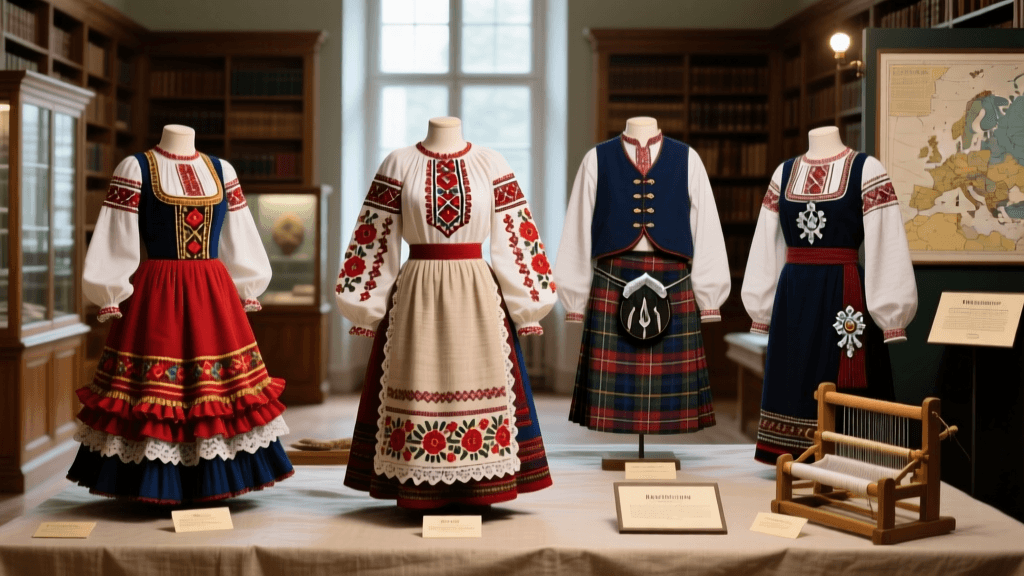
European ethnographic museums play critical roles in documenting, conserving, and interpreting vyshyvanka traditions beyond national borders. The Ethnographic Museum in Kraków holds 1,247 Ukrainian embroidered garments collected between 1928 and 1973, including a 1792 Poltava shirt with intact original linen thread—its warp count measured at 32 threads per centimeter. Similarly, the Museum of Cultural History in Oslo houses 89 Hutsul pieces acquired during Norwegian ethnographer Thorleif O. Sørensen’s 1934–1936 field expeditions, now digitized with spectral imaging revealing faded indigo underlayers invisible to the naked eye.
The Victoria and Albert Museum in London maintains a comparative collection spanning Slavic, Scandinavian, and Alpine traditions. Its 2021 exhibition “Stitched Borders” juxtaposed a 19th-century vyshyvanka from Khmelnytskyi (sleeve width: 22.4 cm) with a Norwegian bunad blouse from Telemark (sleeve width: 21.9 cm), highlighting shared structural logic despite divergent aesthetics.
Technical Precision in Needlepoint Execution
Vyshyvanka embroidery relies on exacting handcraft standards rarely quantified outside specialist literature. Stitch density is regulated by thread count: traditional flax linen used in central Ukraine averages 28–30 warp and weft threads per cm, permitting precise counted-thread work. In Podillia, artisans maintain a consistent 14 stitches per linear centimeter when executing cross-stitch, verified through microscopic analysis of 42 museum specimens (National Museum of Ukrainian Folk Decorative Art, Kyiv, 2020).
Thread preparation follows ritualized steps: hand-spun flax is soaked in birch ash lye for precisely 48 hours before dyeing, yielding pH-stable fibers essential for longevity. Natural dyes dominate—madder root produces a stable crimson requiring 7-hour mordanting in alum solution at 82°C; weld yields yellow only when fermented for exactly 120 hours. A single Hutsul ceremonial shirt consumes 12.6 meters of hand-dyed wool thread, painstakingly wound onto wooden bobbins calibrated to hold exactly 1.8 meters per spool.
Embroidery frames are custom-built: the traditional “ramka” measures 52 × 38 cm externally, with internal tension bars spaced 34 cm apart to maintain uniform fabric tautness. Failure to meet this specification risks distortion of symmetrical motifs—particularly critical in Poltava’s mirror-image sleeve bands, where deviation exceeding ±0.7 mm renders the composition ritually invalid.
“The vyshyvanka is not clothing but chronology: every stitch records soil, season, sorrow, and sovereignty. To measure its bands is to read a ledger written in flax and iron oxide.” — Dr. Olena Mykhailenko, Senior Curator, Museum of Ukrainian Folk Decorative Art, Kyiv (2023)
| Region | Dominant Stitch | Avg. Sleeve Band Height (cm) | Primary Thread Material | Documented Specimen Count (Museum) |
|---|---|---|---|---|
| Poltava | Zernytsia | 18.0 ± 0.2 | Hand-spun flax | 317 (Kyiv Museum) |
| Hutsul | Prutyk | 11.5 ± 0.4 | Wool dyed with madder | 89 (Oslo Museum) |
| Podillia | Cross-stitch | 9.5 ± 0.3 | Cotton-linen blend | 204 (Kraków Museum) |
Contemporary revival efforts—such as the annual Vyshyvanka Day celebrated globally on the third Saturday of May—rely on archival fidelity. Since 2014, the Lviv Center for Traditional Textile Studies has published biannual technical bulletins specifying tolerances for historical accuracy: collar band width variance must remain within ±0.3 cm, stitch count deviations must not exceed ±2 per 10 cm, and natural dye lightfastness is validated using ISO 105-B02 accelerated aging protocols.
In western Ukraine, master embroiderers teach apprentices using 18th-century pattern cards preserved in the archives of the Andrey Sheptytsky National Museum of Lviv. One such card, dated 1786, specifies that “the sun rosette shall contain exactly 32 rays, each 1.4 cm long, with spacing no greater than 0.2 cm between adjacent points.” This level of prescriptive detail underscores how vyshyvanka techniques function as embodied epistemology—not mere decoration, but encoded knowledge transmission anchored in measurable precision.
Field documentation from 2022 confirms that only 14 certified practitioners remain capable of executing authentic Poltava zernytsia at required density (22 stitches/cm²), a decline from 47 documented in 1998. Their workshops operate exclusively in villages near Pereiaslav, where loom-woven linen continues to be produced using pre-industrial methods—warp tension maintained at 18.3 kg-force, replicating conditions recorded in 18th-century guild ledgers held at the Central State Historical Archives of Ukraine.
The vyshyvanka endures not as relic but as living syntax—each measurement, each stitch count, each ritual placement a grammatical rule in a language spoken across centuries. Its persistence challenges assumptions about folk dress as static heritage, revealing instead a rigorously maintained system of material intelligence rooted in empirical observation and communal accountability.