Ukrainian Vyshyvanka Guide 2026: Borshchiv & Poltava
The Resurgence of Eastern European Textile Heritage in 2026
In 2026, the global appreciation for Eastern European folk dress has evolved from a niche historical interest into a vibrant, living fashion movement. At the forefront of this Slavic and Balkan textile renaissance is the Ukrainian Vyshyvanka, a traditional embroidered shirt that serves as both a cultural emblem and a masterclass in ancestral geometry. For collectors, cultural historians, and sustainable fashion enthusiasts, understanding the nuanced differences between regional embroidery styles is no longer optional—it is essential. As mass-produced imitations flood the global market, discerning buyers in 2026 are turning their attention to authentic, hand-loomed, and hand-stitched garments that preserve the sacred codes of Slavic needlework.
This comprehensive guide delves deep into the most revered and technically complex embroidery traditions of Eastern Europe: the striking, protective blackwork of Borshchiv and the ethereal, shadow-play cutwork of Poltava. Whether you are sourcing an heirloom piece for a folk festival, integrating traditional garments into a modern 2026 wardrobe, or simply studying the anthropological significance of Slavic textiles, understanding these regional masterclasses is your first step toward true sartorial authenticity.
Decoding the Vyshyvanka: More Than Just a Garment
The term 'vyshyvanka' translates simply to 'embroidered shirt,' but within the context of Eastern European folk dress, it is a wearable manuscript. Historically, the embroidery was not merely decorative; it was apotropaic, designed to protect the wearer's vulnerable points (the neck, chest, cuffs, and hem) from malevolent spirits. In 2026, contemporary artisans and cultural preservationists continue to honor these ancient placements, ensuring that the spiritual geometry of the garment remains intact even as the silhouettes adapt to modern tailoring.
The Spiritual Geometry of Slavic Stitchery
Unlike the floral, free-form embroidery seen in Western European folk traditions, Slavic and Balkan embroidery is strictly geometric and deeply symbolic. The motifs are built on a grid, reflecting the agrarian calendar, the cycles of the sun, and the connection to the earth. Diamonds represent sown fields and fertility; eight-pointed stars symbolize the sun and cosmic order; and zigzag lines depict water and the boundary between the physical and spiritual realms. According to extensive research on Ukrainian embroidery, the strict adherence to these geometric codes allowed different villages to communicate their regional identity, social status, and marital availability through the very threads of their garments.
Regional Masterclasses: Borshchiv vs. Poltava vs. Hutsul
To build an authentic Eastern European folk wardrobe in 2026, one must be able to distinguish between the major regional schools of embroidery. The contrast between the dark, dense stitches of the Ternopil region and the delicate, monochromatic cutwork of the central steppes represents the incredible diversity of Slavic textile arts.
Borshchiv: The Armor of Black Thread
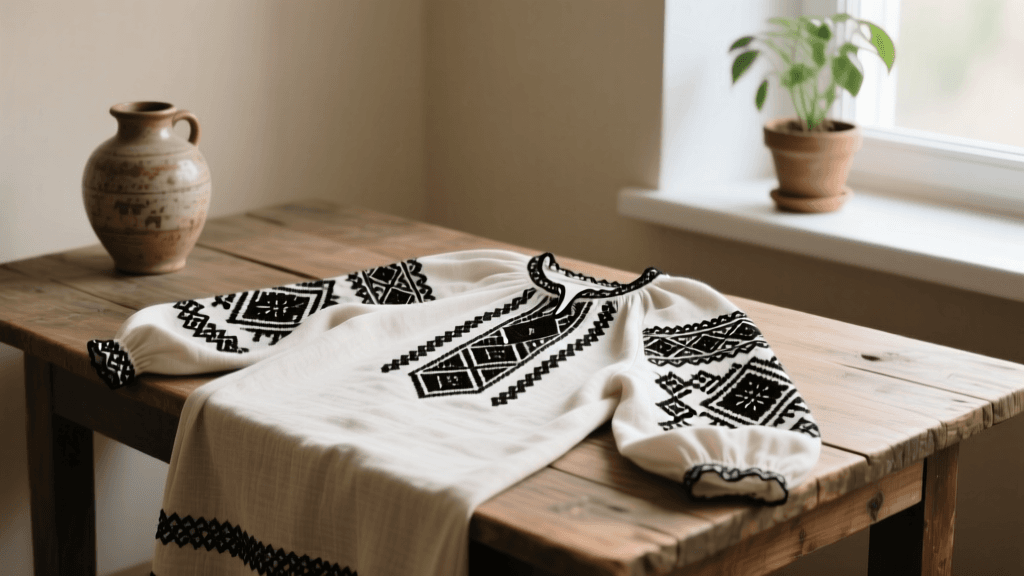
Originating from the Borshchiv region in the Ternopil Oblast, this style is instantly recognizable by its dense, heavy black embroidery on unbleached, raw linen. Legend dictates that the black thread was originally spun from the wool of black sheep, symbolizing mourning, protection, and a deep connection to the fertile, dark earth of the Podillia region. The stitching is incredibly dense, often covering the entire upper bodice and sleeves in a thick, armor-like layer of geometric cross-stitch and 'nyz' (a running stitch worked from the reverse side). In 2026, authentic Borshchiv shirts are highly sought after for their dramatic, avant-garde aesthetic, which pairs remarkably well with contemporary minimalist fashion.
Poltava: The Ethereal White-on-White
In stark contrast, the Poltava region in central Ukraine is famous for its 'white-on-white' embroidery. This technique relies not on color contrast, but on the interplay of light, shadow, and texture. Artisans utilize over 100 different stitches, most notably 'lyshva' (a complex form of cutwork where threads are removed from the linen and the remaining warp and weft are wrapped and woven into intricate openwork patterns). The result is a garment that looks like carved ivory or frost on a windowpane. Poltava vyshyvankas are considered the pinnacle of technical skill and are traditionally worn for major life events, weddings, and high religious holidays.
Hutsul: The Vibrant Carpathian Mosaic
From the Carpathian Mountains comes the Hutsul style, characterized by vibrant, saturated colors—primarily deep reds, bright oranges, and forest greens—often accented with metallic threads or small glass beads. The motifs are heavily influenced by the rugged mountain environment, featuring stylized pine trees, mountain peaks, and solar crosses. Hutsul garments are typically heavier, often woven from wool or thick hemp, designed to withstand the harsh alpine winters.
2026 Regional Embroidery Comparison Chart
| Region | Primary Palette | Key Stitch Technique | Motif Meaning | 2026 Artisan Price Range (USD) |
|---|---|---|---|---|
| Borshchiv (Ternopil) | Black on raw linen | Nyz (reverse running stitch), dense cross-stitch | Earth, protection, mourning, ancestral strength | $350 - $600 |
| Poltava (Central) | White on white | Lyshva (cutwork), Satin stitch, Puncturing | Purity, spiritual light, divine connection | $450 - $850 |
| Hutsul (Carpathian) | Red, Orange, Green, Yellow | Curly stitch, Beadwork, Cross-stitch | Sun, mountain flora, vitality, warding off evil | $250 - $500 |
| Kyiv (Northern) | Red and Black | Zavolikannya (running stitch), Satin stitch | Harvest, bloodline, agrarian cycles | $200 - $400 |
Sourcing Authentic Artisan Pieces in 2026
As the demand for Slavic folk dress has surged globally, the market has been inundated with machine-embroidered replicas produced in fast-fashion factories. While these may mimic the visual aesthetic of a vyshyvanka, they completely lack the structural integrity, the cultural resonance, and the tactile beauty of true hand-stitched garments. For the serious collector or cultural enthusiast in 2026, knowing how to source and verify authentic pieces is paramount.
Identifying True Artisan Work vs. Machine Replicas
The most definitive way to authenticate a hand-embroidered vyshyvanka is to examine the reverse side of the fabric. Machine embroidery relies on a continuous bobbin thread, resulting in a messy, chaotic backside with loose threads and stark color contrasts. Traditional Slavic hand-embroidery, particularly techniques like 'nyz' and 'zavolikannya', is worked in such a way that the reverse side is almost as neat and patterned as the front. In fact, in some Borshchiv traditions, the shirt is worn inside out during times of mourning or danger, making the reverse pattern just as important as the front.
Furthermore, inspect the base fabric. Authentic 2026 artisan pieces utilize hand-loomed or heritage-milled linen and hemp blends. The fabric should have natural slubs (slight irregularities in the yarn) and a distinct, earthy scent. If the fabric is perfectly uniform, overly shiny, or made of a polyester-cotton blend, it is a modern replica.
Where to Buy in 2026
To acquire genuine pieces, buyers should bypass mass-market e-commerce platforms and connect directly with artisan cooperatives and specialized heritage boutiques. Organizations dedicated to the preservation of Eastern European textiles often host annual pop-up exhibitions in major cultural hubs like London, New York, and Berlin. Additionally, direct-to-artisan platforms that verify the geographic origin of the weaver and embroiderer have become the gold standard for ethical sourcing in 2026. Expect to pay a premium; a true hand-embroidered Poltava shirt requires upwards of 300 hours of labor, justifying the $450 to $850 price tag.
Building Your 2026 Slavic Folk Wardrobe: Cost & Care
Integrating a traditional vyshyvanka into a modern wardrobe requires an understanding of both styling and meticulous garment care. The heavy, textured linens and delicate embroidery threads demand specific maintenance to ensure they survive as heirlooms for the next generation.
Styling the Vyshyvanka Today
In 2026, the styling of Eastern European folk dress has moved away from theatrical, costume-like presentations toward subtle, sophisticated integration. A Borshchiv blackwork blouse pairs exceptionally well with tailored, wide-leg wool trousers and minimalist leather footwear, allowing the dense embroidery to serve as the focal point of the outfit. For Poltava white-on-white pieces, layering is key; wearing the sheer, cutwork linen over a high-quality silk camisole or a fine merino turtleneck in the winter highlights the intricate openwork while providing modern comfort. Traditional woven sashes, known as 'pojas' or 'krajka', are being repurposed in 2026 as statement belts over modern outerwear or as elegant ties for wide-brimmed hats.
Washing and Preserving Heirloom Linens
The care of hand-embroidered linen is non-negotiable. Never machine wash or dry clean a traditional vyshyvanka. The harsh chemicals in dry cleaning can dissolve the natural oils in heritage linen, making it brittle, while the agitation of a washing machine can distort the geometric grid of the embroidery.
- Washing: Hand wash in cool water (never exceeding 30°C or 86°F) using a pH-neutral, eco-friendly detergent specifically formulated for delicate natural fibers.
- Drying: Never wring or twist the fabric. Gently press the water out by rolling the garment in a clean, dry cotton towel. Lay flat to dry in the shade. Direct sunlight will cause unbleached linen to yellow unevenly and can fade natural plant dyes used in Hutsul embroidery.
- Ironing: Iron the garment while it is still slightly damp. Always iron on the reverse side, placing a clean cotton pressing cloth between the iron and the embroidery to prevent crushing the three-dimensional texture of the stitches, particularly the raised satin stitches and cutwork.
- Storage: Store folded in acid-free tissue paper inside a breathable cotton bag. Avoid plastic bins, which trap moisture and promote mildew, and never hang heavy, embroidered linen for long periods, as the weight of the wet or heavy thread can distort the shoulder seams over time.
Conclusion: Wearing History with Intention
The Slavic and Balkan folk dress revival of 2026 is a testament to the enduring power of textile heritage. By choosing to invest in authentic, region-specific garments like the Borshchiv blackwork or Poltava cutwork vyshyvanka, you are not merely purchasing a piece of clothing; you are participating in the preservation of an ancient, coded language. As the global fashion industry continues to grapple with sustainability and meaning, the slow, intentional, and deeply spiritual craft of Eastern European embroidery offers a profound alternative—a way to wear history, honor the hands that made it, and carry the protective geometry of the ancestors into the modern world.