14th-Century Cotehardie Construction: 2026 Tailoring Guide
The Evolution of the Fitted Silhouette in Medieval Europe
The transition from the loose, flowing tunics of the 13th century to the highly structured, fitted garments of the 14th century marks one of the most significant revolutions in European fashion history. At the forefront of this sartorial shift was the cotehardie, a close-fitting, buttoned garment worn by both men and women across various social strata. As we navigate the historical tailoring landscape in 2026, the demand for museum-quality reenactment garments and historically accurate European folk dress has never been higher. Modern makers, historical reenactors, and costume historians are increasingly rejecting synthetic shortcuts in favor of authentic, hand-finished textiles and period-accurate construction methods.
Unlike earlier garments that relied on draping and belting to create shape, the cotehardie achieved its silhouette through complex tailoring, curved seams, and the strategic placement of triangular gores. For the contemporary tailor looking to recreate this iconic medieval garment, understanding the intersection of historical evidence and modern textile availability is paramount. This comprehensive guide will walk you through sourcing authentic materials, drafting the pattern, and executing the hand-sewing techniques required to build a flawless 14th-century cotehardie in 2026.
Sourcing Authentic Textiles in 2026
The foundation of any historically accurate medieval garment lies in its fabric. The 14th-century European textile trade was dominated by wool and linen, with silk reserved for the highest echelons of nobility or for specific trims. When sourcing materials today, the goal is to replicate the weight, weave, and drape of medieval broadcloth and worsted wools.
The Outer Layer: Wool Twill and Broadcloth
The cotehardie was almost exclusively crafted from wool. Medieval woolens were heavily fulled (milled) to create a dense, weather-resistant fabric that did not fray easily when cut. In 2026, heritage weaving mills in the United Kingdom and Italy have responded to the growing historical reenactment market by producing specialized 'medieval broadcloth' runs. When selecting your wool, look for a 2/2 twill weave or a heavily fulled plain weave. The fabric should have a high wool content (ideally 100% virgin wool) and a weight of 350 to 500 grams per square meter. Avoid modern worsted suit wools, as they are too thin, too smooth, and lack the structural integrity required for a supportive, fitted bodice.
The Foundation: Linen Chemises
Beneath the wool cotehardie, a linen chemise or braies served as the foundational layer, protecting the expensive wool from body oils and sweat. For the undergarments, you must source unbleached or naturally bleached linen in a tabby (plain) weave. Medium-weight linen (approximately 180 to 220 gsm) is ideal for the chemise. In 2026, Eastern European and Baltic linen mills remain the most reliable sources for high-quality, long-staple flax linens that closely mimic the hand-spun, hand-woven textiles of the Middle Ages.
2026 Supplier Comparison Chart for Historical Textiles
Finding reliable, historically accurate textiles can be challenging. Below is a curated comparison of top-tier suppliers currently serving the historical tailoring community in 2026, complete with current pricing estimates and specialty offerings.
| Supplier Name | Location | Specialty Textile | 2026 Est. Price/Meter | Best Application |
|---|---|---|---|---|
| Diamond Twill Heritage Weavers | Yorkshire, UK | Fulled Wool Broadcloth (2/2 Twill) | £45 - £60 | Outer Cotehardie, Houpelandes |
| Ulster Linen Collective | Northern Ireland | Unbleached Heavy Tabby Linen | €22 - €30 | Chemises, Braies, Linings |
| Biella Historical Mill | Piedmont, Italy | Melton Wool (Heavily Milled) | €55 - €75 | High-Status Garments, Winter Wear |
| Baltic Flax Traditions | Lithuania | Hand-Spun Look Linen | €18 - €25 | Peasant-class Undergarments |
Pattern Drafting and Measurements
Drafting a cotehardie pattern requires a departure from modern block slopers. The 14th-century silhouette relies on curved side seams and center back seams to accommodate the natural curvature of the spine and the bust or chest. To begin, take precise measurements: chest, waist, hips, shoulder width, upper arm, wrist, and the crucial waist-to-floor measurement.
The body of the cotehardie is typically constructed from four main panels (two front, two back) with gores inserted into the side seams or directly into the skirt panels to provide the necessary flare for movement. According to extensive research on surviving garments, such as the famous Herjolfsnes finds in Greenland, gores were not merely decorative but essential for conserving fabric while maximizing mobility. For a modern maker, drafting the pattern on muslin first is highly recommended. Pin the muslin directly onto the wearer, smoothing the fabric over the torso and carving out the armholes and side curves until a snug, supportive fit is achieved without restricting breathing.
Tailoring Techniques: Gores and Set-In Sleeves
Once your pattern is finalized and your wool is cut, the assembly begins. The insertion of gores (godets) is a hallmark of medieval tailoring. To insert a gore into a slashed panel, mark the apex of the slash and sew the gore in with a precise backstitch, ensuring the seam allowance is clipped at the apex to allow the fabric to lay flat. In 2026, historical tailoring experts emphasize the use of a 'stab stitch' for finishing hems and edges on heavy wool, as it provides a nearly invisible finish on the right side of the garment while securing the hem allowance firmly.
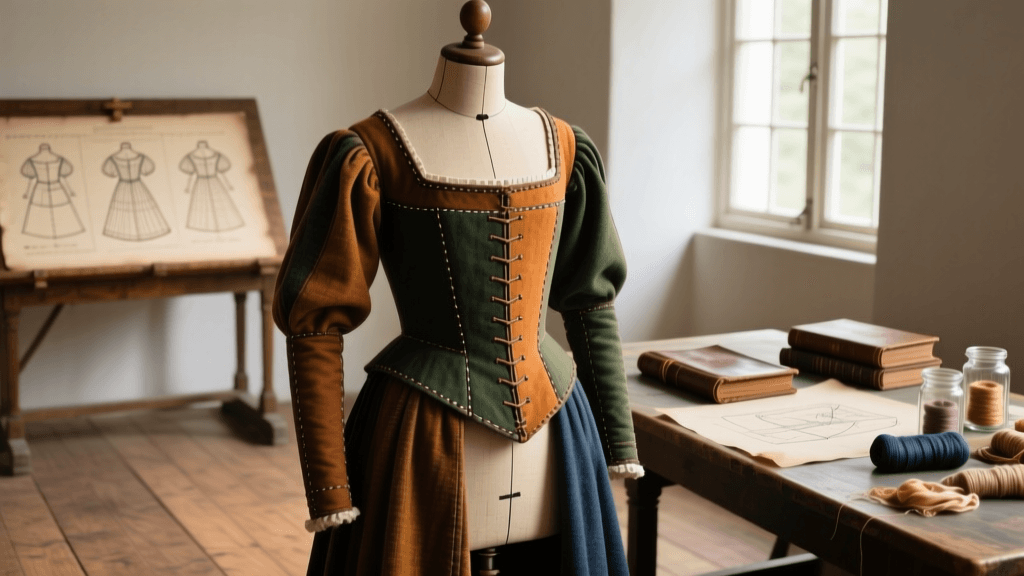
The sleeves of the cotehardie represent another major technological leap in medieval clothing: the set-in sleeve with a curved sleeve cap and a shaped elbow. Unlike earlier garments where the sleeve and body were cut from a single piece of fabric (the T-tunic style), the cotehardie sleeve was tailored separately and eased into a rounded armhole. This allowed for a tight fit down the arm while maintaining mobility at the shoulder. The lower arm was often fitted so tightly that it had to be buttoned from the elbow to the wrist, a detail that brings us to the most revolutionary fastening of the era.
The Revolution of Fastenings: Cloth Buttons
The 14th century saw the widespread adoption of the button, transforming European fashion forever. While metal buttons existed, cloth buttons were the standard for the cotehardie, allowing for the skin-tight fit that defined the era's silhouette. Making authentic cloth buttons is a meticulous but rewarding process. You will need to cut small circles of your fashion fabric, gather the edges with a strong linen thread, and stuff the center with scraps of the same wool or raw cotton. The resulting sphere is then secured with a complex web of stitching, creating a durable, period-accurate fastener.
For the buttonholes, avoid modern machine-stitched methods. Historical buttonholes were worked in thick silk or linen thread using a specialized buttonhole stitch that creates a raised, durable edge capable of withstanding the immense tension of a fitted bodice. Studying primary sources is vital for mastering these details. Institutions like the Europeana digital cultural heritage archives provide invaluable high-resolution scans of 14th-century manuscripts, such as the Luttrell Psalter, which clearly depict the tight buttoning and tailoring lines of the cotehardie on both noble and working-class figures.
Seam Finishes and Historical Accuracy
How you finish the inside of the garment is just as important as the outside, especially for high-end reenactment and living history. While raw edges were sometimes left unfinished on heavily fulled wools that did not fray, linen undergarments and lighter wools required seam finishing. The flat-felled seam and the overcast stitch were widely used. To execute a historical overcast stitch, use a fine, waxed linen thread and wrap it tightly over the raw edge of the seam allowance in a spiral motion. This technique, extensively documented by the Textile Research Centre in their digital exhibitions on historical sewing techniques, prevents fraying and adds structural rigidity to the seams.
Furthermore, lining the bodice of the cotehardie with linen was a common practice for higher-status garments. This not only protected the wool but also added an extra layer of stiffness to support the fitted silhouette. When attaching the lining, use a fell stitch to secure it to the seam allowances, ensuring it does not pull or pucker the outer wool layer.
Conclusion: Embracing the Medieval Maker Movement
Constructing a 14th-century cotehardie in 2026 is more than just a sewing project; it is an act of historical preservation and tactile archaeology. By investing time in sourcing authentic heritage wools and linens, mastering the geometry of gores and set-in sleeves, and hand-stitching period-accurate cloth buttons, you bridge the gap between the modern world and the master tailors of the Middle Ages. Whether you are preparing for a high-level historical reenactment event, contributing to a museum exhibit, or simply expanding your traditional tailoring skills, the cotehardie remains a testament to the ingenuity and artistry of European folk dress. Equip yourself with the right materials, respect the historical techniques, and let the rich textile traditions of the 14th century guide your needle.