Drafting the Ukrainian Sorochka: Zero-Waste Patterns 2026
The Geometry of Tradition: Understanding the Sorochka
In the contemporary fashion landscape of 2026, the intersection of ancestral wisdom and modern sustainability has never been more relevant. As the global push for circular design accelerates, historical garment construction offers a masterclass in efficiency. The traditional Ukrainian sorochka (a foundational linen shirt worn by both men and women across various regions of Ukraine) stands as a pinnacle of zero-waste pattern drafting. Unlike Western European tailoring, which evolved to sculpt the body using curved armholes, princess seams, and darts that inevitably generate textile waste, Eastern European folk dress relies entirely on the natural geometry of the loom.
Historically, linen was an incredibly labor-intensive crop. From sowing flax seeds to retting, scutching, and spinning, every inch of yarn was precious. Therefore, the cutting layout of a sorochka was designed to utilize 100% of the woven fabric. According to the Encyclopedia of Ukraine, the traditional shirt was constructed using straight lines, rectangles, squares, and triangles, ensuring that not a single scrap of hand-woven linen was discarded. Today, as documented by the Ellen MacArthur Foundation, modern zero-waste design principles are actively looking back at these historical methodologies to solve the textile waste crisis of the 2020s.
Essential Materials and 2026 Sourcing
To construct an authentic sorochka, the choice of fabric is paramount. The garment requires a medium-weight, 100% European flax linen, typically ranging from 150 to 190 grams per square meter (GSM). In 2026, the market for heritage textiles has stabilized, but authentic hand-loomed linen from Eastern European cooperatives commands a premium, generally costing between $45 and $75 per yard. Mill-woven linen from established European mills (such as those in Lithuania or Belarus) offers a more accessible alternative, averaging $25 to $35 per yard.
When purchasing fabric for a zero-waste project, you must buy based on the width of the bolt. Traditional narrow looms produced fabric roughly 18 to 24 inches wide, requiring specific seaming techniques. Modern commercial linen is usually 54 to 60 inches wide. For this guide, we will adapt the historical zero-waste layout to a standard 45-inch wide linen bolt, which is the most common width available from textile merchants in 2026.
Step-by-Step Zero-Waste Pattern Drafting
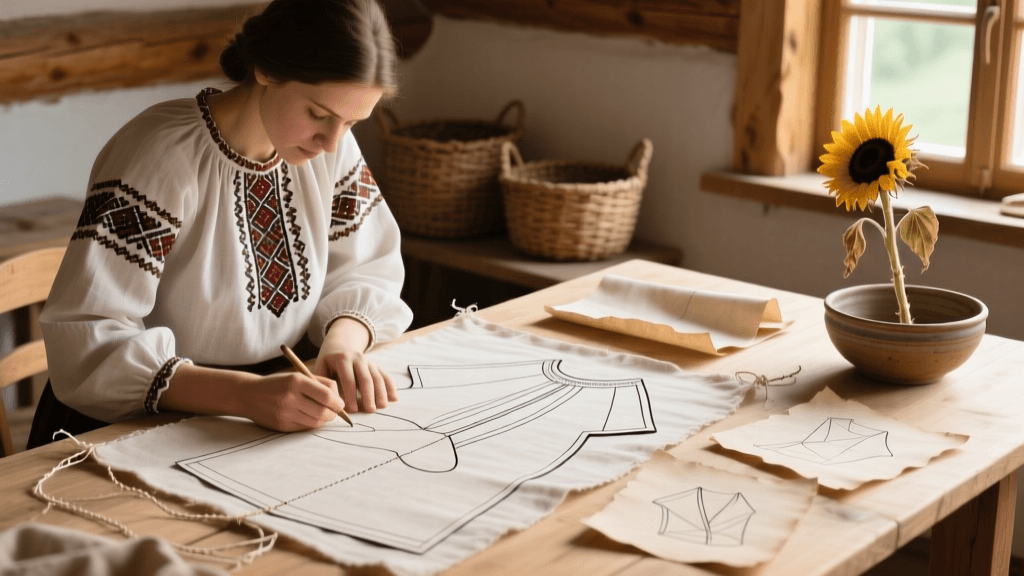
The brilliance of the sorochka lies in its modularity. The pattern consists of large rectangular panels for the body and sleeves, small square gussets for mobility, and narrow strips for bindings. Because there are no curved lines, the fabric can be cut entirely by measuring and tearing along the grainline, ensuring perfect structural integrity and zero off-cuts.
Fabric Yield and Measurement Chart
The following table outlines the cutting layout for a standard adult medium sorochka, utilizing a 45-inch wide bolt of linen. This layout assumes a total garment length of approximately 30 inches and a sleeve length of 24 inches.
| Pattern Piece | Quantity | Dimensions (Inches) | Grainline & Notes |
|---|---|---|---|
| Main Body Panel | 1 (Folded) | 45 x 60 | Selvedge to selvedge, folded at the shoulder line to create the front and back. |
| Sleeve | 2 | 45 x 24 | Cut parallel to the selvedge. The 45-inch width provides the necessary volume for traditional gathering. |
| Underarm Gusset (Lastka) | 2 | 6 x 6 | Cut from the leftover sleeve width. Can be cut on the straight grain or bias for stretch. |
| Neckline Binding / Collar | 1 | 3 x 18 | Cut parallel to the selvedge for maximum stability and resistance to stretching. |
| Cuff Bindings | 2 | 2 x 12 | Cut parallel to the selvedge. |
By calculating the cuts in this specific order, the 45-inch width of the fabric is entirely consumed. The 21 inches remaining from the 45-inch sleeve cut (after removing the 24-inch length from a 45-inch width segment) is perfectly divided to yield the two 6x6 gussets, the collar, and the cuff bindings. This mathematical harmony is the hallmark of Eastern European folk geometry.
Assembly and Insertion Techniques
Constructing the sorochka requires specific hand-sewing or machine techniques that honor the fabric's grain and ensure longevity. In 2026, many makers utilize a hybrid approach: sewing the primary structural seams on a modern straight-stitch machine while finishing the edges and gathering by hand.
- The Shoulder Fold: The main body panel is folded in half width-wise. A horizontal slit is cut at the exact center of the fold to create the neckline. This eliminates the need for a shoulder seam, distributing the garment's weight evenly across the wearer's back and chest.
- Flat-Felled Seams: Because linen frays easily, all internal side seams and sleeve seams are finished using flat-felled seams. This involves sewing the pieces wrong sides together, trimming one seam allowance, folding the longer allowance over the shorter one, and stitching it flat. This creates a clean, durable interior without the need for modern sergers.
- Inserting the Gusset (Lastka): This is the most complex step in Slavic shirt-making. The side seam of the body and the underarm seam of the sleeve are left open at the top. The 6x6 square gusset is inserted into this intersection, acting as a pivotal hinge that allows the wearer to raise their arms without pulling the entire body of the shirt upward. Pinning the gusset requires precise pivoting at the inner corners to prevent puckering.
- Whip-Gathering: The 45-inch width of the sleeve must be reduced to fit the 12-inch cuff and the armhole. Traditional makers use a whipstitch along the raw edge, pulling the thread tight to create dense, cartridge-like pleats. This technique not only gathers the fabric but simultaneously finishes the raw edge, preventing fraying.
Embroidery Integration and Structural Zones
The zero-waste pattern of the sorochka is intrinsically linked to its decorative elements. Embroidery in Ukrainian folk dress was never merely ornamental; it served as a structural reinforcement and a talismanic boundary protecting the wearer's vulnerable points (neck, wrists, and hem). The rectangular pattern pieces provide a stable, predictable grid for counting threads, which is essential for traditional cross-stitch and zavolikannya (woven darning) techniques.
The ustavka (the upper rectangular section of the sleeve or the shoulder insert) is the primary canvas for regional embroidery. Because the sleeve is cut as a simple rectangle, the embroiderer can hoop the flat piece and work the intricate geometric motifs before the garment is assembled. In regions like Poltava, the embroidery relies on delicate white-on-white cutwork and satin stitch, while Hutsul regions favor dense, vibrant geometric patterns in red, black, and yellow. The straight-grain cutting method ensures that the embroidery grid aligns perfectly with the structural seams of the garment.
Tools Required for the Modern Maker
To execute this project to historical standards in 2026, specific tools are recommended beyond a basic sewing kit:
- Linen Thread: Use 100% long-staple linen thread (such as 35/2 or 50/2 weight) for all structural seams and gathering. Cotton thread will degrade faster than the linen fabric itself.
- Beeswax: Running linen thread through a block of pure beeswax before sewing prevents tangling and reduces friction, a vital step when hand-whipping gathers.
- Bone Folder or Agate Smoother: Used to press flat-felled seams open and crisp before the final topstitching, reducing the need for high-heat ironing which can sometimes scorch delicate open-weave linens.
- Thread Counter / Linen Tester: A small magnifying loupe with a measurement grid, essential for verifying the thread count of your linen before beginning counted-thread embroidery.
Modern Revival and Sustainable Tailoring
The study of historical garments, such as those preserved in the Victoria and Albert Museum Textiles Collection, reveals that our ancestors were the original sustainable designers. The sorochka was designed to be easily repaired, completely biodegradable, and entirely devoid of waste. When the garment eventually wore out, the un-embroidered linen was repurposed into household linens, bandages, or even paper pulp.
As we navigate the environmental challenges of 2026, drafting and sewing a traditional Ukrainian sorochka is more than an exercise in historical costuming. It is a radical act of sustainable creation. By adopting the zero-waste geometry of Eastern European folk dress, modern sewists and fashion designers can reconnect with the intrinsic value of textiles, honoring the labor of the past while actively participating in the circular fashion economy of the future. Whether you are hand-stitching every seam or adapting the geometry for a contemporary linen collection, the mathematical elegance of the sorochka remains a timeless blueprint for conscious design.