Authentic Ukrainian Namysto Coral & Vinok Wreath Guide 2026
The Resurgence of Ukrainian Folk Accessories in 2026
The global appreciation for Eastern European folk dress has evolved significantly over the past decade, moving beyond simple costume replication into a deep, respectful revival of heritage craftsmanship. In 2026, the integration of traditional Ukrainian accessories into both heritage festival attire and contemporary fashion-forward wardrobes has reached new heights. While the vyshyvanka (embroidered shirt) serves as the foundational canvas of Ukrainian folk dress, the true narrative of a regional outfit is articulated through its jewelry and headwear. Specifically, the namysto (beaded necklaces) and the vinok (traditional floral wreath) are not merely decorative; they are complex semiotic systems that historically conveyed a woman's age, marital status, regional origin, and family wealth. According to the Encyclopedia of Ukraine, these accessories were integral to the spiritual and social fabric of village life, serving as protective talismans and markers of identity. Today, understanding how to ethically source, accurately construct, and properly style these pieces is essential for any serious practitioner of European folk dress.
Namysto: The Art of Coral, Amber, and Glass Beadwork
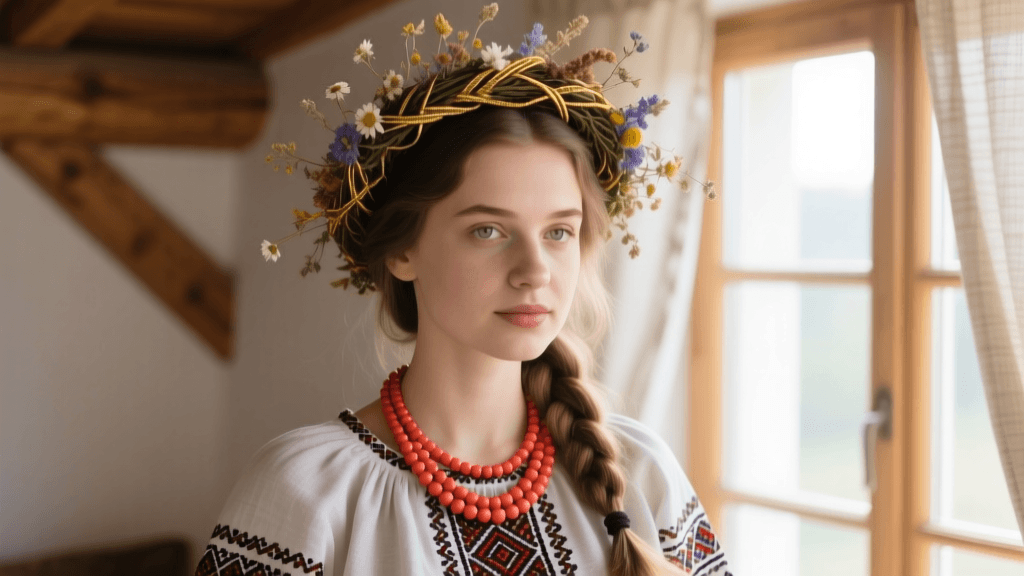
The term namysto translates broadly to beads or necklaces, but in the context of traditional Ukrainian dress, it most famously refers to strands of red coral. Historically, red coral was the most prized and expensive material available to Ukrainian women. Because it had to be imported from the Mediterranean or the Red Sea via complex trade routes, it was a direct indicator of a family's financial standing. A wealthy woman in the 19th century might wear ten to fifteen strands of thick coral beads, while a woman of more modest means might wear just one or two, or substitute coral with locally sourced amber, river pearls, or colorful Venetian glass.
Sourcing Authentic Materials and 2026 Market Pricing
Navigating the market for authentic folk jewelry in 2026 requires a keen eye and an understanding of international conservation laws. Genuine Mediterranean red coral (Corallium rubrum) is now heavily restricted due to strict CITES regulations aimed at protecting marine ecosystems. As a result, antique coral strands have become highly sought-after collector's items, with authenticated 19th-century strands fetching between $400 and $1,200 at specialized Eastern European auctions.
For modern revivalists seeking the authentic look without the ecological or financial burden, 2026 has seen a massive surge in high-quality, sustainable alternatives. Artisans are now utilizing sustainably harvested bamboo coral, which is naturally white but takes on a brilliant, permanent crimson hue when dyed with natural madder root or eco-friendly synthetic dyes. A high-quality strand of dyed bamboo coral typically costs between $40 and $80. Additionally, Baltic amber (burshtyn) remains a staple of Ukrainian jewelry. Raw, unpolished 'butterscotch' amber strands, sourced directly from certified Lithuanian and Ukrainian artisans, currently retail for $150 to $300, offering a warm, historically accurate alternative to coral.
The Vinok: Constructing the Traditional Wreath Headwear
The vinok is perhaps the most iconic symbol of Ukrainian maidenhood. Historically worn exclusively by unmarried girls and young women, the wreath is a masterpiece of botanical symbolism and color theory. Research supported by the Harvard Ukrainian Research Institute highlights that the vinok was believed to protect the wearer's hair—the traditional seat of a woman's spiritual power—from evil eyes and malevolent spirits. A proper traditional vinok is not a random assortment of field flowers; it is a highly structured composition that traditionally incorporates up to twelve specific types of flowers, each carrying its own meaning.
Floral Symbolism and Ribbon Mechanics
When constructing a historically accurate vinok for 2026 folk dress events, the selection of flora is paramount. The twelve traditional flowers include yarrow (for resilience), immortelle (for health), cornflower (for simplicity and beauty), daisy (for innocence), cherry blossoms (for motherly love), and sunflowers (for strength). Today, while fresh flowers are still used for midsummer Ivan Kupala celebrations, most revivalists opt for high-grade silk or preserved botanical elements to ensure the wreath survives multiple festival seasons.
Equally important to the flowers are the stuzhky (ribbons) that trail down the back. The ribbons must be exactly as long as the wearer's hair, typically reaching the shoulder blades. The color sequence of the ribbons is strictly codified:
- Light Brown: The first ribbon, tied closest to the center, symbolizes the earth and the soil that feeds the people.
- Yellow: Representing the sun and the wheat fields.
- Green: Symbolizing youth, beauty, and the untamed forest.
- Light Blue: Representing the sky and the pure waters of the Dnipro River.
- Orange and Pink: Added for vitality, health, and joy.
Measuring and Fitting Your Vinok
A poorly fitted vinok will slip during traditional dances like the hopak or arakan. To ensure a secure fit in 2026, follow these precise construction steps:
- Measure the circumference of the head exactly where the wreath will sit (usually just above the eyebrows and over the occipital bone).
- Add exactly one inch (2.5 cm) to this measurement to allow for comfort and the thickness of the hair.
- Cut a piece of 18-gauge floral wire to this length, leaving an extra two inches on each end to form adjustable loops.
- Wrap the wire tightly in green floral tape to prevent the metal from catching on delicate hair strands.
- Secure the trailing ribbons to the back loops using strong linen thread, ensuring they are evenly spaced and hang flat.
Regional Styling Guide: Pairing Accessories with the Vyshyvanka
Ukraine is vast, and its ethnographic regions boast wildly different aesthetic traditions. Pairing a Hutsul wreath with a Poltava shirt is a common mistake made by beginners in European folk dress. Below is a comprehensive 2026 styling matrix to ensure your accessories perfectly match your regional garment.
| Region | Headwear Style (Vinok) | Jewelry Focus (Namysto) | Vyshyvanka Pairing |
|---|---|---|---|
| Hutsulshchyna | Tall, voluminous wreath incorporating peacock feathers and metallic tinsel. | Gerdan (wide beaded collar) and Zgarda (heavy brass coin necklaces). | Dark wool garments with dense, geometric cross-stitch in yellow, green, and black. |
| Poltava | Delicate, low-profile wreath featuring subtle wildflowers and pale ribbons. | A single, thick strand of genuine red coral or polished river pearls. | Famous white-on-white cutwork embroidery (broderie anglaise) on fine linen. |
| Bukovyna | Wreath heavily adorned with glass beads, small mirrors, and bright silk threads. | Layered Venetian glass beads and heavy brass chains with coin pendants. | Black and red geometric embroidery, often featuring smocking techniques on the cuffs. |
| Kyiv Region | Standard 12-flower botanical wreath with vibrant, multi-colored trailing ribbons. | A balanced mix of raw Baltic amber and dyed coral strands. | Red and black floral vine embroidery, utilizing the zavolikannya (running stitch) technique. |
Care, Maintenance, and Ethical Storage
Heritage accessories require meticulous care to survive for future generations. Both amber and coral are relatively soft, organic materials. Amber ranks only a 2 to 2.5 on the Mohs hardness scale, meaning it can be easily scratched by metal zippers or harsh synthetic fabrics. Coral is highly porous; it will absorb perfumes, hairsprays, and natural skin oils, which can cause it to lose its vibrant luster and turn a dull, chalky white over time. Always put your namysto on after applying cosmetics and fragrances, and wipe the beads gently with a soft, damp microfiber cloth after every wear.
Silk ribbons used in the vinok are highly susceptible to UV degradation. Prolonged exposure to direct sunlight during outdoor summer festivals will cause the natural dyes to fade rapidly. When storing your vinok and namysto between seasons, never hang the wreath by its ribbons, as this will stretch and distort the fabric. Instead, stuff the center of the wreath with acid-free archival tissue paper to maintain its circular tension, and lay it flat in a dark, climate-controlled archival box. By respecting the materials and the profound cultural history embedded in these pieces, we ensure that the vibrant legacy of Ukrainian folk dress continues to thrive and inspire throughout 2026 and beyond.