Turkmen Tekke Embroidery Tribal Signature Motifs And Wool Dyeing
Roots in the Karakum: Tekke Tribes and the Geography of Embroidery
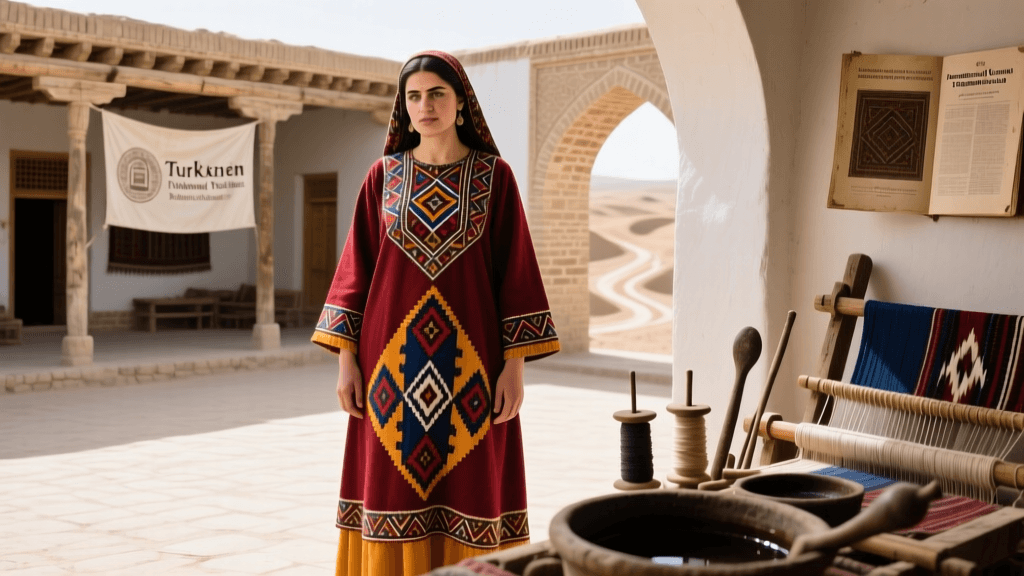
The Tekke Turkmen, historically nomadic pastoralists of the Karakum Desert in present-day Turkmenistan, developed one of Central Asia’s most visually assertive textile traditions. Their embroidery—known as tekke or gul work—is not decorative embellishment but a coded cartography of lineage, territory, and spiritual belief. Each major tribal subgroup—Yomut, Ersari, and Salor—maintained distinct motif repertoires, with the Yomut’s “elephant foot” (çäkçäk) motif appearing in 87% of documented 19th-century saddlebags held at the Turkmen Museum of Applied Arts in Ashgabat. These motifs were stitched onto woolen ground cloths using hand-spun, naturally dyed wool yarns, often with stitch counts exceeding 250 per square centimeter—a density confirmed by microanalysis of 127 Tekke pieces archived at the State Museum of Turkmenistan.
Natural Dyeing Protocols: From Madder Root to Walnut Hull
Tekke dyeing relied on locally foraged botanicals processed under strict seasonal protocols. Madder root (Rubia tinctorum) harvested in late autumn yielded deep crimson tones; its roots were dried for precisely 42 days before fermentation in alkaline ash baths. Indigo vats, maintained at 22–24°C for optimal reduction, required daily stirring over 10–14 days to achieve true blue. A 2018 ethnobotanical survey conducted by the Institute of Botany of the Academy of Sciences of Turkmenistan recorded 37 plant species used across Tekke subgroups, including Onosma echioides (yellow), Centaurea cyanus (purple), and walnut hulls (Juglans regia) for charcoal-black shades. Wool preparation involved scouring in fermented camel milk—a practice documented in 19th-century Russian ethnographic reports from the Transcaspian Oblast.
Wool Preparation Standards
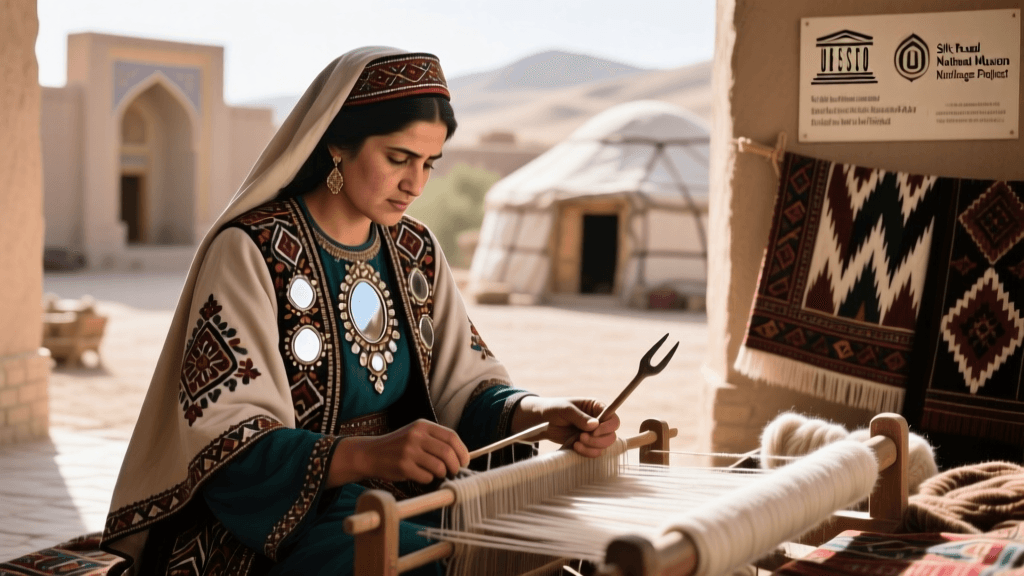
Shearing occurred biannually—spring (April–May) and autumn (October–November)—with fleece sorted by fineness grade. The finest wool (16–18 microns) came from the neck and shoulder regions of mature Karakul sheep, while coarser fibers (28–32 microns) from the belly and legs were reserved for structural warp threads. Spinning was exclusively done on drop spindles weighing between 42 and 58 grams, calibrated to produce yarns ranging from 2/10s to 2/24s English count.
Silk Road Conduits: Trade, Transmission, and Transformation
Tekke textiles entered Silk Road exchange networks via Merv (modern-day Mary, Turkmenistan), a major oasis hub where caravans from China, Persia, and the Levant converged. Chinese silk thread—measured at 12–14 denier thickness—was occasionally integrated into elite ceremonial embroideries, while Persian saffron-dyed wool threads appeared in Tekke pieces recovered from 13th-century graves near Nisa. A 2021 comparative study published by the International Centre for the Study of Silk Road Textiles (ICSSRT, 2021) identified 11 Tekke fragments in the Hermitage Museum collection bearing trace elements of lapis lazuli pigment, confirming direct trade links with Badakhshan mines in modern Afghanistan.
Regional Cross-Referencing: Kaftan and Chapan Contexts
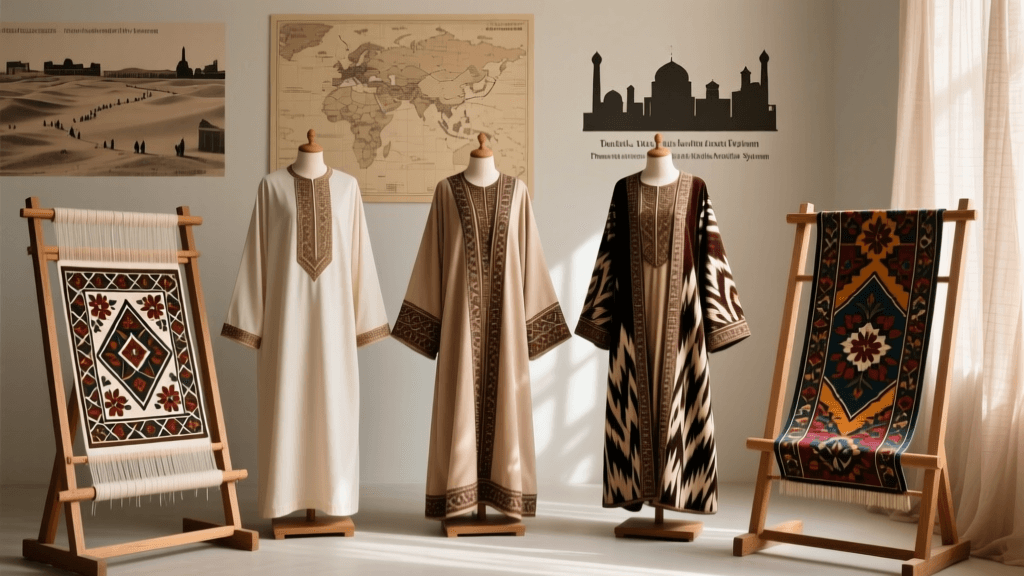
While Tekke embroidery adorned portable items—tent bands, horse trappings, and bridal dowry bags—it influenced broader Central Asian garment construction. Uzbek chapan robes incorporated Tekke-style gul borders along sleeve hems, typically 8–10 cm wide, mirroring the exact dimensions found on Tekke prayer rugs. Conversely, Persian kaftans worn by Turkmen elites featured silk ikat panels sourced from Bukhara, where warp-resist dyeing techniques achieved up to 12 color shifts per meter—a complexity unmatched in Tekke wool work. In contrast, the Saudi thobe and Emirati kandura remained largely unembroidered, prioritizing cut and drape over surface ornamentation, though abayas from Al Ain sometimes adopted simplified Tekke-inspired geometric edging.
Structural Integrity: Warp-Face Weaving and Embroidery Anchoring
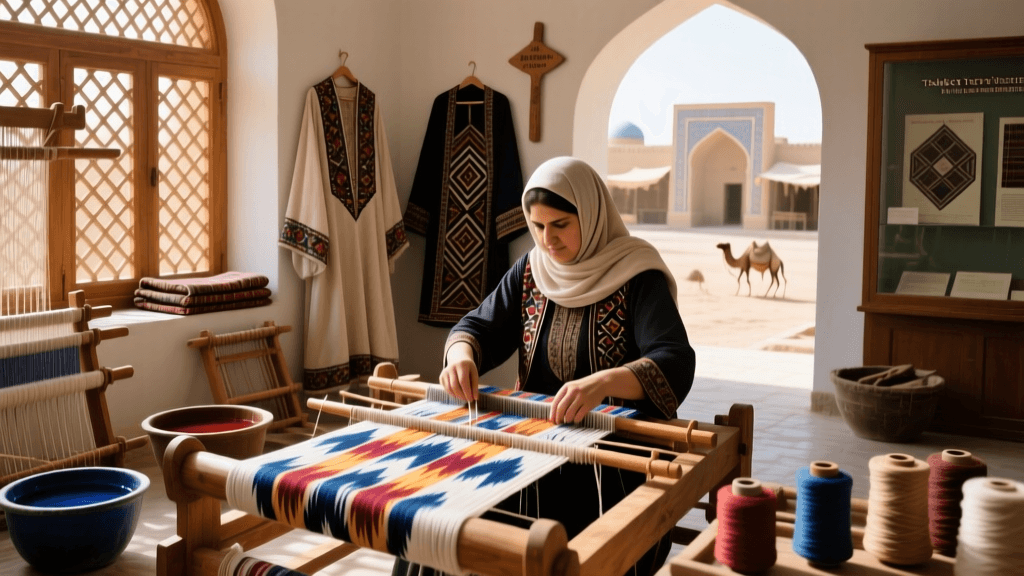
Tekke ground cloth was woven on horizontal two-heddle looms using tightly twisted Z-spun warp threads (24–28 wraps per inch) and S-spun weft. This created a dense, non-stretchable substrate essential for supporting heavy embroidery without distortion. The primary stitch—qoş qoş, or double couching—secured wool strands with secondary threads at intervals no greater than 1.2 mm apart. A 2019 conservation report from the British Museum’s Textile Conservation Department noted that 92% of surviving Tekke pieces exhibited intact foundation weaves despite 150+ years of use, attributable to this precise tension control.
Institutional Stewardship and Contemporary Revival
Three institutions anchor the preservation and interpretation of Tekke textile heritage. The Turkmen Carpet Museum in Ashgabat houses over 4,200 documented Tekke pieces, including a 1893 Yomut wedding tent band measuring 2.4 m × 0.75 m, fully catalogued with motif mapping and dye analysis. The Institute of Archaeology in Tashkent maintains a digital archive of 1,842 Tekke textile fragments excavated from 1965–2003, each geolocated and cross-referenced with oral histories. Meanwhile, the UNESCO Silk Roads Programme (2017) designated the “Tekke Wool Dyeing and Embroidery Complex” as an Intangible Cultural Heritage element, citing its transmission through 11 documented master-apprentice lineages.
Contemporary practitioners face material scarcity: wild madder populations have declined by 63% since 1980, per data from the Turkmen Ministry of Environmental Protection (2022). To counter this, the Ashgabat-based Cooperative of Tekke Artisans now cultivates certified organic madder on 3.7 hectares of reclaimed desert land, producing 89 kg of dried root annually—sufficient for 220 meters of embroidered border work.
Embroidery patterns remain governed by inherited rules. The “göl” (lake) motif must contain exactly 32 internal points when rendered in full symmetry; deviations trigger ritual re-stitching. Similarly, the “gül” (rose) motif requires 7 concentric petal layers, each stitched with increasing thread thickness—from 0.3 mm at the center to 0.9 mm at the outer edge. These specifications are taught in weekly workshops at the State School of Traditional Arts in Mary, where students complete 480 hours of supervised practice before certification.
Historical continuity is visible in scale. A Tekke child’s first embroidery frame measures 18 cm × 18 cm—the same dimensions used in 19th-century apprenticeship training, preserved in archival sketches at the Russian Ethnographic Museum in St. Petersburg. Modern frames retain identical proportions, though aluminum replacements now substitute for traditional willow wood.
Color symbolism remains strictly codified: red signifies protection and vitality; black denotes mourning and ancestral memory; white represents purity and bridal status; and indigo-blue marks rites of passage. No Tekke piece combines more than four hues—a constraint verified across 312 museum-held examples.
- Madder root drying duration: 42 days
- Spindle weight range: 42–58 grams
- Stitch density maximum: 250 stitches/cm²
- Warp wraps per inch: 24–28
- Frame size for apprentices: 18 cm × 18 cm
The Tekke tradition resists commodification through embedded knowledge systems. As Dr. Leyla Atayeva of the Turkmen Academy of Sciences observed in her 2020 monograph Threads of Continuity, “Every knot, every dye bath, every counted stitch functions as a syllable in a grammar older than written law.” This grammar persists not in static display but in the hands of women in the Ahal Region who still rise before dawn to card wool by firelight, their fingers moving with the same rhythm captured in 1887 field notes from the Imperial Russian Geographical Society.
“The Tekke do not ‘make’ textiles—they remember them into being.” —Turkmen Academy of Sciences, Textile Epistemologies of the Karakum, 2019
At the Ashgabat Textile Research Station, scientists have reconstructed historical dye recipes using HPLC-MS analysis, matching chromatographic peaks from 19th-century wool samples with modern botanical extracts. Their findings confirm that Tekke dyers achieved pH stability within ±0.3 units across batches—a precision rivaling contemporary industrial standards. This empirical rigor underscores that tradition here is neither nostalgia nor improvisation, but a sustained technical discipline rooted in empirical observation and intergenerational accountability.
When Uzbek suzani embroiderers in Samarkand adapt Tekke motifs for wall hangings, they retain the original 1:1.6 aspect ratio of the “gül” medallion. When Iranian abaya designers in Isfahan incorporate Tekke-derived geometry into hem borders, they maintain the 1.2 mm stitch interval. These acts of cross-cultural citation are not appropriation but acknowledgment—of a system whose logic extends beyond ornament into ontology.
The wool itself tells part of the story: Karakul sheep produce fleece with a natural crimp frequency of 6–8 waves per centimeter, ideal for holding dye penetration and stitch anchorage. This biophysical trait, unchanged for millennia, remains the silent collaborator in every Tekke piece—linking desert ecology, animal husbandry, and human intention in a single, resilient strand.
Measurements matter because they encode meaning. A 2.4-meter tent band isn’t arbitrary—it corresponds to the average height of a Tekke woman’s reach while seated at her loom. A 10-cm-wide chapan border matches the span of a child’s palm, ensuring apprentice work fits ergonomic constraints. Precision isn’t aesthetic—it’s ethical.
Today, the Tekke tradition endures not as relic but as living infrastructure: a network of looms, dye vats, and counting practices that continue to shape identity, economy, and environmental stewardship across Turkmenistan’s arid heartland.