The 2026 Tudor Kirtle and Spanish Farthingale Sewing Guide
The Evolution of the Tudor Silhouette
The transition from the soft, flowing drapes of the late medieval period to the highly structured, geometric silhouettes of the Tudor era represents one of the most fascinating shifts in European folk dress and court fashion. As we navigate the 2026 reenactment season, historical costuming has embraced both rigorous accuracy and eco-conscious textiles, allowing modern makers to recreate the iconic early 16th-century look with unprecedented precision and sustainability. The foundation of this striking silhouette relies on two essential garments: the supportive Tudor kirtle and the conical Spanish farthingale, known historically as the verdugado.
According to the Victoria and Albert Museum's fashion archives, the introduction of the farthingale to the English court is largely credited to Catherine of Aragon, who brought the Spanish structural aesthetic to England in the early 1500s. This garment fundamentally altered the drape of the skirts, creating a smooth, bell-like cone that became the defining shape of the Tudor and subsequent Elizabethan eras. For modern historical costumers and European folk dress enthusiasts, mastering the construction of these base layers is the critical first step in achieving an authentic 16th-century profile.
Sourcing Materials for the 2026 Reenactment Season
In 2026, the historical costuming community has largely shifted toward sustainable, heritage-grade materials that mimic the hand-woven textiles of the Renaissance while adhering to modern eco-textile standards. When planning your kirtle and farthingale, selecting the correct weight and drape of your fabric is paramount. A kirtle requires a heavy, structured fabric to act as a supportive base layer, while the farthingale requires a sturdy, tightly woven canvas to withstand the tension of the hoops.
Below is a comprehensive comparison chart detailing the best material choices for your 2026 Tudor reconstruction project, including current estimated market pricing.
| Garment Component | Historical Material | 2026 Sustainable Alternative | Estimated Cost (per yard) |
|---|---|---|---|
| Kirtle Bodice Base | Heavyweight Linen | Organic Hemp/Linen Blend (10oz) | $28 - $35 |
| Kirtle Skirt | Worsted Wool | Recycled Wool Flannel (Heavy) | $40 - $55 |
| Farthingale Hoops | Willow or Baleen | Synthetic Whalebone (12mm) | $15 - $20 (per 10m roll) |
| Farthingale Cover | Canvas or Fustian | Heavyweight Organic Cotton Drill | $18 - $24 |
| Boning Channels | Linen Tape | Twill Tape (Cotton/Poly Blend) | $8 - $12 (per 50yd roll) |
Drafting and Constructing the Tudor Kirtle
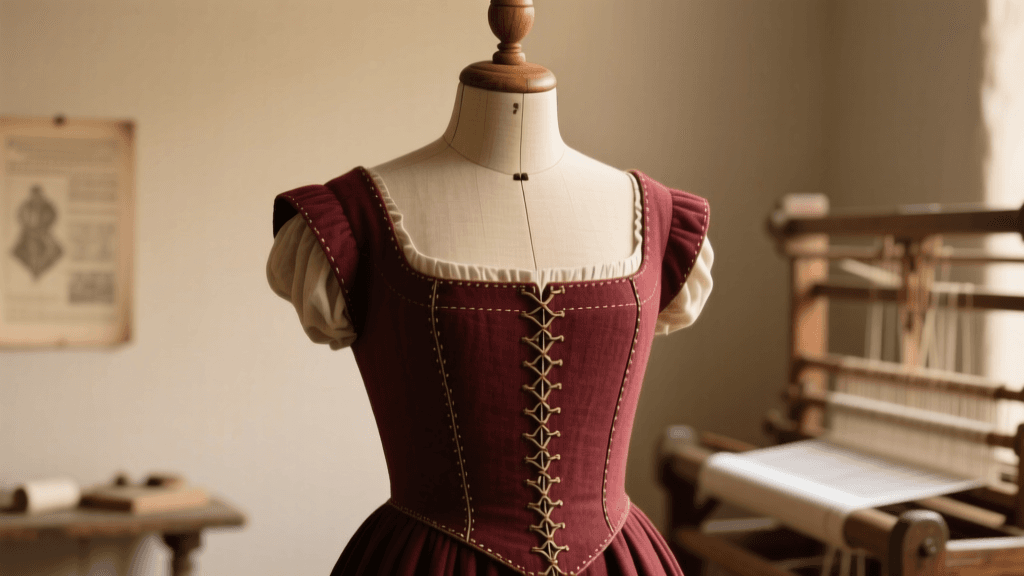
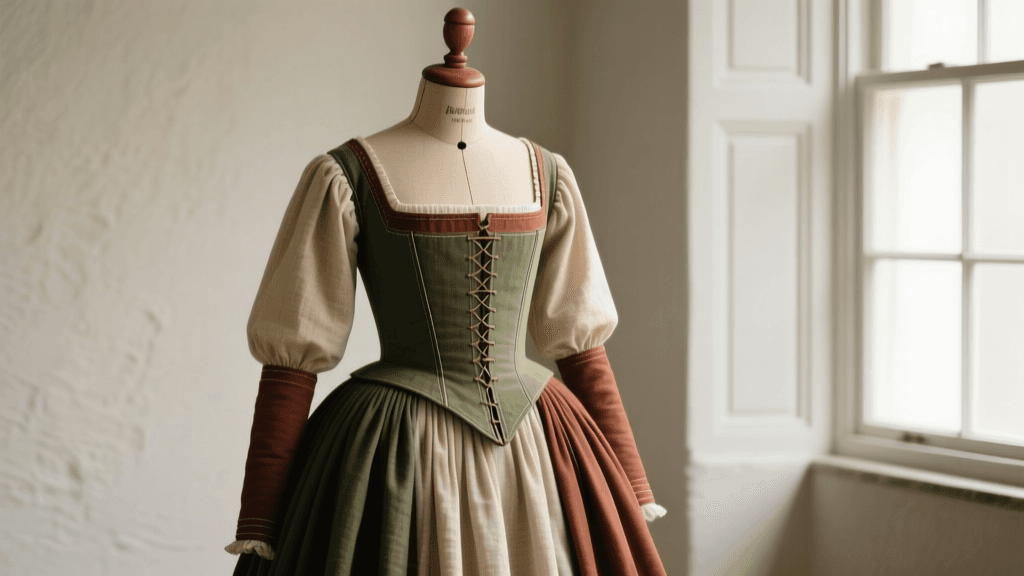
The Tudor kirtle is not merely a dress; it is a foundational support garment. In the early 16th century, before the invention of the separate pair of bodies (stays), the kirtle bodice was heavily stiffened to flatten the torso and support the bust. Experts at The Tudor Tailor recommend drafting the bodice using a four-panel pattern (two front, two back) with a distinctively low, square neckline and a slightly lowered back waist to accommodate the period's posture.
The Bodice: Structure and Support
To achieve the necessary rigidity without modern steel, historical makers used layers of stiffened linen and reeds. For the 2026 maker, we recommend utilizing a heavy organic hemp canvas, interlined with a layer of dense cotton drill. You will need to create vertical boning channels in the front panels. While historical willow is difficult to source and maintain, modern 6mm flat steel or high-grade synthetic whalebone provides excellent historical accuracy in silhouette while offering the flexibility needed for sitting and movement. Ensure your boning stops roughly one inch from the bottom edge of the bodice to prevent the stiffeners from digging into your hips when seated.
The kirtle typically fastens at the front or side-front. For a front-lacing kirtle, install hand-bound eyelets spaced exactly one inch apart. Use a single, continuous length of heavy-duty linen cord for the lacing, employing a spiral lacing technique rather than the modern criss-cross method, which is historically inaccurate for the early Tudor period.
The Skirt: Mastering Cartridge Pleats
The skirt of the Tudor kirtle is where the true volume lies. To attach a massive circumference of heavy wool to a relatively small bodice waistline without adding bulk, you must master the cartridge pleat. Unlike standard knife or box pleats, cartridge pleats stand out perpendicular to the waistband, creating the distinctive shelf-like hip flare seen in 16th-century portraiture.
To execute this in 2026, use a heavy-duty upholstery thread and a thick needle. Run three parallel rows of gathering stitches along the top edge of your skirt, spacing them exactly half an inch apart. Pull the threads tightly to compress the fabric into dense, accordion-like folds. Whipstitch the top of each individual pleat directly to the bottom edge of your finished bodice. This technique takes time, but the structural integrity it provides is unmatched.
Building the Spanish Farthingale (Verdugado)
Worn beneath the kirtle, the Spanish farthingale dictates the final shape of the outfit. The verdugado is characterized by its smooth, conical profile, achieved through a series of graduated hoops sewn into channels on a heavy fabric base.
Hoop Graduation and Boning Channels
The mathematics of the farthingale are crucial. A standard early Tudor farthingale requires between five and seven hoops. The bottom-most hoop should measure approximately 110 to 120 inches in circumference, depending on your height and desired skirt width. Each subsequent hoop moving up toward the waist should decrease in circumference by roughly 12 to 15 inches. The topmost hoop, resting at the high hip, should measure around 45 to 50 inches.
Cut your organic cotton drill base fabric into a series of trapezoidal panels that, when sewn together, form a cone. Before sewing the side seams, mark your horizontal boning channels. The channels should be spaced closer together at the bottom (about 4 inches apart) and wider at the top (about 8 inches apart). Sew your channels using a 1/2 inch seam allowance, leaving a small opening at the side seams to insert the hoop material.
Modern Boning Alternatives in 2026
As of 2026, synthetic whalebone (often made from high-density polyethylene) is the gold standard for historical hoop skirts. It is lightweight, impervious to moisture, and can be heat-molded using a standard heat gun to create perfect, permanent circles. Avoid modern zip-ties or PVC piping, which tend to kink, collapse under the weight of heavy wool skirts, and create an unnatural, jagged silhouette that ruins the historical illusion.
When inserting the synthetic whalebone, overlap the ends by about two inches and secure them tightly with heavy-duty zip ties or by melting the plastic ends together with a soldering iron. Ensure the overlapping joint is placed at the center back or directly under the hip, where it will be least visible and least likely to press uncomfortably against the body.
Final Assembly and Historical Fitting
The National Trust notes that clothing in the Tudor era was a primary indicator of social status, meaning the fit and finish of your garments must be impeccable. When fitting the ensemble, always put on your farthingale first, followed by a smock or chemise, and finally the kirtle. The kirtle should be laced tightly enough to provide bust support but loose enough to allow for deep breathing and comfortable movement.
Pay close attention to the hem of your kirtle. Because the farthingale pushes the skirt outward, the front of the kirtle will naturally rise. You must hem the kirtle while wearing the farthingale underneath, ensuring the hem runs perfectly parallel to the floor. Add a deep, heavy facing of velvet or wool to the inside bottom edge of the kirtle hem; this adds weight, helping the skirt drape beautifully over the hoops and preventing it from catching on the farthingale channels.
Conclusion
Recreating the Tudor kirtle and Spanish farthingale is a rewarding journey into the engineering of Renaissance fashion. By combining historical drafting techniques with the best sustainable materials available in 2026, modern makers can achieve a stunning, historically accurate silhouette that honors the rich legacy of European folk dress and courtly fashion. Whether you are preparing for a high-level historical interpretation event or simply expanding your traditional garment wardrobe, mastering these foundational layers will elevate your entire 16th-century wardrobe.