2026 Guide to Drafting a 16th-Century Tudor Kirtle
The Foundation of 16th-Century Wardrobes
As we navigate the 2026 historical reenactment and Renaissance festival season, the demand for impeccable, historically grounded European folk dress has never been higher. At the very core of the 16th-century English wardrobe lies the Tudor kirtle. Far from a simple undergarment, the kirtle was the foundational structural piece for women across all social classes, providing the silhouette upon which gowns, partlets, and foreparts were layered. According to the Metropolitan Museum of Art's Heilbrunn Timeline of Art History, the structured bodice and flowing skirt of the Renaissance era fundamentally shifted European fashion away from the soft, draped lines of the medieval period toward tailored, geometric precision.
For modern makers and historical costumers in 2026, recreating a Tudor kirtle requires a departure from modern commercial patterns. It demands an understanding of historical tailoring, period-accurate textile sourcing, and specialized hand-sewing techniques. This comprehensive guide will walk you through drafting, sourcing, and constructing an authentic 16th-century Tudor kirtle tailored to current 2026 standards of historical accuracy.
Sourcing Authentic Textiles in 2026
The success of any historical garment relies heavily on the drape, weight, and fiber content of the fabric. The global textile market in 2026 has seen a resurgence in heritage mills producing historically accurate weaves, but knowing what to look for is critical. Avoid modern synthetic blends, polyesters, and lightweight 'costume' satins. The Victoria and Albert Museum's fashion archives consistently demonstrate that 16th-century garments relied on the natural body of heavy wools, crisp linens, and silk taffetas to achieve their iconic silhouettes without the need for excessive modern interfacing.
When sourcing wool, look for 'broadcloth' or 'melton' with a fulled finish that prevents fraying when cut. For linens, seek out mid-weight (5.3 oz to 7 oz) opaque linens for lining and heavier weights for smocks. Below is a breakdown of the current 2026 market for historically accurate textiles.
2026 Textile Market Comparison Chart
| Textile Type | Weight | 2026 Avg. Cost per Yard | Best Application |
|---|---|---|---|
| Wool Broadcloth | 14-16 oz | $45 - $65 | Outer Skirt & Main Bodice |
| Wool Flannel | 10-12 oz | $30 - $45 | Interlining & Winter Kirtles |
| Medium Linen | 5.3 - 7 oz | $22 - $32 | Bodice Lining & Partlets |
| Silk Taffeta | 3-4 oz | $85 - $130 | Visible Foreparts & Sleeves |
Drafting the Kirtle Bodice Pattern
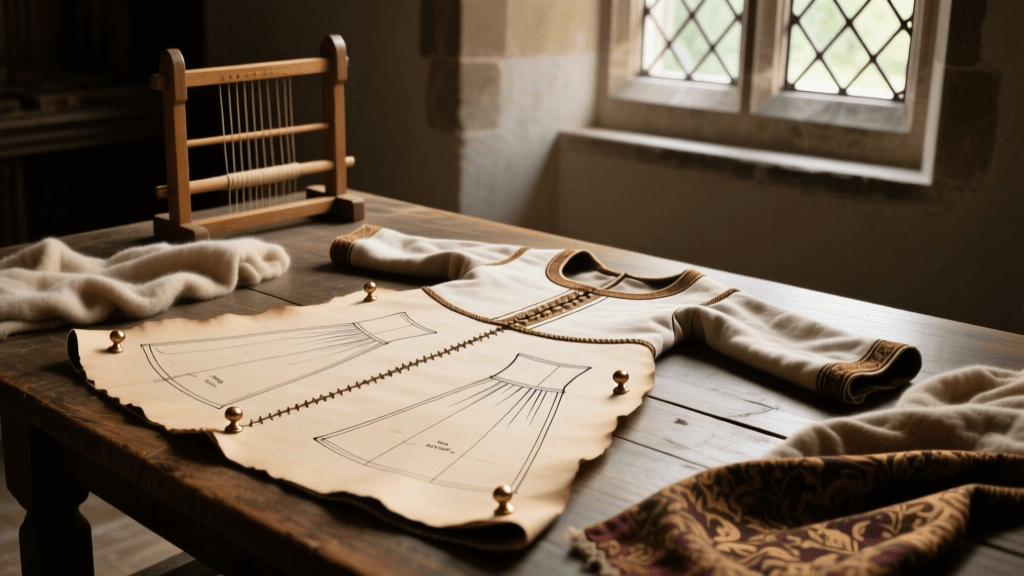
Unlike modern princess-seamed bodices, the authentic Tudor kirtle bodice is typically drafted using a four-panel or three-panel system. The most historically supported method for the mid-16th century involves a front panel, a back panel, and two side-back panels. This places the side seams slightly toward the back of the body, allowing for a smoother front profile and better structural support.
To draft your pattern in 2026, you can utilize digital drafting software like Seamly2D, which has been updated with historical formula libraries, or stick to traditional paper drafting. Begin by taking your measurements over a fitted linen smock and your preferred bust support. The kirtle bodice should end precisely at the natural waist, which is typically higher than the modern commercial waistline—usually just above the navel.
Key drafting measurements include:
- Bust Circumference: Taken snugly but allowing for a full breath.
- Underbust to Natural Waist: This determines the length of the boned section.
- Armscye Depth: Tudor armscyes are cut higher and tighter into the armpit than modern garments to allow for full arm mobility without the bodice riding up.
- Shoulder Strap Width: Typically 1.5 to 2 inches wide, angled toward the back of the neck to accommodate the square neckline of the era.
Structural Elements: Boning and Lining
The Tudor kirtle bodice must be rigid enough to support the weight of the heavy skirt and the layers worn over it. While historical examples occasionally used bents (reed) or heavily stiffened linen buckram, the 2026 standard for safe, durable, and historically sympathetic reenactment is German synthetic whalebone. This plastic boning mimics the flexibility and heat-molding properties of baleen without the ethical or legal issues of antique whalebone.
Use 1/4-inch synthetic whalebone for the front and side panels, placing the channels roughly 1/2 inch apart. For the center front, where the lacing will bear the most tension, use a 1/2-inch wide bone or a flat steel busk encased in linen to prevent the center front from bowing outward. Line the entire bodice in your medium-weight linen, using a bag-lining technique to encase the raw edges of the boning channels before attaching the skirt.
Constructing the Skirt and Cartridge Pleats
The skirt of a Tudor kirtle is where the garment truly comes to life, requiring an immense amount of fabric to achieve the bell-shaped silhouette. For a standard 5-foot-6-inch wearer, you will need approximately 3.5 to 4 yards of wool broadcloth, cut in panels to maximize the hem circumference while minimizing waste at the waist.
The hallmark of the 16th-century skirt attachment is the cartridge pleat. Unlike knife pleats or box pleats, cartridge pleats allow several inches of thick wool to be compressed into a single inch of bodice waistline, creating a hinge-like effect that pushes the skirt outward. To execute this in 2026:
- Finish the top edge of your skirt panels with a narrow linen facing or binding to prevent stretching.
- Mark parallel rows of dots along the top edge, typically 1/2 inch apart vertically and 1/4 inch apart horizontally.
- Using a heavy, waxed linen thread, run a gathering stitch through each row of dots.
- Pull the threads tight to form dense, cylindrical pleats that resemble the cardboard tubes of ammunition cartridges.
- Whipstitch the top of each individual pleat directly to the bottom edge of the finished bodice, ensuring the skirt stands out at a 90-degree angle before falling to the floor.
Hand-Sewing Techniques and Assembly
While machine sewing the long structural seams of the skirt is an acceptable compromise for modern makers on a time budget, the visible seams, hems, and bodice assembly should be completed by hand to ensure historical integrity. In 2026, historical sewing guilds heavily emphasize the use of period-accurate stitches.
Use a running stitch for long, non-stress seams, backstitching every few inches for security. For the armscye and waistline seams, which bear significant tension, use a tight backstitch. When hemming the heavy wool skirt, avoid folding the hem up twice, which creates unbearable bulk. Instead, bind the raw edge with a strip of linen bias tape and use a catch stitch to secure it to the inside of the skirt, allowing the hem to remain flexible and drape beautifully over the feet.
Lacing and Final Fitting
The kirtle typically fastens at the center front or side-back using spiral lacing. Avoid modern cross-lacing (like a sneaker), which is largely a Hollywood invention. Spiral lacing requires offset eyelets: the holes on the left side should be spaced slightly differently than the right side, allowing a single continuous lace to spiral up the bodice and pull it tightly closed without buckling.
To create your eyelets, never use a metal hole punch, which cuts the fibers and leads to tearing. Instead, use a tapered metal awl to gently push the linen and wool threads apart, then stitch around the hole using a heavy buttonhole stitch or whipstitch. Finish your garment with a set of brass lacing hooks or a handmade wool braid lace tipped with brass aglets. By adhering to these meticulous construction methods and sourcing guidelines, your 2026 Tudor kirtle will not only withstand the rigors of modern reenactment but will stand as a true tribute to the master tailors of the 16th century.