16th-Century Peasant Kirtle and Smock Sewing Guide 2026
The Shift to Authenticity in 2026 Reenactment
As we navigate the 2026 living history and reenactment season, the standards for historical accuracy have reached an all-time high. The days of synthetic blends, machine-sewn shortcuts, and aristocratic-focused costuming are fading, replaced by a deep appreciation for the everyday garments of the working class. For enthusiasts of European folk dress and medieval history, mastering the 16th-century commoner’s wardrobe—specifically the linen smock and the wool kirtle—is the ultimate benchmark of authenticity. This comprehensive guide will walk you through the geometry, textile sourcing, and hand-sewing techniques required to build a historically accurate Tudor peasant ensemble in 2026.
Unlike the highly structured, heavily boned gowns of the Tudor court, the commoner’s kirtle relied on clever tailoring, layered linen, and the natural properties of wool to provide support and mobility. According to the extensive weave databases and historical analyses maintained by the Textile Research Centre, working-class women in 16th-century Europe primarily wore tabby-woven wools and unbleached linens that were locally sourced, durable, and designed for rigorous daily labor.
The Foundation Layer: Drafting the Linen Smock
The smock (or chemise) is the absolute foundation of any 16th-century wardrobe. It protected the outer wool garments from body oils and sweat, and its visible edges at the neckline and cuffs served as a subtle indicator of cleanliness and status. For a historically accurate 2026 reconstruction, you must abandon modern curved armholes and princess seams in favor of traditional rectangular construction.
Fabric Selection and Measurements
Opt for a medium-weight linen, ideally between 3.5 oz and 5.3 oz per square yard. While bleached white linen was prized, unbleached or half-bleached 'natural' linen is highly appropriate for a peasant persona. The smock is constructed entirely from rectangles and squares, minimizing fabric waste—a crucial economic factor for 16th-century commoners.
- Main Body: Two large rectangles, typically 20 to 24 inches wide and 32 to 36 inches long, depending on your height.
- Sleeves: Two rectangles, measuring roughly 18 inches wide by the length of your arm plus a slight drop for the shoulder.
- Underarm Gussets: Two 6x6 inch squares to provide mobility and prevent tearing at the stress points.
- Side Gores: Optional trapezoidal panels inserted into the side seams from the hip down to add walking ease.
Assembly involves sewing the shoulder seams, attaching the sleeves flat, and then sewing the side seams and underarm sleeves in one continuous line, inserting the gussets at the intersection. All seams should be flat-felled to prevent fraying and to create a clean interior finish.
The Core Garment: Constructing the Wool Kirtle
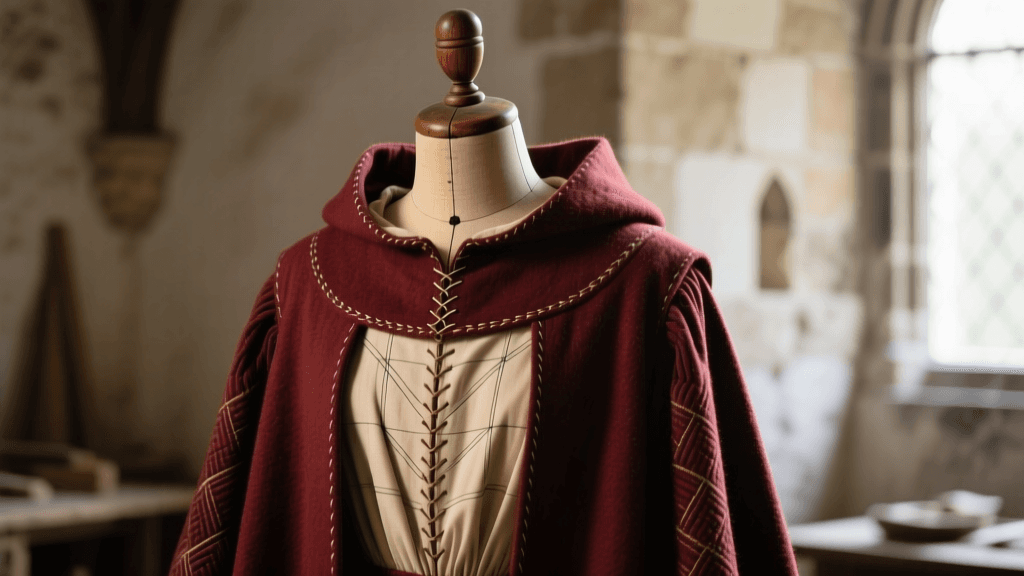
The kirtle is the primary dress of the 16th-century working woman. It consists of a fitted, supportive bodice and a full, gathered or pleated skirt. Extant fragments and silhouettes documented in the Victoria and Albert Museum's Renaissance collection reveal that commoner bodices were stiffened with heavy linen canvas or multiple layers of quilted fabric rather than the rigid whalebone used by the nobility.
Bodice Drafting and Interlining
To draft the bodice, use a four-panel pattern (two front, two back) with a slight curve at the side seams to follow the natural waist. The front panels should meet edge-to-edge at the center front for lacing. The interlining is where the magic happens: use two layers of heavy-duty linen canvas or hemp, pad-stitched together to create a firm, supportive shell. This layered technique provides excellent bust support without the discomfort of modern corsetry.
Skirt Attachment and Cartridge Pleating
The skirt of a peasant kirtle is typically made of three to four panels of wool, resulting in a hem circumference of 120 to 150 inches. To attach this massive amount of fabric to the fitted bodice, 16th-century tailors utilized cartridge pleating. This technique involves running parallel rows of gathering stitches along the top edge of the skirt and pulling them tight to create dense, uniform folds that stand out perpendicular to the waistline. These pleats are then individually whipped to the bottom edge of the bodice, allowing the skirt to spring outward and drape beautifully while maintaining a smooth waistline.
2026 Textile Sourcing and Cost Analysis
Sourcing historically accurate textiles remains one of the biggest challenges for modern makers. In 2026, global supply chain shifts have altered the pricing and availability of heritage fabrics. Below is a comparative analysis of top-tier suppliers currently serving the historical reenactment community.
| Supplier (2026) | Material | Weight/Weave | Cost per Yard | Accuracy Rating |
|---|---|---|---|---|
| Burnley & Trowbridge | Wool Flannel | Medium / Tabby | $32.00 | Excellent |
| Wm. Booth Draper | Heavy Linen | 5.3 oz / Canvas | $18.50 | Excellent |
| Fabrics-Store | IL019 Linen | 5.3 oz / Tabby | $14.00 | Good (Requires softening) |
| Suffolk Trimmings | Wool Broadcloth | Heavy / Twill | $45.00 | Superior (Museum Grade) |
Note: Prices reflect early 2026 market rates and exclude international shipping. For the most accurate drape, always pre-wash and block your wool and linen before cutting.
Hand-Sewing Techniques for Historical Accuracy
In 2026, the living history community heavily emphasizes the 'inside' of the garment as much as the outside. Machine sewing is strictly prohibited in high-level authenticity circles. To achieve a true 16th-century finish, you must master a few fundamental hand stitches.
'The strength of a commoner's garment lies not in the fineness of the silk, but in the density of the linen thread and the patience of the flat-felled seam.' — Traditional Tailor's Axiom
- The Running Stitch: Used for long seams and gathering. Use a fine linen thread (35/2 or 60/2 weight) and aim for 8 to 10 stitches per inch.
- The Backstitch: Reserved for high-stress areas like the armholes and the base of the lacing rings. It mimics the strength of a modern machine lockstitch.
- Flat-Felling: After sewing the initial seam with a running stitch, trim one allowance, fold the other over it, and whipstitch it flat to the fabric. This encases all raw edges.
- Hand-Bound Eyelets: Avoid metal grommets entirely. Pierce the fabric with an awl, push the threads aside rather than cutting them, and bind the hole tightly using a buttonhole stitch with heavy linen or silk twist.
Accessories to Complete the Commoner Silhouette
A kirtle and smock alone do not make a complete outfit. The 16th-century peasant silhouette is defined by its layered accessories, which served both practical and modest purposes.
Headwear and Neckwear
No respectable woman in the 16th century went bareheaded. A linen coif, secured with a tie or pins, is mandatory. Over the coif, a woven straw hat or a wool flat cap provides sun protection and completes the profile. For the neck, a linen partlet fills in the square or round neckline of the kirtle, protecting the chest from the sun and keeping the bodice clean.
Hosiery and Footwear
Wool hose, cut on the bias or knitted, are held up by woven garters tied just below the knee. For footwear, invest in a pair of hand-lasted leather turnshoes. Modern reproduction shoemakers in 2026 have perfected the historical turnshoe method, where the shoe is sewn inside out and then turned right-side out, resulting in a seamless interior that is incredibly comfortable for walking on uneven terrain at historical festivals.
Final Thoughts for the 2026 Maker
Reconstructing a 16th-century peasant kirtle and smock is a labor of love that connects you directly to the textile traditions of early modern Europe. By prioritizing natural fibers, utilizing geometric pattern drafting, and committing to hand-sewing techniques, you create a garment that is not only historically accurate but also remarkably comfortable and durable. As you stitch your way through the layers of linen and wool, you are participating in a vital preservation of European folk dress, ensuring that the stories and skills of the working class are remembered and respected in the modern era.