2026 Tudor Kirtle & Gown Guide: Fabrics, Patterns & Fit
Introduction to 16th-Century English Dress
As we enter the 2026 historical reenactment and Renaissance festival season, the demand for meticulous, historically accurate European folk dress has never been higher. Among the most iconic and highly requested garments is the 16th-century Tudor kirtle and gown. Whether you are preparing for a high-court portrayal or a working-class English village demonstration, understanding the foundational layers, appropriate textiles, and structural engineering of these garments is essential. This comprehensive guide will walk you through the anatomy, fabric sourcing, and construction techniques required to build an authentic Tudor wardrobe for the modern era.
The Anatomy of the Tudor Kirtle
The kirtle is the undisputed workhorse of the 16th-century English woman's wardrobe. Worn over the linen smock and beneath the outer gown, the kirtle provides both the fashionable silhouette and the structural support necessary for the period's distinct bodice shape. In 2026, historical costumers have largely moved away from the heavily boned, corset-like interpretations of the early 2000s, favoring instead the historically accurate, lightly structured kirtle that relies on precise tailoring and flat-lining for support.
The Bodice and Flat-Lining
The bodice of a Tudor kirtle is typically constructed from three main pattern pieces: a back panel and two front panels that meet at a center-front lacing line. To achieve the smooth, conical torso shape popularized during the reigns of Henry VIII and Edward VI, the outer fashion fabric must be flat-lined to a sturdy inner layer. Today, heavyweight linen or hemp canvas is the gold standard for this interlining. By basting the wool or silk fashion fabric directly to the canvas before sewing the seams, the garment gains immense structural integrity without the need for excessive rigid boning.
Strategic Boning Techniques
While a fully boned corset is anachronistic for the early-to-mid 16th century, strategic boning is highly effective for preventing the center-front lacing gap from buckling. Modern reenactors in 2026 favor synthetic whalebone or properly prepared natural reed over plastic zip-ties, which degrade and warp under the heat of summer festivals. A single channel of synthetic whalebone placed directly adjacent to the center-front lacing holes on either side provides a beautifully flat front while allowing the bodice to mold to the wearer's natural torso.
2026 Fabric Sourcing: Authenticity Meets Modern Wearability
Sourcing historically accurate textiles remains one of the greatest challenges for modern makers. The drape, weight, and weave of your fabric will make or break the final silhouette. According to the Victoria and Albert Museum's Renaissance collection, the interplay of heavy woolens and crisp linens defined the era's textile hierarchy. Here is what you need to look for in the current 2026 market:
- Linen for Smocks and Partlets: Opt for a medium-weight (3.5 to 5 oz) opaque linen in white or unbleached natural. Avoid modern, slubby 'craft' linens; seek out tightly woven, evenly spun linen that softens beautifully after a hot wash.
- Wool for Kirtles and Gowns: Wool broadcloth, melton, or flannel are ideal. The fabric must be fulled (milled) so that the raw edges do not fray when cut. A 100% wool with a slight nap will drape heavily and resist wrinkles during long festival weekends.
- Silk for High-Status Gowns: For courtly portrayals, silk taffeta, damask, or velvet are appropriate. Avoid dupioni or shantung, as their characteristic slubs were not present in the highly refined, tightly woven silks of the 16th century.
Comparison Chart: 2026 Historical Textile Suppliers
To help you navigate the current landscape of historical fabric vendors, we have compiled a comparison of the most reliable sources for Tudor-appropriate textiles this year.
| Supplier | Specialty | 2026 Price Range (per yard) | Best For |
|---|---|---|---|
| Burnley & Trowbridge | Historically accurate wools, linens, and silk taffetas | $25 - $65 | Authentic broadcloth and smock linen |
| Renaissance Fabrics | Velvets, brocades, and period-correct trims | $30 - $85 | High-status gowns and courtly sleeves |
| Wm. Booth Draper | Working-class wools, linsey-woolsey, and notions | $18 - $45 | Everyday kirtles and peasant portrayals |
| Fabrics-Store | Accessible, affordable linens in various weights | $12 - $25 | Smocks, partlets, and linings on a budget |
Pattern Drafting: The Grid Method vs. Draping
When it comes to patterning the Tudor bodice, modern sewists generally choose between two methods: the mathematical grid method or direct draping. Experts like those at The Tudor Tailor have spent decades refining the grid method, which uses a series of proportional measurements based on the wearer's bust, waist, and back width to draft a mathematically precise, period-correct pattern on gridded paper. This method is highly recommended for beginners and those sewing for others, as it ensures the iconic, slightly elongated torso and wide, flat neckline characteristic of the 1540s through 1570s.
Conversely, advanced costumers often prefer draping directly on a dress form. By pinning unbleached muslin to a form padded to the wearer's exact measurements (including any historical padding or bum rolls), you can manipulate the fabric to achieve the perfect tension. Regardless of the method chosen, a mock-up in heavy canvas is non-negotiable before cutting into your expensive 2026 wool broadcloth.
The Skirt and Cartridge Pleating
The skirt of the Tudor kirtle is where the garment truly shines, offering a lush, voluminous drape that supports the heavy outer gown. The most historically accurate method for attaching the skirt to the bodice is cartridge pleating. Unlike standard knife or box pleats, cartridge pleats stand out perpendicular to the waistband, creating a pronounced, rounded shelf at the hips that perfectly mimics the silhouettes seen in 16th-century portraiture.
To execute cartridge pleating in 2026, use a heavy-duty upholstery thread to sew two or three parallel rows of running stitches along the top edge of your skirt. Pull the threads taut to gather the fabric into tight, uniform flutes. Whip-stitch the top edge of each pleat directly to the finished bottom edge of your bodice. This technique not only looks spectacular but also allows the skirt to be easily removed or replaced if it suffers damage during muddy outdoor festivals.
Assembling the Gown and Sleeves
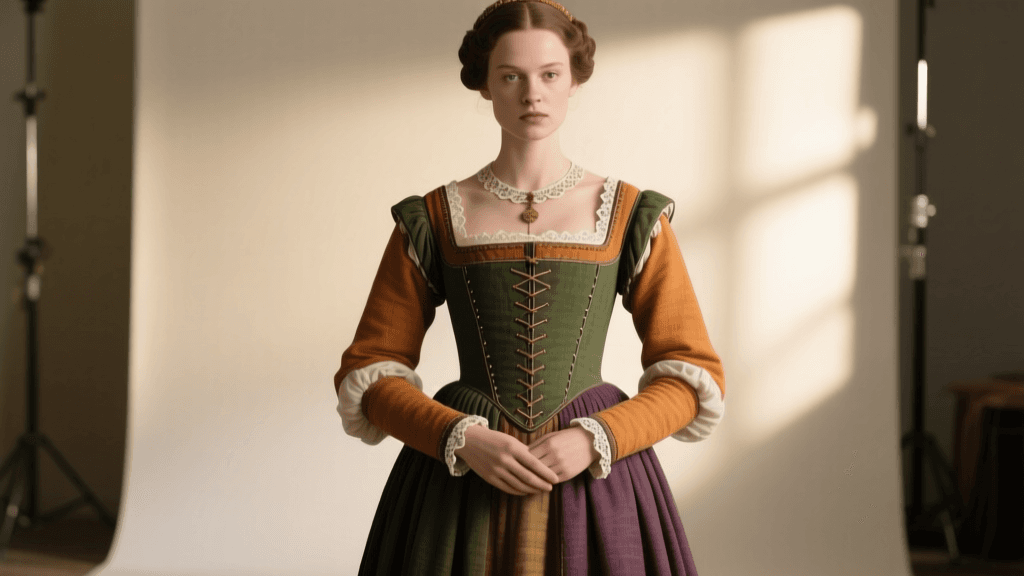
Once the kirtle is complete, the outer gown is constructed to complement it. The Tudor gown of the mid-16th century typically features a V-shaped or square neckline that reveals the kirtle beneath, along with a split front skirt that parts to show the kirtle's contrasting fabric. The sleeves are often constructed separately and tied or pinned to the gown's shoulders, allowing for versatility and ease of movement.
The beauty of the layered Tudor system lies in its modularity. A single kirtle can be paired with multiple sets of sleeves, partlets, and gowns to create entirely different outfits suitable for varying weather conditions and social occasions.
For the sleeves, consider making them in two parts: a fitted fore-sleeve made of rich silk or velvet, and a voluminous upper sleeve (or 'trunk sleeve') lined with contrasting fabric and slashed to reveal the linen smock underneath. This layering not only adds immense visual interest but also provides crucial insulation for early spring or late autumn events.
2026 Festival Survival: Breathability and Layering
Wearing multiple layers of wool and linen in the peak of summer requires strategic planning. As climate patterns shift and summer festivals in 2026 see record-high temperatures, modern reenactors must prioritize breathability without sacrificing historical accuracy. Ensure your foundational smock is made of high-quality, loosely woven linen, which acts as a natural moisture-wicking layer. Avoid the temptation to line your wool kirtle with synthetic poly-blends; a 100% linen lining will keep you significantly cooler. Additionally, invest in a well-fitted linen partlet to protect your neck and chest from sunburn while maintaining a modest, period-correct neckline.
By mastering the structural nuances of the kirtle, sourcing the correct natural fibers, and employing authentic hand-finishing techniques like cartridge pleating, you will create a Tudor ensemble that not only withstands the rigors of modern reenactment but also honors the rich textile heritage of 16th-century Europe.