Authentic Tudor Kirtle Bodice Pattern Drafting Guide 2026
The Foundation of the Renaissance Silhouette
As the historical costuming and European folk dress revival continues to evolve in 2026, makers are increasingly moving away from theatrical, synthetic approximations and embracing rigorous historical accuracy. At the very heart of the 16th-century English silhouette lies the Tudor kirtle. While the opulent gowns and French hoods often steal the spotlight in Renaissance portraiture, it is the structured kirtle bodice that actually creates the iconic, conical torso and smooth bustline of the era. Understanding how to draft, interline, and construct a Tudor kirtle bodice is essential for any serious student of Renaissance fashion history.
Unlike modern bodices that rely on darts and stretch fabrics to contour to the body, the Tudor kirtle achieves its shape through rigid interlining, strategic boning, and precise geometric pattern drafting. The transition from the flowing, draped garments of the late medieval period to the highly structured, tailored garments of the Tudor court represents a massive leap in European textile engineering. In this comprehensive 2026 guide, we will walk through the exact steps to draft and construct an authentic Tudor kirtle bodice, utilizing historically accurate materials and techniques that meet the rigorous standards of today's historical reenactment community.
Sourcing Authentic Materials in 2026
The 2026 textile market has seen a welcome resurgence in the availability of historically accurate, natural-fiber fabrics. The modern historical dress community has largely rejected polyester brocades and synthetic linings in favor of biodegradable, breathable materials that behave exactly as their 16th-century counterparts did. When planning your kirtle, sourcing the correct weight of linen for the interlining is just as critical as choosing the outer fashion fabric.
| Bodice Component | 16th-Century Original Material | 2026 Authentic Alternative | 2026 Budget/Practice Alternative |
|---|---|---|---|
| Outer Fashion Fabric | Fine Wool Broadcloth or Silk Damask | Heavyweight Melton Wool or 100% Silk Brocade | Wool-blend Suiting or Heavy Linen |
| Interlining (Core) | Heavy Linen Canvas or Hemp | 100% Linen Canvas (7oz to 11oz weight) | 100% Cotton Duck Canvas |
| Lining | Medium-weight Bleached Linen | 5.3oz Bleached or Natural Linen | Lightweight Cotton Sateen |
| Boning Structure | Bents (Reeds), Horn, or Cords | Natural Rattan Reed or 4mm German Plastic Boning | Heavy-duty Zip Ties (Not recommended for accuracy) |
| Thread | Silk or Linen Thread | 100% Silk Buttonhole Twist or 35/2 Linen Thread | Poly-wrapped Cotton Core Thread |
For the outer fabric, a dense, fulled wool is highly recommended for everyday Tudor wear, as it drapes beautifully and holds a crisp edge when bound. According to the Victoria and Albert Museum's extensive fashion archives, wool was the backbone of the English Tudor wardrobe across all social classes, with silk reserved strictly for the nobility. For the interlining, do not compromise on the linen canvas; it must be stiff enough to support the boning and resist wrinkling under tension.
Drafting the Kirtle Bodice Pattern
Drafting a Tudor bodice requires a departure from modern pattern-making logic. Modern patterns are drafted to follow the natural curves of the body, while a Tudor pattern is drafted to reshape the body into a geometric cone. We recommend the draping method over flat-pattern drafting for beginners, as it allows you to visually establish the iconic square neckline and the slightly dropped armscye.
Step 1: Establishing the Core Measurements
Before cutting into your expensive linen canvas, take precise measurements while wearing your foundational smock and any bust-support garments you plan to use. You will need your full bust, underbust, natural waist, torso length (from the nape of the neck to the waist, and from the shoulder to the waist), and the desired width of your shoulder straps. The Tudor kirtle typically features a wide, square neckline that sits low on the bust, with shoulder straps that sit far out on the edge of the shoulders to accommodate the voluminous sleeves of the over-gown.
Step 2: Draping the Linen Canvas
Using a cheap, heavy cotton muslin or scrap canvas, drape the front panels directly onto your dress form or your own body (with a helper). Pin the fabric smoothly, ensuring that the grainline runs perfectly straight down the center front. The side seams should be placed slightly toward the back of the natural side seam, which helps to push the bust forward and flatten the torso. The armscye (armhole) must be cut further back than a modern garment; this historical placement allows for a greater range of motion when wearing heavy, restrictive outer sleeves.
Step 3: The Back and Lacing Edge
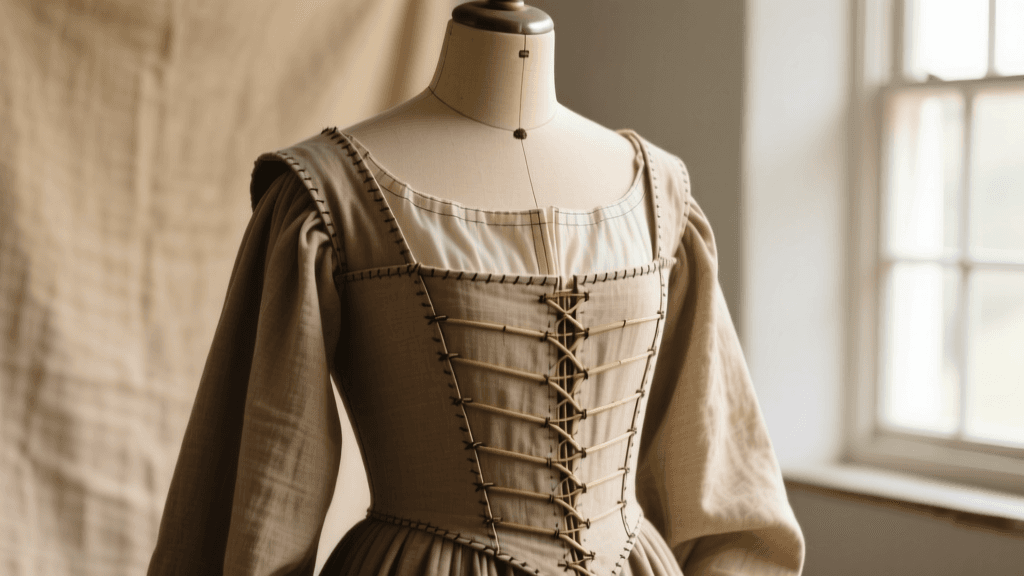
The back of a Tudor kirtle is typically fitted with a seam at the center back or laced at the center back/front. For this guide, we will utilize a center-back spiral lacing closure, which provides the most adjustable and secure fit. Ensure the back panels are drafted with enough tension to pull the shoulders back and support the weight of the heavy skirts that will eventually be pleated and attached to the bodice waistline.
Interlining and Boning Channels
Once your mock-up is perfected, transfer the pattern to your heavyweight linen canvas. The interlining is the true skeleton of the garment. To achieve the stiff, wrinkle-free conical shape documented by experts at The Tudor Tailor, you must employ a technique called pad-stitching, alongside strategic boning channels.
Pad-Stitching the Core
Pad-stitching involves using a dense, diagonal running stitch to bond the outer fashion fabric to the linen canvas interlining. This prevents the delicate silk or fine wool from buckling or shifting when the bodice is under tension. Use a 100% silk buttonhole twist and a fine needle, working in V-shaped rows across the bust and torso. Keep your stitches on the outer fabric tiny and nearly invisible, while taking larger bites of the canvas underneath.
Inserting the Boning
While modern corsetry relies on flat or spiral steel, the 16th-century kirtle utilized 'bents'—bundles of stiff reeds—or thick cording. In 2026, the most historically accurate and accessible alternative is natural rattan reed, which can be soaked in water, bent to the curve of the body, and allowed to dry into a custom shape. If you prefer a modern, low-maintenance alternative, 4mm German plastic synthetic whalebone is the accepted standard in the historical costuming community. It mimics the flexibility and warmth-reactive properties of actual baleen or horn.
Create boning channels by stitching parallel lines through the canvas and a secondary layer of lining fabric. Place the heaviest concentration of boning at the center front, the side seams, and radiating slightly from the bust toward the underarm to prevent the fabric from collapsing inward.
Hand-Bound Eyelets and Finishing Techniques
Perhaps the most crucial detail that separates a historically accurate 2026 reproduction from a mass-produced costume is the method of closure. Metal grommets and two-piece eyelets are strictly forbidden in accurate Tudor dress; they tear the historical fabric, lack period accuracy, and fail to distribute tension correctly.
The Awl Method for Hand-Bound Eyelets
To create authentic spiral lacing holes, use a tapered bone or steel awl. Instead of cutting a hole with scissors (which severs the structural threads of the fabric), forcefully push the awl through the fabric layers to displace the threads. Once the hole is opened, use a heavy linen or silk thread and a whip-stitch or buttonhole stitch to bind the raw edges tightly. This creates an incredibly strong eyelet that can withstand the immense pulling force required to lace the bodice shut.
Space your eyelets approximately one inch apart. For spiral lacing, the eyelets on the left and right sides of the center back should be offset by half an inch. This offset allows a single continuous lace to spiral up the bodice, pulling both edges together evenly and creating a seamless, flush closure that lies perfectly flat beneath the outer gown.
Modern Revival and Sustainable Practices
The 2026 European folk dress and historical reenactment movements are deeply intertwined with the broader push for sustainable, slow fashion. By utilizing 100% natural fibers like wool, linen, and silk, modern makers are not only achieving unparalleled historical accuracy but also creating biodegradable garments that reject the fast-fashion cycle. Furthermore, historical pattern drafting inherently promotes zero-waste cutting techniques. Because fabric was incredibly expensive in the 16th century, Tudor tailors used ingenious geometric layouts to ensure almost every scrap of wool or linen was utilized, a practice that modern eco-conscious sewists are enthusiastically reviving today.
Constructing a Tudor kirtle bodice is a labor-intensive journey that requires patience, precision, and a deep respect for the textile artisans of the past. By mastering the drape of the canvas, the geometry of the square neckline, and the structural integrity of hand-bound eyelets, you are not merely sewing a garment; you are actively preserving a vital piece of European cultural heritage for the next generation of historical enthusiasts.