Authentic Chiton & Toga Draping Guide for 2026 Reenactors
The Renaissance of Classical Dress in 2026
As we navigate the historical reenactment and classical theater boom of 2026, the demand for authentic ancient Mediterranean garments has never been higher. Modern audiences and historical societies are moving away from the inaccurate, mass-produced 'costumes' of the past, favoring meticulously researched, accurately draped textiles that reflect the true ingenuity of ancient Greek and Roman tailors. Unlike modern fashion, which relies on complex cutting and sewing patterns, classical antiquity favored the art of the drape. The garments were woven to shape on the loom and then wrapped, folded, and pinned around the body. Understanding the physics of these folds is essential for any serious reenactor, costumer, or historian working in 2026.
According to The Metropolitan Museum of Art's Heilbrunn Timeline of Art History, the fundamental principle of ancient Greek dress was the rectangular piece of cloth, which was draped in various ways to create garments that were both functional and deeply expressive of social status, gender, and regional identity. This guide will break down the exact measurements, fabric weights, and step-by-step draping techniques required to recreate the Greek chiton, the peplos, and the complex Roman toga with absolute historical fidelity.
Decoding the Greek Chiton and Peplos
The foundation of the ancient Greek wardrobe was the chiton, a tunic worn by both men and women, and the peplos, a heavier, distinctly female garment. The beauty of these garments lies in their mathematical relationship to the human body. In 2026, custom weaving and historically accurate loom-width textiles are more accessible than ever, allowing reenactors to achieve the precise drape seen on the Parthenon marbles.
The Doric Chiton and the Peplos
The Doric chiton and the female peplos were typically made from heavyweight wool. The defining feature of the peplos is the apoptygma—a deep overfold at the top of the garment that drapes over the chest and back. To construct an authentic peplos for a woman of average height (165 cm to 170 cm), you will need a rectangular piece of wool measuring approximately 150 cm in width and 200 cm in height. The top 40 cm is folded outward and downward to create the apoptygma. The garment is then wrapped around the body and pinned at the shoulders with heavy bronze or iron fibulae (brooches), leaving the sides open or partially sewn depending on the specific city-state's modesty laws.
The Ionic Chiton
In contrast, the Ionic chiton was crafted from lightweight, finely woven linen or silk, featuring a much wider cut and multiple pins along the upper arms to create a sleeve-like effect. For a modern reenactor, the width of an Ionic chiton should be at least twice the wearer's shoulder width, often spanning 2.5 to 3 meters. The fabric is gathered and pinned at intervals of 10 to 15 centimeters along the arms, creating a cascading, rippling effect that was highly prized in classical antiquity. A belt, or zone, is tied around the waist, and the fabric is bloused over the belt to create the kolpos, adjusting the hemline to the desired length.
Fabric Selection: The Secret to the Perfect Drape
The most common mistake modern enthusiasts make is choosing the wrong fabric weight. A heavy linen will not drape like a chiton, and a thin cotton will not hold the structural folds of a toga. In the 2026 textile market, we measure fabric density in GSM (grams per square meter). Selecting the correct GSM is critical for achieving the statuesque silhouettes of antiquity.
| Fabric Type | Recommended GSM | Drape Quality | Historical Accuracy & Use Case |
|---|---|---|---|
| Medium-Weight Linen | 180 - 220 | Crisp, structured, holds sharp folds | High (Ionic Chiton, Summer Tunics) |
| Lightweight Merino Wool | 120 - 150 | Fluid, heavy, clings to the body | High (Doric Chiton, Peplos, Toga) |
| Cotton-Linen Blend | 150 - 180 | Soft, breathable, moderate drape | Low (Acceptable modern budget substitute) |
| Raw Silk / Tussah | 90 - 120 | Extremely fluid, luminous | High (Elite Roman Stola, Hellenistic Royalty) |
The Roman Toga and Stola: Symbols of Citizenship
While Greek dress was celebrated for its elegant simplicity, Roman dress was a complex visual language of civic duty, gender, and class. The World History Encyclopedia notes that the toga was the ultimate symbol of Roman citizenship, a garment so complex and restrictive that it was entirely impractical for manual labor, thereby signaling the wearer's elevated social and political status.
Mastering the Imperial Toga Drape
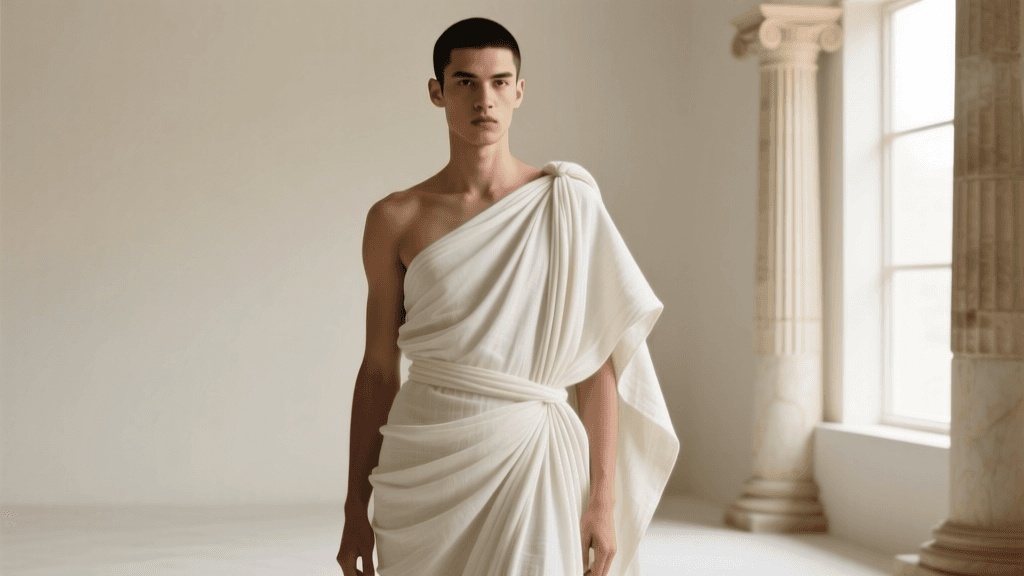
Forget the semi-circle sheets of modern costume parties. By the Imperial period, the toga had evolved into a massive, intricately shaped garment, often measuring 4.5 to 5.5 meters in length and 2.5 meters in width, featuring a complex curved edge. To drape a historically accurate 2026 reproduction of the toga virilis (the plain white toga of the adult male citizen), follow these precise steps:
- The Anchor: Drape the fabric over the left shoulder, allowing the front hem to fall to the floor, grazing the instep of the left foot.
- The Wrap: Pull the remaining fabric across the back, under the right arm, and across the chest. The fabric must be pulled taut across the back to restrict the right arm's movement, enforcing a dignified, measured posture.
- The Sinus: Create a deep, sweeping fold (the sinus) across the front of the body by pulling the lower edge of the fabric downward before throwing the remainder back over the left shoulder.
- The Umbo: Gather a pouch of fabric from the chest drape and pull it up and over the left shoulder to create the umbo, a decorative and functional knot that helps weigh down the front drape and provides a makeshift pocket for scrolls or small items.
"The toga was not merely clothing; it was an architectural feat of wool that demanded a specific physical bearing. To wear it correctly in 2026 reenactments is to understand the physical weight of Roman civic responsibility." — Dr. Aris Thorne, Classical Textile Historian.
The Roman Stola and Palla
Roman citizen women did not wear the toga; instead, they wore the stola over a base tunic (tunica interior). The stola was a long, sleeveless or short-sleeved dress, suspended from the shoulders by straps or small pins, and characterized by the institia—a decorative border at the hem that signaled the wearer's modesty and matronly status. Over the stola, women draped the palla, a large rectangular mantle that could be pulled over the head when entering sacred spaces or walking in public. For 2026 productions, using a 200 GSM linen for the stola and a softer 140 GSM wool for the palla provides the perfect visual contrast and functional layering.
Sourcing Historical Textiles and Accessories in 2026
The landscape of historical sourcing has shifted dramatically. In 2026, the most dedicated reenactors are bypassing commercial costume shops and partnering directly with sustainable European mills that utilize traditional shuttle looms. Mills in Ireland and Lithuania are currently producing unbleached, naturally dyed linens that perfectly mimic the archaeological textile fragments found in Mediterranean digs. For wool, lightweight merino and alpaca blends from specialized weavers in the UK offer the necessary fluidity without the suffocating heat of modern commercial wools.
Essential Accessories: Fibulae, Belts, and Footwear
A garment is only as authentic as its hardware. The structural integrity of a chiton or peplos relies entirely on the fibula. Modern safety pins are an immediate anachronism. Reenactors must source cast bronze or iron penannular or bow fibulae, ensuring the pin gauge is thick enough (at least 2mm) to pierce heavy wool without tearing the weave. Belts should be constructed from vegetable-tanned leather, fastened with simple bronze rings or tied in a knot, avoiding modern buckles entirely.
Footwear completes the silhouette. For indoor Greek scenes, bare feet or simple leather soleae (sandals) are appropriate. For Roman military or outdoor civic contexts, the caliga (hobnailed military sandal) or the calceus (enclosed leather shoe for senators) are mandatory. In 2026, several bespoke cobblers specialize in historically lasted Roman footwear, utilizing authentic vegetable-tanned leathers and hand-forged iron hobnails for traction on uneven terrain.
Conclusion
Recreating the garments of ancient Greece and Rome is an exercise in architectural draping, material science, and historical empathy. By abandoning modern sewing conventions and embracing the mathematical precision of the loom-width rectangle, modern reenactors can achieve a level of authenticity that honors the classical world. Whether you are draping the crisp, structured folds of an Ionic chiton or managing the heavy, restrictive majesty of an Imperial toga, the key lies in respecting the fabric's weight, the historical context of the wearer, and the timeless elegance of the ancient drape.