Guide to Traditional Tai Chi and Martial Arts Practice Wear
The Intersection of Movement and Attire in Taijiquan
Tai Chi (Taijiquan) is much more than a sequence of slow, deliberate movements; it is a profound mind-body practice rooted in traditional Chinese medicine, martial arts, and the cultivation of internal energy, or qi. As practitioners deepen their understanding of this art, the clothing they wear becomes an essential component of their practice. According to Harvard Medical School, Tai Chi offers immense benefits for balance, flexibility, and cardiovascular health, all of which require a physical environment—including your attire—that supports unrestricted movement. Traditional Tai Chi practice wear is specifically engineered to facilitate deep stances, sweeping arm movements, and the seamless flow of energy across the body's meridian lines.
Unlike modern athletic wear, which often relies on tight, compressive synthetic fabrics to wick sweat and support muscles, traditional Chinese martial arts clothing prioritizes looseness, breathability, and a harmonious connection with the natural environment. Wearing restrictive clothing can impede circulation and disrupt the mindful, grounded state required for effective practice. This guide explores the essential elements of traditional Tai Chi and martial arts practice wear, providing actionable advice on fabrics, garment construction, footwear, and proper sizing for both beginners and seasoned martial artists.
The Philosophy of Loose Fitting and Qi Flow
In traditional Chinese culture, clothing is viewed as an extension of the body and its energy system. The foundational principle of Tai Chi attire is that it must never bind or constrict. Tight waistbands, restrictive shoulder seams, and compressive sleeves can block the flow of qi through the body's meridians. The Mayo Clinic highlights that the stress-reduction and mindfulness aspects of Tai Chi are deeply tied to physical comfort and breathwork. If your clothing restricts your diaphragm or limits the expansion of your ribcage during deep abdominal breathing, you are actively working against the core tenets of the art.
Traditional practice wear features relaxed silhouettes that drape naturally over the body. This allows the practitioner to focus entirely on their form, weight shifting, and rooting into the ground, rather than adjusting to the friction or tension of their garments. Furthermore, the flowing nature of silk and cotton uniforms visually accentuates the continuous, circular movements of Tai Chi, providing immediate visual feedback to the practitioner and their instructors regarding the smoothness of their transitions.
Fabric Choices: Silk, Cotton, Linen, and Bamboo
Selecting the right fabric is critical and depends heavily on your practice environment, the climate, and whether you are practicing for daily health maintenance or preparing for a formal competition. Below is a comprehensive comparison of the most common fabrics used in traditional Tai Chi uniforms.
| Fabric Type | Breathability | Durability | Best Use Case | Estimated Cost |
|---|---|---|---|---|
| 100% Cotton | High | Very High | Daily outdoor practice, summer training, heavy sweating | $30 - $60 |
| Mulberry Silk | Moderate | Low (Delicate) | Indoor practice, competitions, demonstrations, cool weather | $100 - $250+ |
| Raw Linen | Very High | High | Hot and humid climates, outdoor park practice | $50 - $90 |
| Bamboo Blends | High | Moderate | Year-round indoor practice, sensitive skin | $40 - $80 |
When to Choose Cotton
Cotton is the undisputed workhorse of daily Tai Chi practice. It is highly absorbent, easy to wash, and withstands the friction of outdoor environments, such as brushing against tree branches in a park. For daily morning practice, a medium-weight cotton uniform is ideal. However, cotton retains moisture, so if you sweat heavily, it can become cold and clammy in winter weather.
The Allure of Silk
Silk is the traditional fabric of choice for Tai Chi competitions and formal demonstrations. It is lightweight, temperature-regulating, and possesses a natural elasticity that moves beautifully with the body. The visual shimmer of silk highlights the fluidity of forms like the Yang or Chen styles. However, silk requires meticulous care—hand washing in cold water with mild detergent and air drying away from direct sunlight is mandatory to prevent fiber degradation.
Essential Garments: Cuts, Slits, and Frog Buttons
A standard Tai Chi uniform, often referred to as a Taijiquan fu, consists of a top and matching pants. The construction of these garments features specific traditional elements designed for martial arts mobility.
The Tai Chi Jacket (Tangzhuang)
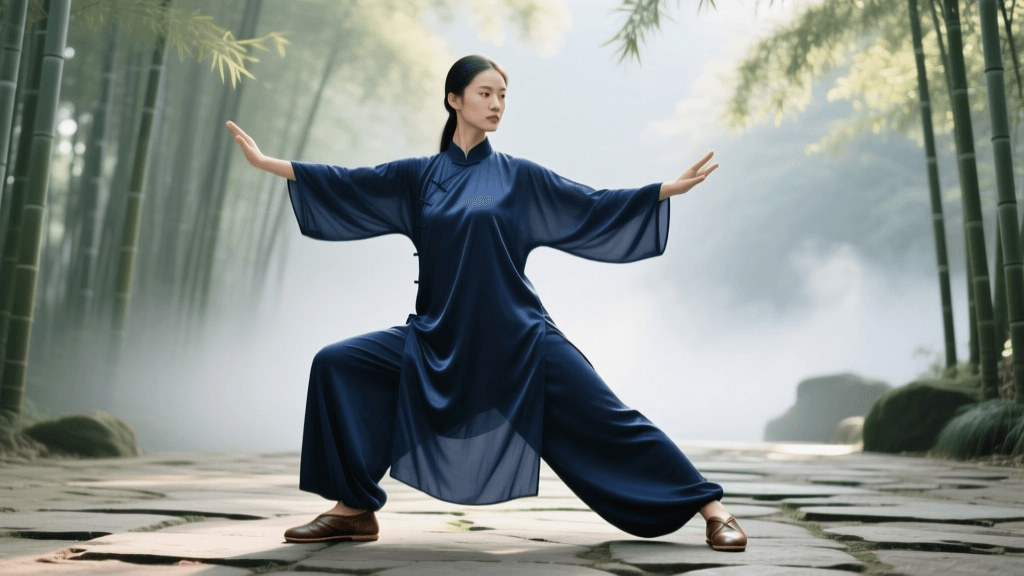
The traditional top is characterized by a mandarin collar and pankou (traditional Chinese frog buttons). These knotted buttons are not merely decorative; they lie flat against the body, ensuring that no hard plastic or metal elements press into the skin during grounding exercises or when practicing with weapons like the Tai Chi sword or fan. Crucially, the jacket features deep side slits that extend up to the hip or waist. These slits are non-negotiable for martial artists, as they allow the jacket to drape elegantly over the hips during deep stances, such as the Pu Bu (drop stance) or Xu Bu (empty stance), without bunching up or restricting the thighs.
The Tai Chi Pants and the Diamond Gusset
The most important structural element of Tai Chi pants is the gusseted crotch. Unlike standard trousers that feature a simple intersecting seam at the crotch, traditional martial arts pants incorporate a diamond-shaped piece of fabric (the gusset) sewn into the inseam. This design drops the crotch line significantly, providing an extraordinary range of motion. When performing deep squats or wide horse stances (Ma Bu), a gusseted pant prevents the seams from pulling tight and tearing. The waist is typically equipped with a wide, soft elastic band and a drawstring to ensure the garment stays securely in place without digging into the abdomen, which would interfere with Dantian breathing.
Footwear: Grounding, Balance, and Proprioception
Your connection to the earth is the foundation of all Tai Chi movements. Modern running shoes, with their thick, cushioned heels and rigid arch supports, are entirely unsuited for Tai Chi. They elevate the heel, alter your center of gravity, and dull the proprioceptive feedback from the soles of your feet. The global community celebrated during events like World Tai Chi and Qigong Day often showcases practitioners in traditional, flat-soled footwear, emphasizing the universal standard for proper grounding.
Traditional Kung Fu Shoes
The ideal footwear for Tai Chi is the traditional Chinese cloth shoe, often called a Kung Fu shoe. These shoes feature a canvas or cotton upper and a very thin, flat rubber or cotton sole. The thin sole allows the practitioner to feel the texture of the ground, grip the earth with their toes, and smoothly transition weight from the heel to the ball of the foot. When purchasing Kung Fu shoes, look for a sole thickness of no more than 4mm to 6mm. Ensure the toe box is wide enough to allow your toes to splay naturally, which is vital for maintaining balance during single-leg stances like Jin Ji Du Li (Golden Rooster Stands on One Leg).
Sizing, Fit, and Care Instructions
Proper sizing for Tai Chi wear differs from Western fashion sizing. The garments are meant to be oversized, but not so large that they become a tripping hazard.
- Measuring the Inseam: Tai Chi pants should break just at the top of the shoe or ankle bone. Measure from the crotch to the ankle bone. If the pants are too long, they will catch under your heel during stepping exercises.
- Sleeve Length: When your arms are extended straight out to the sides, the sleeves of the jacket should end exactly at the wrist bone. This ensures your hands remain free for weapon manipulation and precise hand forms (like the 'sword fingers').
- Shoulder Fit: The shoulder seam should drop slightly past your natural shoulder line, creating a relaxed, sloping silhouette that prevents tension in the neck and upper back.
Maintenance and Longevity
To maintain the structural integrity of your practice wear, avoid using high heat in the dryer, which can shrink cotton and melt the elastic in the waistbands. For cotton uniforms, machine wash on a gentle cycle with cold water and hang dry. For silk garments, invest in a specialized silk wash, never wring the fabric, and iron on the lowest possible heat setting using a pressing cloth to avoid scorching the delicate fibers.
Conclusion
Investing in high-quality, traditional Tai Chi practice wear is an investment in your martial arts journey. By choosing breathable fabrics, accommodating cuts with side slits and gusseted crotches, and proper flat-soled footwear, you remove physical barriers between your mind, your body, and the ground. Whether you are practicing the slow, meditative movements of the Yang style in a quiet park or performing the explosive, dynamic fajin of the Chen style in a studio, the right traditional attire will support your pursuit of harmony, balance, and internal strength.