Zero-Waste Kimono Construction: Flat Pattern Cutting Guide 2026
The Environmental Imperative of 2026 and Ancient Solutions
As the global fashion industry navigates the stringent environmental regulations and textile waste directives enacted across the European Union and parts of Asia in 2026, zero-waste pattern drafting has transitioned from an avant-garde concept to a fundamental industry requirement. Modern designers are scrambling to eliminate the 15% to 20% fabric offcut waste inherent in Western contoured tailoring. Yet, the ultimate blueprint for sustainable garment construction has existed for centuries within traditional Asian dress traditions. The Japanese kimono represents a masterclass in zero-waste engineering, utilizing a strictly rectangular, flat-pattern cutting system that leaves absolutely no fabric behind. According to the Victoria and Albert Museum, the kimono's structural brilliance lies not in complex tailoring, but in its profound respect for the integrity of the woven textile. By examining these historical construction techniques, today's pattern makers and sustainable fashion advocates can unlock timeless solutions for modern wardrobes.
Understanding Tanmono: The Foundation of Rectangular Cutting
The core of traditional kimono construction is the tanmono, a standardized bolt of fabric woven specifically for garment creation. Unlike Western textile manufacturing, which produces broadcloth widths (often 115cm to 150cm) that must be cut into curved shapes, a standard kimono tanmono is woven to a precise, narrow width—typically between 36cm and 40cm (approximately 14 to 16 inches), with a total length of about 12 meters (13 yards).
This specific dimension is not arbitrary; it is mathematically calibrated to the human form. The 36cm width perfectly accommodates the width of a standard body panel, a sleeve, or an overlap panel when accounting for seam allowances. Because the fabric is cut entirely in straight lines parallel or perpendicular to the selvage edges, the entire 12-meter bolt is utilized. If the garment is ever damaged, stained, or outgrown, the seams can be unpicked, the rectangular panels washed, and the fabric completely re-tailored or repurposed. The Metropolitan Museum of Art's Heilbrunn Timeline of Art History notes that this modular approach to Japanese textiles reflects a deep cultural reverence for materials, ensuring that textiles are treated as enduring assets rather than disposable commodities.
Anatomy of the Kimono: A Masterclass in Modular Construction
To understand the zero-waste genius of the kimono, one must deconstruct its anatomy. A standard kimono is composed of exactly eight primary rectangular panels, plus smaller pieces for the collar and lining. There are no darts, no curved armholes, and no shoulder slopes. The construction relies entirely on straight seams and the manipulation of fabric volume through folding and tying.
- Migoro (Body Panels): Two long rectangular panels that form the front and back of the main body. They are folded over the shoulders, eliminating the need for a shoulder seam.
- Okumi (Front Overlaps): Two narrower panels attached to the front edges of the migoro to create the overlapping front closure essential for wrapping the garment.
- Sode (Sleeves): Rectangular panels attached to the migoro. The sleeve opening and the underarm opening (waki) are left partially unstitched, creating the iconic square sleeve shape and allowing for ventilation and movement.
- Eri (Collar): A long, narrow strip of fabric folded and attached to the neckline, extending down the front edges to finish the garment.
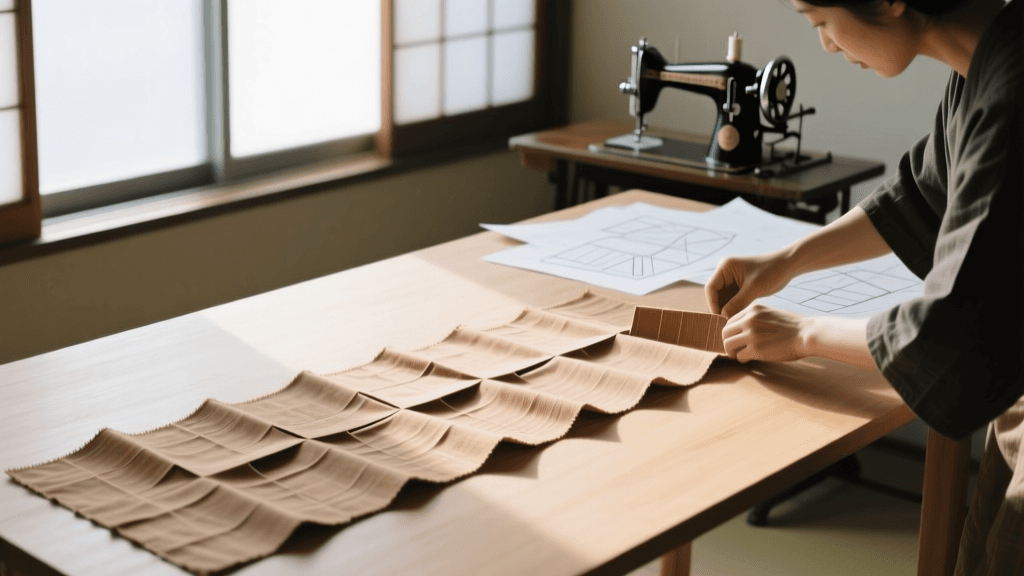
Because every piece is a rectangle, the cutting process requires only measuring and straight snips. The selvage edges of the tanmono are frequently utilized as finished edges inside the garment, preventing fraying without the need for modern serging or overlocking techniques.
The Art of the Seam: Kise and Unshin Techniques
While the cutting is straightforward, the sewing techniques used in traditional kimono construction (wasai) are highly specialized to ensure the garment drapes elegantly despite its geometric origins. Two techniques are paramount:
Unshin (The Running Stitch)
Long seams in a kimono are sewn using unshin, a specialized hand-running stitch. Unlike the rigid, locked stitches of a modern sewing machine, unshin creates a slightly flexible seam that moves with the wearer. The sewer uses a thimble on the middle finger to push the needle through multiple fabric folds at once, creating incredibly straight, even, and durable seams that allow the silk to breathe and drape naturally.
Kise (The Folded Seam Allowance)
In Western tailoring, seam allowances are typically pressed flat open or serged. In kimono construction, seams are finished using kise. The seam allowance is folded back slightly toward the inside of the garment, leaving a tiny, soft roll of fabric at the seam line rather than a hard, pressed edge. This technique protects the silk from tearing along the stitch line, adds a subtle three-dimensional softness to the garment's vertical lines, and allows the seams to be easily unpicked and re-sewn decades later without damaging the visible face of the fabric.
Comparative Analysis: Rectangular vs. Contoured Tailoring
The contrast between traditional East Asian construction and Western tailoring highlights a fundamental divergence in how clothing interacts with the human body. The following table outlines these structural differences:
| Feature | Traditional Kimono (Rectangular) | Western Tailoring (Contoured) |
|---|---|---|
| Pattern Base | Straight lines, modular rectangles | Curved lines, body-mapped shapes |
| Fabric Waste | 0% (Zero-waste by design) | 15% - 25% offcut waste |
| Shoulder Construction | Folded continuous panel (no seam) | Cut and seamed shoulder slope |
| Fitting Method | Wrapped and tied (Obi) | Darts, pleats, and structured seams |
| End-of-Life | Unpicked, panels reused entirely | Difficult to recycle due to mixed cuts |
Essential Traditional Tools for Flat-Pattern Sewing
For artisans and sustainable fashion students practicing these techniques in 2026, mastering the traditional tools of wasai is essential. While modern equivalents exist, traditional tools offer unparalleled precision for delicate textiles.
- Shaku (Bamboo Ruler): A traditional measuring stick marked in the Japanese shaku system. Modern practitioners often use specialized flexible bamboo rulers that allow for precise measuring of long, continuous rectangular panels without bending the fabric.
- Hera (Marking Spatula): A smooth, flat piece of bamboo or deer antler used to crease fabric and mark seam lines without the use of ink or chalk, ensuring no chemical residues are left on heirloom silks.
- Kote (Traditional Iron): Historically a charcoal-heated iron, modern 2026 iterations are temperature-controlled, heavy-bottomed electric irons designed specifically for pressing silk seams and executing the delicate kise fold without scorching.
- Machi-bari (Silk Pins): Exceptionally fine, flexible pins used to hold layers of silk together without leaving permanent holes in the tightly woven fibers.
The 2026 Revival: Adapting Tanmono for Modern Sustainable Wardrobes
In 2026, the principles of tanmono cutting are experiencing a massive renaissance beyond traditional ceremonial wear. Leading sustainable design houses in Tokyo, Seoul, and Copenhagen are adopting the '36cm constraint' as a creative framework for modern zero-waste collections. By limiting their digital pattern-making software—such as the latest iterations of CLO 3D and Marvelous Designer, which now feature dedicated 'Rectangular Bolt' modules—to these strict dimensions, designers are creating modern trench coats, modular trousers, and wrap dresses that generate zero landfill waste.
Furthermore, the secondary market for vintage tanmono has surged. According to Encyclopædia Britannica, the cultural preservation of the kimono has heavily influenced global textile arts. In early 2026, pricing for authentic, unused vintage silk bolts in Kyoto's Nishijin district rose by approximately 18%, driven by international designers purchasing deadstock historical textiles to craft modern, zero-waste capsule collections. This cross-pollination ensures that the ancient mathematics of Asian garment construction continue to shape the future of global eco-fashion.
Conclusion
The construction of the traditional kimono is a testament to the ingenuity of Asian dress traditions. By viewing fabric not as a raw material to be carved away, but as a precious geometry to be folded and respected, traditional artisans solved the fashion industry's waste problem centuries before it was recognized as a crisis. For the modern maker, studying the tanmono system, the unshin stitch, and the kise finish offers more than just historical knowledge; it provides a viable, elegant, and entirely sustainable blueprint for the future of garment construction in 2026 and beyond.