2026 Seoul Hanbok Sewing Masterclasses: Chima & Jeogori Guide
The 2026 Resurgence of Hanbok Construction
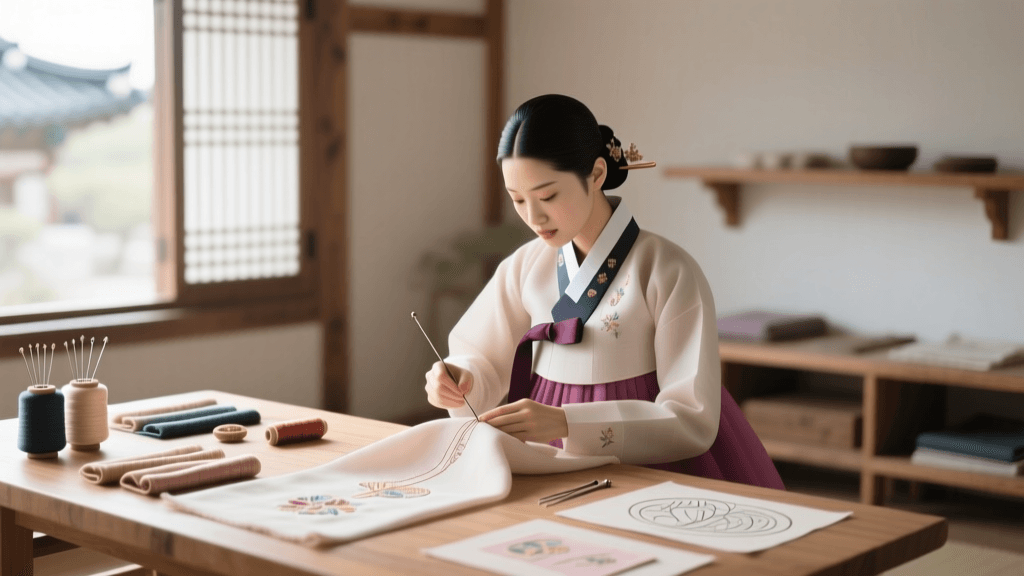
The global fascination with Korean culture has reached a pivotal moment in 2026, shifting from passive appreciation to active, hands-on creation. While renting and wearing the hanbok has been a staple of Seoul tourism for years, a new wave of 'maker-tourism' has taken over the city. Today, international visitors and serious textile enthusiasts are flocking to specialized sewing seminars to learn the intricate art of constructing the chima (voluminous skirt) and jeogori (structured jacket). According to the Korea Craft & Design Foundation, participation in traditional textile and garment-making workshops has surged by over 45% in early 2026, driven by a global desire for sustainable, slow-fashion practices and deep cultural immersion.
Learning to sew a hanbok is not merely about stitching fabric; it is an exercise in geometry, philosophy, and heritage. The straight lines and gentle curves of the hanbok reflect the traditional Korean aesthetic of yeongye (natural harmony). For those looking to master these techniques, Seoul offers an array of world-class masterclasses that blend centuries-old methodologies with 2026's smart-tailoring technologies.
Top Seoul Hanbok Sewing Academies for 2026
Choosing the right workshop is critical for mastering the precise measurements and hidden stitching techniques required for authentic hanbok construction. Here are the premier institutions offering comprehensive seminars this year.
1. Seoul Woori Hanbok Academy
Located in the historic Bukchon Hanok Village, the Seoul Woori Hanbok Academy is renowned for its uncompromising dedication to traditional methods. Their flagship 2026 intensive course, 'The Architecture of the Jeogori,' focuses heavily on the bae-hwa (the curved underarm gusset) and the structural integrity of the git (collar). Students in this seminar work exclusively with Myeongju (traditional Korean silk) and learn the meticulous hand-stitching techniques that allow the garment to drape effortlessly without rigid seams. The academy also introduced a new module this year on natural indigo and persimmon dyeing, allowing students to customize their fabric before cutting.
2. Jongro Traditional Craft Center
For a more modern, hybrid approach, the Jongro Traditional Craft Center offers the 'Contemporary Chima & Goreum Masterclass.' This seminar is perfect for those who want to understand traditional aesthetics but require modern sizing adaptations. The highlight of this course is the creation of the goreum (the long, elegant chest ties). In 2026, the center introduced digital tension meters to help beginners achieve the perfect knot stiffness and drape, a task that traditionally takes years of muscle memory to master. For international travelers booking cultural tourism packages, the official VisitKorea portal now features a dedicated 2026 cultural immersion directory where you can secure spots at Jongro with English-speaking translators.
Essential Tools: Traditional vs. 2026 Smart Tailoring
One of the most exciting aspects of attending a hanbok seminar in 2026 is witnessing the intersection of heritage craftsmanship and modern innovation. While the fundamental geometry of the hanbok remains unchanged, the tools used to measure and cut have evolved to help beginners achieve professional results faster.
| Tool Category | Traditional Heritage Tool | 2026 Smart Upgrade | Primary Application in Hanbok |
|---|---|---|---|
| Measuring | Bamboo Ruler (Ja) | Laser-Guided Smart Tape | Calculating the exact drop and waist circumference of the Chima. |
| Marking | Soapstone Chalk | Water-Soluble Digital Pen | Drafting the curved Baerae (sleeve hem) on slippery silk. |
| Cutting | Carbon Steel Shears | Ultrasonic Fabric Cutter | Sealing the edges of synthetic-blend Ramie to prevent fraying. |
| Pressing | Heavy Iron Charcoal Press | Steam-Grid Vacuum Board | Setting the sharp, permanent pleats of the Chima skirt. |
Core Curriculum: What You Will Learn in a 5-Day Seminar
Most comprehensive hanbok-making workshops in Seoul operate on a rigorous five-day schedule. If you are enrolling in a full-time 2026 seminar, here is the step-by-step curriculum you can expect to tackle:
- Day 1: Sourcing and Fabric Preparation. Students visit the famous Gwangjang Market textile alleys to source their Mosi (ramie) or silk. The afternoon is spent on fabric preparation, including pre-shrinking and aligning the grain, which is crucial for the asymmetrical draping of the left-over-right jacket closure.
- Day 2: Drafting and Cutting the Jeogori. Unlike Western tailoring, hanbok patterns are largely based on straight lines and geometric angles. Students learn to draft the gil (front and back panels) and the somae (sleeves) using traditional flat-pattern techniques.
- Day 3: The Art of the Hidden Stitch. The hallmark of a high-quality hanbok is that the seams are virtually invisible from the outside. Day 3 is dedicated entirely to mastering the gamchim-jil (blind stitch) and the delicate topstitching required for the dongjeong (the removable white paper collar).
- Day 4: Chima Pleating and Waistband Construction. The chima requires an immense amount of fabric, often upwards of four meters. Students learn the mathematical distribution of pleats to ensure the skirt flares perfectly when the wearer sits or walks.
- Day 5: The Goreum and Final Fitting. The final day focuses on attaching the goreum and learning the proper kitsuke (dressing) techniques. Students learn how to tie the traditional bow, ensuring the loops are asymmetrical and the ends fall at the precise traditional lengths.
Virtual and Hybrid Seminar Alternatives
Not everyone can travel to South Korea for a multi-week immersion. Fortunately, the 2026 educational landscape includes robust hybrid options. Institutions like the Global Hanbok Heritage Institute now offer augmented reality (AR) assisted online masterclasses. Students receive a pre-measured, pre-dyed textile kit shipped directly to their home. During live-streamed seminars, instructors use AR overlays on the student's camera feed to highlight exact stitching lines and correct fabric tension in real-time.
'The beauty of the hanbok lies in its empty space. It is not tailored tightly to the body; it is tailored to the space between the body and the fabric, allowing for breath, movement, and grace.' — Master Artisan Kim Soo-yeon, 2026 Seoul Textile Symposium.
Preparing for Your Workshop: Practical Advice
If you are planning to attend a hanbok sewing seminar in Seoul this year, preparation is key. First, ensure you have a basic understanding of hand-sewing; while machines are sometimes used for inner linings, the outer structural elements are almost exclusively hand-stitched. Second, invest in a high-quality pair of fabric shears before your trip, as left-handed traditional shears can be difficult to source quickly in Seoul. Finally, familiarize yourself with basic Korean tailoring terminology. Knowing the difference between hwa-seon (curved lines) and jik-seon (straight lines) will vastly accelerate your learning curve during the intensive drafting sessions.
Conclusion
The year 2026 marks a golden era for traditional Asian garment education. By stepping into a Seoul masterclass to construct your own chima and jeogori, you are doing more than learning a sewing technique; you are participating in the living preservation of Korean heritage. Whether you are utilizing 2026's smart-tailoring lasers or relying on the quiet discipline of a bamboo ruler and needle, the result is a profoundly personal connection to one of Asia's most breathtaking sartorial traditions.