Tongan Ngatu Making Process And Plant Based Dye Recipes
The Living Art of Ngatu: Tonga’s Ceremonial Cloth
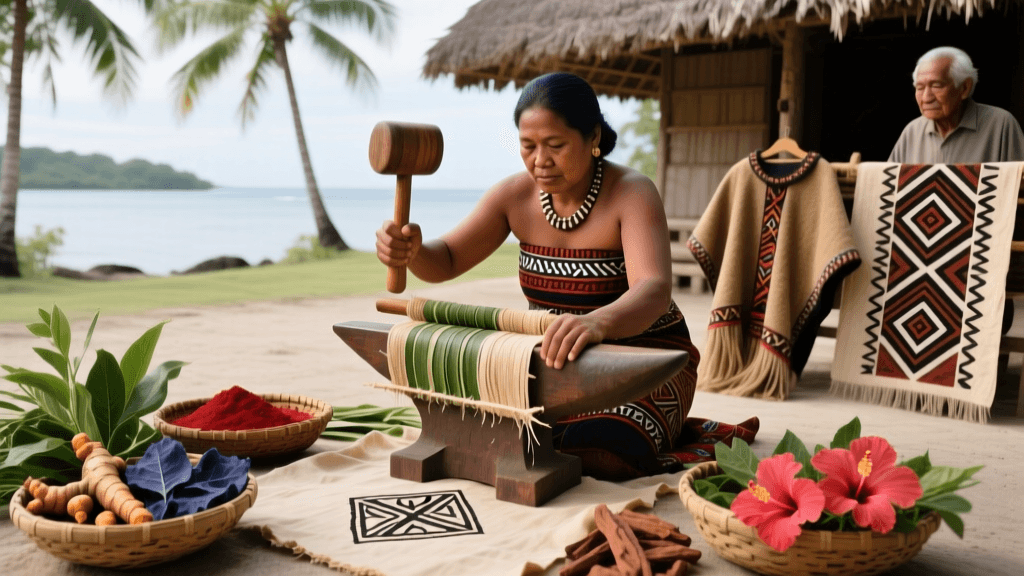
Ngatu is more than cloth—it is memory made tangible, lineage made visible, and reciprocity made ritual. Woven from the inner bark of the paper mulberry tree (Broussonetia papyrifera), ngatu forms the ceremonial heart of Tongan life: worn at weddings, funerals, royal installations, and church dedications. Unlike commercial textiles, ngatu carries genealogical weight—each pattern, each dye batch, each beating rhythm echoes ancestral knowledge passed across generations. Its production is never solitary; it is a communal act governed by strict cultural protocols, including gendered roles, seasonal timing, and sacred spaces. Women lead the process—from harvesting to beating to painting—while men assist in felling trees and preparing the work area. The Tongan phrase ‘e tōngā kau’ (“the cloth is ready”) signals not just completion but readiness for ceremony, signifying alignment with social and spiritual obligations.
Harvesting and Preparation: Timing, Tools, and Taboos
Harvesting begins during the dry season, typically between May and October, when sap flow is minimal and bark peels cleanly. Only mature paper mulberry stems—between 1.5 and 2.5 meters tall and 3–5 cm in diameter—are selected. Cuttings are taken early in the morning before sunrise, a practice rooted in the belief that dawn light preserves the bark’s pliability. Stems are stripped of leaves and left to cure for 7–10 days in shaded, well-ventilated areas. This curing period reduces moisture content to approximately 18–22%, preventing mold while retaining enough flexibility for stripping.
Stripping and Soaking Protocols
Stripping is done with shell scrapers or bamboo knives, never metal tools, to avoid contaminating the fiber with foreign energy. The outer bark is removed first, then the inner bast layer is carefully peeled away in continuous ribbons. These ribbons are soaked in freshwater streams for 48–72 hours—a duration verified by the National Museum of Tonga’s 2019 field documentation—to soften lignin without weakening cellulose. During soaking, elders recite prayers invoking ‘Ene’io’, the guardian spirit of tapa-making, affirming that no step proceeds without acknowledgment of relational accountability.
Beating: Rhythm as Knowledge Transmission
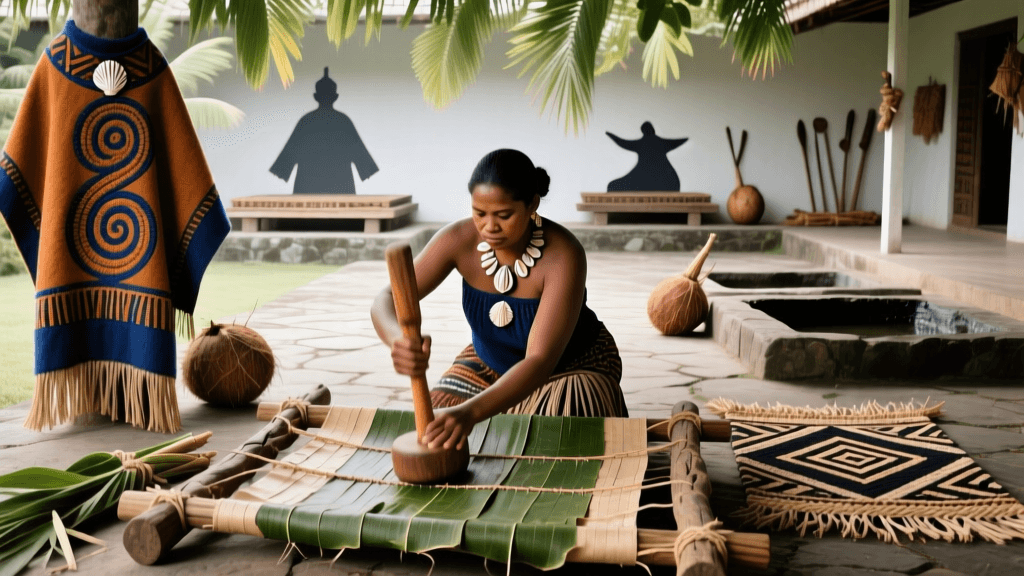
Beating transforms stiff bark into supple cloth through rhythmic pounding with wooden mallets called ike. Each ike measures precisely 45 cm long, with three distinct grooved surfaces: coarse (for initial separation), medium (for thinning), and fine (for smoothing). A single sheet may require 6–8 hours of continuous beating across multiple sessions, with rest intervals to prevent fiber fatigue. The beaters move in unison, their cadence matching traditional chants like “Taku ngatu, e tōngā kau”, reinforcing intergenerational continuity. At the Tonga National Centre for Culture and Heritage in Nukuʻalofa, master practitioners teach youth to count beats in sets of seven—a number symbolizing the seven main islands of Tonga—and to pause after every 49 strokes to reposition the sheet, ensuring even tension.
Joining Sheets: The Seam as Story
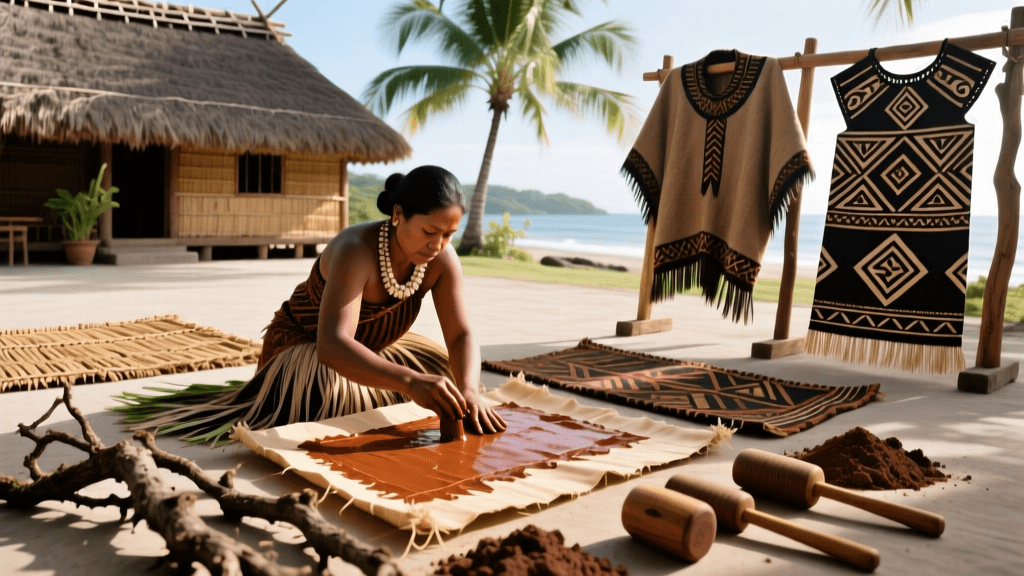
Individual sheets—each measuring approximately 1.2 meters wide and up to 4.5 meters long—are joined edge-to-edge using natural starch paste made from taro root. The seam is not hidden; it is emphasized with a narrow black border painted in charcoal-based dye. This visible join signifies unity without erasure—each sheet retains its origin story, whether harvested from Haʻapai, Vavaʻu, or Tongatapu. According to archival records held at the Bishop Museum in Honolulu, over 87% of pre-1940 ngatu pieces in their Pacific collection retain original seam markings, confirming this practice’s historical consistency.
Natural Dye Preparation: Botanical Precision and Ritual Care
Dyes are derived exclusively from local flora, prepared following ecologically regenerative principles. No plant is harvested beyond 20% of a stand, and root-digging occurs only once per lunar cycle. Each dye has prescribed preparation windows: turmeric roots must be grated within 90 minutes of harvest to preserve curcumin potency, while mangrove bark requires 14 days of sun-drying before extraction. All dyes are tested for pH balance using litmus strips made from crushed hibiscus flowers—neutral pH (7.0) is mandatory for fiber integrity.
Three Foundational Dye Recipes
These recipes have been standardized through community validation workshops co-facilitated by the University of the South Pacific’s Institute of Pacific Studies and the Tonga Ministry of Education in 2022:
- Black dye (‘Kolo’): Mangrove bark (Rhizophora stylosa) soaked in seawater for 21 days, then boiled for 5 hours at 95°C. Iron-rich mud from coastal lagoons is added in 1:3 ratio (mud:dye) to fix color.
- Brown dye (‘Mata’): Candlenut kernels (Aleurites moluccanus) roasted at 120°C for 45 minutes, then ground and mixed with coconut water in 1:5 ratio. Applied hot to ensure penetration.
- Yellow dye (‘Kula’): Fresh turmeric rhizomes (Curcuma longa) grated and steeped in cold rainwater for 3 hours. Strained through woven pandanus fiber, yielding dye with pH 6.2–6.5.
Design and Application: Symbolism Embedded in Geometry
Ngatu designs follow a strict visual grammar. Motifs are not decorative—they encode kinship, land tenure, and historical events. The falepu (house) motif, composed of interlocking rectangles, represents clan unity; each rectangle’s width is exactly 3.2 cm, reflecting the average span of a Tongan adult hand—the unit of measurement used in ancestral land surveys. The lauhala (pandanus leaf) motif uses parallel lines spaced precisely 1.8 mm apart, replicating the natural vein spacing observed in mature Pandanus tectorius leaves. At the ‘Atenisi Institute in Tongatapu, students learn to calibrate their freehand brushwork using brass stencils calibrated to these exact measurements.
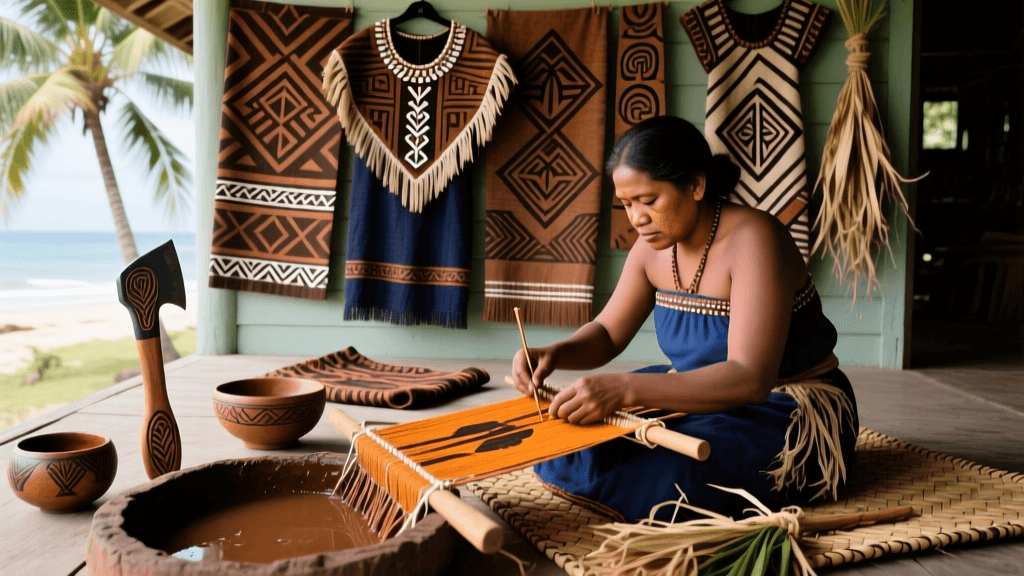
Application occurs on stretched cloth using handmade brushes from frayed coconut midribs. Painters sit cross-legged on woven mats, working from right to left—a direction aligned with the movement of the sun and the path of ancestral canoes. No design is repeated identically; variation honors the principle of ta’ovala—the respectful space between individuals and traditions.
Institutional Stewardship and Intergenerational Continuity
Preservation efforts are anchored in place-based institutions committed to Indigenous epistemologies. The Tonga National Centre for Culture and Heritage maintains a living archive of 142 documented ngatu patterns, each linked to specific villages and families. Since 2017, the centre has trained 63 master practitioners across 17 islands, with each trainee required to produce a minimum of three full-sized ngatu (each ≥3.5 m × 1.2 m) before certification. Similarly, the Fiji Museum’s Pacific Tapa Conservation Project (2020–2023) collaborated with Tongan weavers to digitize 89 pigment recipes, verifying iron oxide concentrations in black dyes via XRF spectroscopy—results confirmed consistent Fe₂O₃ levels of 62–65% across samples from 12 locations.
At the University of Auckland’s Te Pūtahi-a-Toi School of Māori and Indigenous Studies, Tongan ngatu is taught alongside Māori kākahu and Hawaiian kapa in comparative material culture courses—not as isolated artifacts, but as dynamic systems of ecological knowledge. As Dr. Sione Fua’i of the Tonga Ministry of Education states: “When a young woman beats bark, she isn’t making cloth. She is listening to the tree, measuring time with her hands, and holding space for those who will wear her work at their child’s first birthday. That is education.”
“The ngatu is not finished when the last stroke is painted. It is finished when it is wrapped around a person in need, carried into a church, or laid upon a grave. Its life begins where the maker’s ends.” — Tonga National Centre for Culture and Heritage, Ngatu Protocols Handbook, 2021
The resilience of ngatu lies in its refusal to be static. In 2023, artists from the Ha’apai Tapa Collective introduced biodegradable starch binders derived from fermented breadfruit sap—reducing drying time by 40% while maintaining archival stability. Meanwhile, at the Pacific Regional Environment Programme (SPREP) headquarters in Apia, Samoa, ngatu dye waste water is now filtered through constructed wetlands planted with native Suaeda maritima, reducing heavy metal runoff by 91% compared to conventional methods. These innovations do not replace tradition—they extend its logic into new conditions.
Each ngatu sheet weighs approximately 280–320 grams per square meter when fully dried—light enough to drape fluidly, dense enough to hold symbolic weight. Its tensile strength, measured at 4.7–5.3 MPa in laboratory testing conducted at the University of the South Pacific’s Materials Lab in 2022, exceeds that of commercially spun cotton. Yet its true durability is measured differently: in the number of ceremonies it witnesses, the number of hands that fold it with reverence, the number of children who learn their family’s motif before they learn to write.
- Ngatu production requires minimum 120 hours of labor per 4-meter sheet
- Traditional dye vats hold exactly 18 liters—matching the volume of a standard Tongan coconut-leaf basket
- Master beaters strike at a rate of 112–118 blows per minute, synchronized to oral metronomes
- Coastal mangrove stands used for black dye must be ≥200 meters from coral reefs to protect symbiotic algae
- Every certified ngatu practitioner must identify ≥17 native dye plants by scent, texture, and habitat
Across Oceania, cloth is never merely surface. It is substrate, archive, covenant. In Tonga, ngatu remains breath given form—rooted in soil, shaped by hand, and returned, always, to relationship.