Fijian Tapa Beating Techniques And Bark Cloth Pattern Transfer Methods
Origins and Botanical Foundations of Fijian Tapa
Fijian tapa, known locally as masi, is a bark cloth produced exclusively from the inner bast fibres of the paper mulberry tree (Broussonetia papyrifera). Unlike Hawaiian kapa or Tongan ngatu, which may incorporate breadfruit or fig species, Fijian masi relies almost entirely on cultivated paper mulberry—introduced over 1,500 years ago and now grown in carefully managed groves across Viti Levu and Vanua Levu. Trees are harvested when they reach 1.8–2.4 meters in height and 5–7 cm in trunk diameter, typically after 12–18 months of growth. The inner bark is stripped during the rainy season (November–April) when sap flow is highest, facilitating easier separation from the outer bark. This seasonal timing reflects deep ecological knowledge embedded in Fijian land stewardship protocols.
Preparation begins with soaking harvested stems in freshwater for 24–48 hours, followed by meticulous hand-scraping using shells or bamboo knives to remove green epidermis and woody tissue. The remaining white bast is then laid out in shaded, humid areas to ferment lightly—usually for 36–48 hours—before beating. This fermentation softens lignin without compromising tensile strength, a critical step that distinguishes high-grade masi from brittle or overly porous variants.
The Beating Process: Rhythms, Tools, and Spatial Discipline
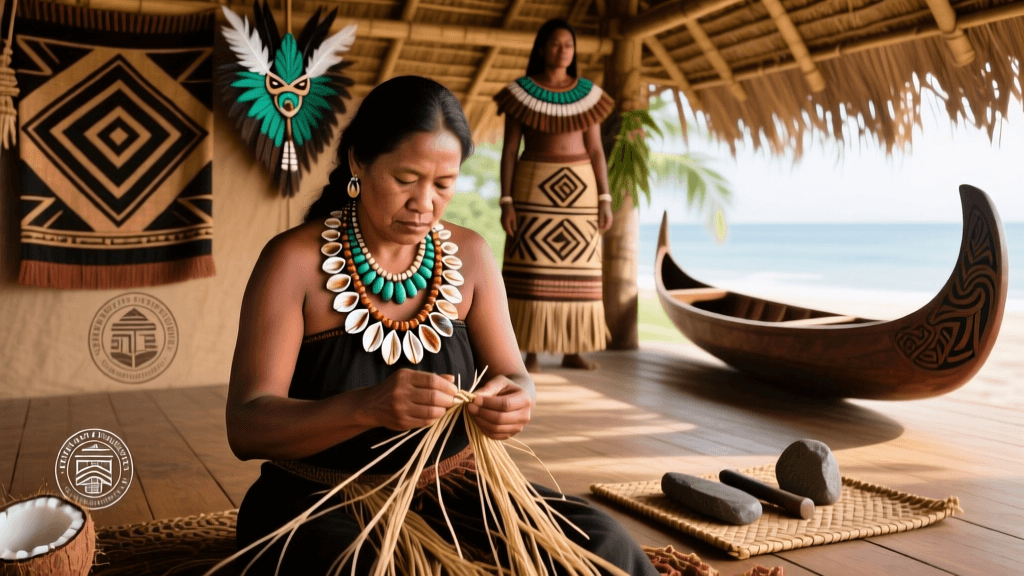
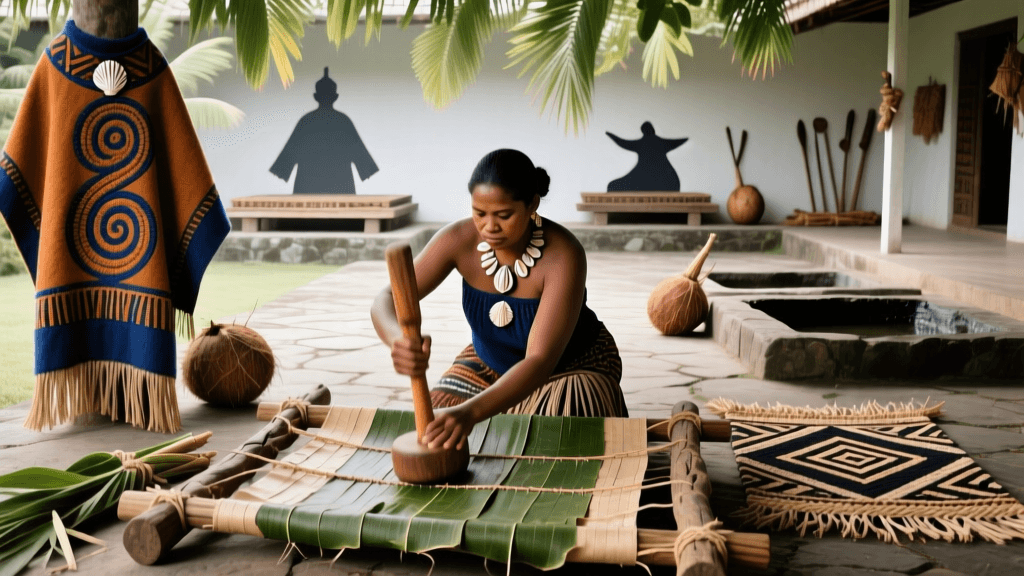
Beating transforms fibrous strips into cohesive cloth through controlled mechanical fibrillation. In villages like Navala in the Nadroga-Navosa Province, women sit in rows on woven pandanus mats, each working a single strip stretched taut over a wooden anvil called a lali. These anvils are traditionally carved from Vitex cofassus (kavika), a hardwood selected for its density (measured at 720–780 kg/m³) and resistance to warping. Each lali measures precisely 1.2 meters in length, 25 cm wide, and 15 cm thick—dimensions standardized across western Fiji to ensure consistent fibre alignment.
Beaters, or i laga, are multi-faced wooden mallets carved from Diospyros spp. (Pacific ebony). A standard i laga weighs between 1.3–1.7 kg and features four distinct striking surfaces: coarse (for initial flattening), medium-coarse (for width expansion), fine (for surface smoothing), and ultra-fine (for final sheen). Each surface bears between 22 and 36 parallel grooves, spaced 1.5 mm apart—engineered to embed micro-ridges that later accept pigment without bleeding. Beating follows strict rhythmic sequences: 12 strokes per section in the first pass, increasing to 28 in the third, always moving from centre outward to prevent curling.
Gendered Knowledge Transmission
Technique mastery is intergenerational and gender-specific. Girls begin observational learning at age 7, handling scrap strips under supervision; formal instruction starts at 12. By age 16, apprentices must produce a continuous sheet of masi measuring at least 2.5 meters long and 90 cm wide without seam breaks—a benchmark verified annually during the Sigatoka Masi Festival.
This pedagogy is codified in oral genealogies linking contemporary practitioners to ancestral lineages such as the Qaranivalu clan of Ba Province, whose women historically supplied ceremonial masi to the Vunivalu of Bau.
Pattern Transfer: From Freehand Stencils to Geometric Precision
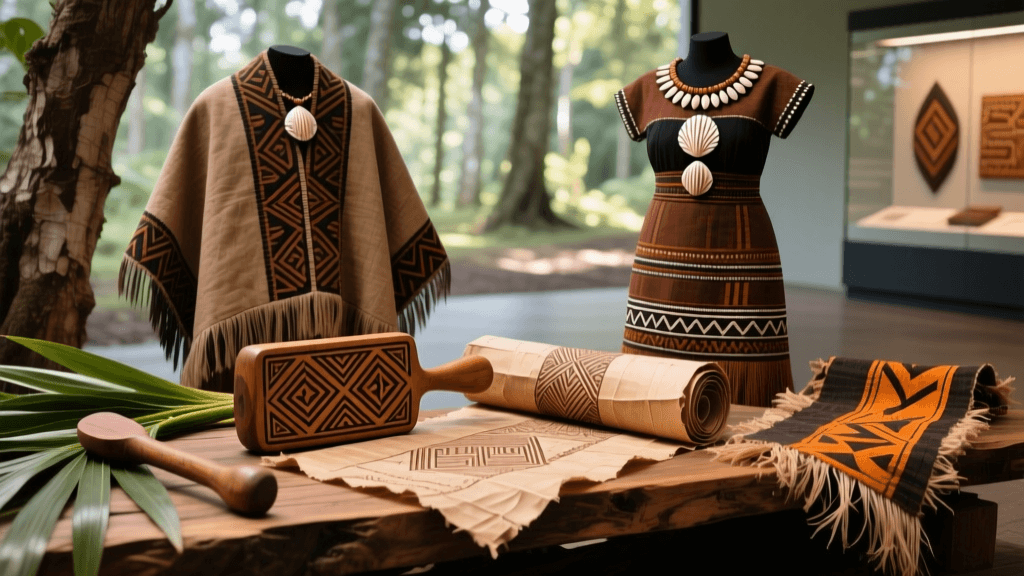
Design application occurs only after beating, on fully dried masi. Unlike Samoan siapo, which uses freehand painting, Fijian pattern transfer relies on cut-palm-leaf stencils (veiqele) applied with natural pigments. Each stencil is carved from mature leaves of the Livistona australis palm, cured for 14 days in seawater, then sun-dried for 72 hours to achieve optimal rigidity. Stencil thickness averages 0.8 mm—thin enough for crisp edge definition, yet robust enough to withstand repeated use.
Pigments derive from mineral and botanical sources: black from soot collected over coconut-oil lamps (particle size 0.2–0.5 µm), red from roasted iron-rich clay from the Sigatoka Sand Dunes (tested at pH 5.2–5.6), and yellow from turmeric root extract filtered through hibiscus fibre mesh. Application pressure is calibrated to 12–15 kPa—measured using handheld digital manometers during master workshops at the Fiji Museum in Suva.
Symbolic Grammar of Motifs
Motifs encode social identity, geography, and occasion. The veikau (shark tooth) pattern signifies chiefly lineage and appears exclusively on cloths reserved for bulu (funerary rites); its teeth measure exactly 1.2 cm in length and repeat every 4.5 cm. The valavala (woven mat) motif, denoting communal unity, features interlocking diamond units scaled to 3.0 cm × 3.0 cm. Only cloths bearing the dravu (turtle shell) design—comprising 21 concentric arcs per quadrant—are permitted at installation ceremonies for new village chiefs.
Institutional Safeguarding and Contemporary Practice
The Fiji Museum in Suva maintains the largest documented archive of historic masi, including a 1927 ceremonial cloak measuring 4.3 meters × 1.1 meters, accessioned in 1973. Its conservation lab employs non-invasive spectral imaging to map pigment degradation rates—findings indicate iron oxide red fades 37% faster than carbon black under UV exposure (Fiji Museum Conservation Report, 2021). Similarly, the Oceania Centre for Arts at the University of the South Pacific in Laucala Bay hosts biannual masi revival intensives, where elders from Kadavu Island teach youth the 13-step veiqele carving protocol.
The National Archives of Fiji in Nadi preserves 47 colonial-era field notebooks documenting regional variations—including a 1939 survey noting that Yasawa Islanders used only three beaters per sheet versus the standard five in Rewa, reflecting differential fibre preparation methods.
Cultural Protocols Governing Use and Display
Masi is never treated as mere textile. It carries mana—spiritual authority—and its handling observes strict protocols. Unbeaten bast cannot be touched by menstruating women or those who have recently attended funerals, a restriction lifted only after ritual bathing in saltwater and presentation of a yaqona (kava) offering. Ceremonial cloths are stored rolled—not folded—to prevent creasing that could fracture pigment bonds; storage cylinders are lined with dried Alphitonia zizyphoides leaves, proven to inhibit fungal growth at 65–70% relative humidity (Institute of Pacific Studies, 2019).
When worn, masi must drape correctly: men’s sulu va cloths wrap counter-clockwise, while women’s liku skirts require clockwise wrapping. Violation risks spiritual imbalance, not merely aesthetic error. At the annual Bure Kalou ceremony in Lomanikoro, cloths are unfurled only after the vakasama (ritual speaker) recites the vakamalua genealogy chant lasting precisely 11 minutes and 42 seconds.
Contemporary Adaptations and Ethical Boundaries
Contemporary designers collaborate with elders under binding agreements. For example, the Na Masimasi Project at the Fiji Handicraft Association requires written consent from originating villages before digitizing motifs—each approved design carries a QR code linking to the source community’s oral explanation. No motif associated with death rites may appear on commercial apparel; this prohibition is enforced by the Ministry of iTaukei Affairs’ Cultural Integrity Unit.
- Standard masi sheet dimensions: 2.5 m × 0.9 m (apprentice benchmark)
- Lali anvil density: 720–780 kg/m³
- Veiqele stencil thickness: 0.8 mm
- Veikau motif tooth length: 1.2 cm
- Dravu turtle-shell arcs per quadrant: 21
“The masi is not made by hands alone. It is made by memory held in the wrists, by rain remembered in the bark, by ancestors who taught us how many strokes make a truth.” — Adi Litia Qiolevu, Senior Masi Practitioner, Navala Village (Fiji Museum Oral History Archive, 2020)
| Institution | Location | Key Function | Notable Collection/Initiative |
|---|---|---|---|
| Fiji Museum | Suva | Conservation & archival research | 1927 ceremonial cloak (4.3 m × 1.1 m) |
| Oceania Centre for Arts | Laucala Bay, USP Campus | Intergenerational training | Kadavu Island veiqele carving intensives |
| National Archives of Fiji | Nadi | Historical documentation | 47 colonial-era field notebooks (1930s–1950s) |
At the Sigatoka Sand Dunes, archaeologists uncovered carbonized bast fragments dated to 1120 CE—confirming continuity of material practice over nearly nine centuries (National Trust of Fiji, 2018). This endurance reflects more than technical skill: it embodies a relational ethic wherein trees, tools, time, and people cohere as one system of meaning. When a young woman in Rakiraki completes her first seamless sheet, elders do not praise the cloth—they thank the tree, the river that soaked it, and the grandmother whose hands first showed hers how to count strokes. Such reciprocity remains the unspoken grammar beneath every pattern, every beat, every breath drawn in rhythm with the anvil.
The precision of the 1.5 mm groove spacing, the calibrated 12–15 kPa application pressure, the 21 arcs of the dravu—all these numbers are anchors. They hold fast not to industrial efficiency, but to the slow, insistent pulse of cultural memory measured in generations, not gigabytes.
Even today, in workshops at the Fiji Handicraft Association’s Nadi headquarters, apprentices still learn to test bast readiness by holding a strip to the ear and snapping it sharply: a clean, high-pitched crack means the fibres are aligned and ready. That sound—sharp, clear, resonant—is the first note in a composition that has echoed across millennia.
It is not heard in isolation. It is answered by the thud of the i laga, the rustle of veiqele against dried masi, the murmur of chant guiding the wrist’s arc. These are not techniques. They are conversations—across time, across kin, across islands—conducted in fibre, pigment, and pulse.
No museum label can contain them. No database can fully index their weight. They live where the hand meets the anvil, where the stencil meets the surface, where the number meets the name.