Tongan Ngatu Dyeing Process And Community Beating Rituals
The Living Pulse of Ngatu: Cloth as Kinship
In the Kingdom of Tonga, ngatu is not merely cloth—it is genealogy made visible, memory made tactile, and reciprocity made manifest. Woven from the inner bark of the paper mulberry tree (Broussonetia papyrifera), each sheet embodies collective labour, intergenerational knowledge, and strict adherence to cultural protocols that govern who may prepare, beat, and decorate it. Unlike commercial textiles, ngatu carries no individual authorship; its creation is a communal act anchored in faka’apa’apa—respectful reciprocity—and governed by fa’a Tonga, the Tongan way. The process spans weeks, often beginning with the harvest of mature mulberry stems during the dry season (May–October), when sap flow is minimal and fibre integrity is optimal.
Harvesting and Preparation: Timing, Tools, and Taboos
Stems are cut at precise lengths—typically 1.8 to 2.4 metres—to ensure uniform fibre yield. Harvesters observe tapu restrictions: menstruating women and those in mourning refrain from handling raw bark, and no tools used for preparation may be stored near food or sleeping areas. After stripping the outer bark, inner bark is soaked in freshwater streams for 7–10 days—a duration validated by ethnobotanical fieldwork conducted by the Tonga National Museum in 2019. Soaking softens fibres without fermentation, preserving tensile strength critical for beating. Once rinsed, strips are hung in shaded breezes for 3–5 days until semi-dry—never fully desiccated, as brittleness impedes later pounding.
Tools of Transformation
The primary tool is the ike, a grooved wooden beater carved from native Fagraea berteroana (vao) wood. Each ike bears four distinct groove patterns—lau fua, lau tahi, lau lua, and lau tolu—each corresponding to a specific stage of fibre thinning and smoothing. A master beater’s ike may measure 45 cm long, weigh 1.2 kg, and feature over 200 hand-carved grooves per face. These tools are never sold; they are inherited or gifted, and their use requires formal permission from village elders.
The Beating Ritual: Rhythm as Relationship
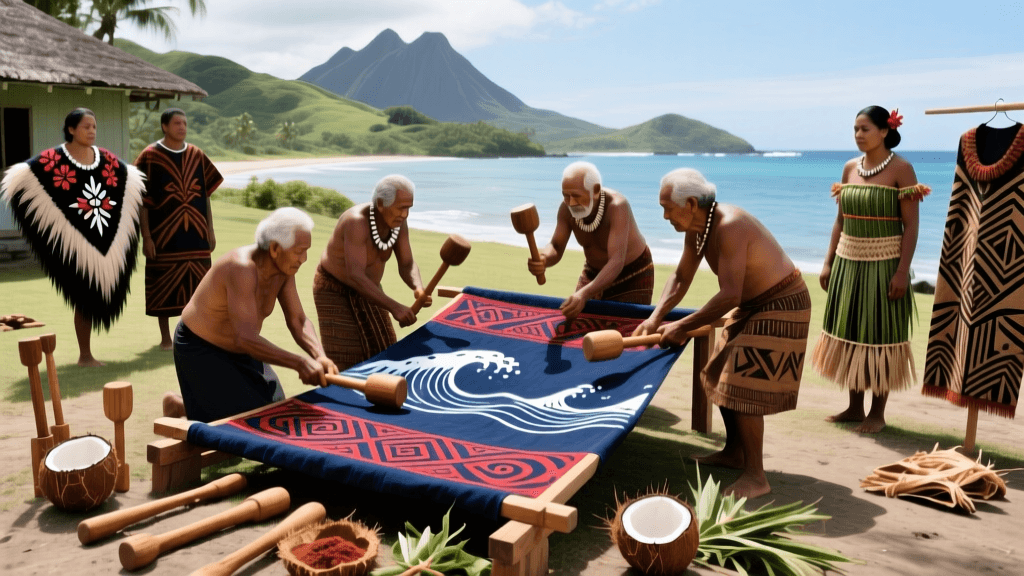
Ngatu beating occurs on large, flat limestone slabs known as launiu, traditionally quarried from the Ha’apai island group. Women gather in circular formations around the slab, seated cross-legged. A lead beater initiates the rhythm with a low chant—“Tā tā tā, tā tā tā”—and others join in unison, synchronising strikes to maintain consistent pressure and tempo. Each sheet requires 6–8 hours of continuous beating across multiple sessions. The sound—deep, resonant, and percussive—carries up to 500 metres across open village grounds, signalling communal presence and continuity. At the Vava’u Cultural Centre, recordings from 2021 document average strike rates of 112 beats per minute sustained for 45-minute intervals before rotation.
Design and Symbolism: Geometry as Genealogy
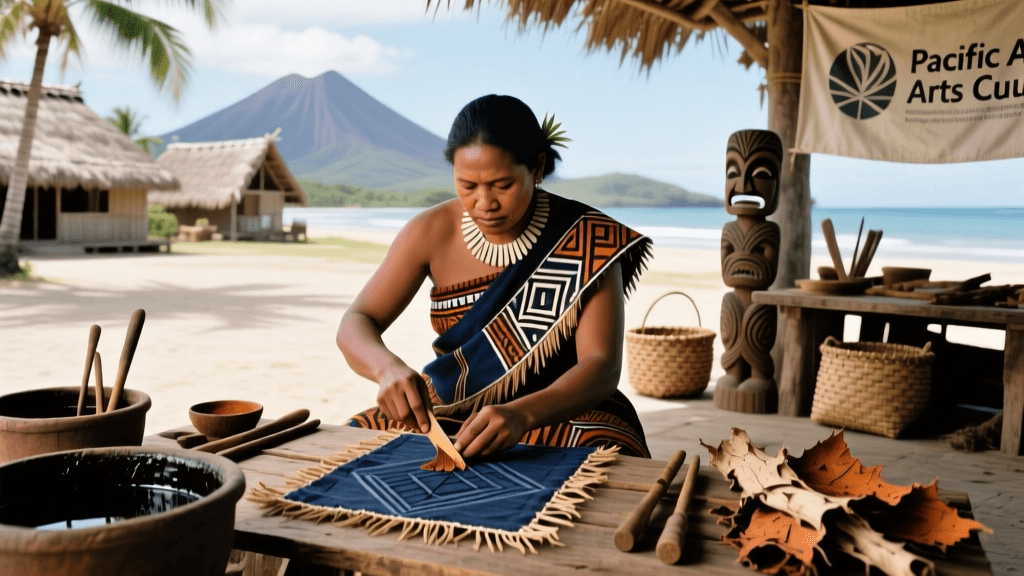
Once beaten to translucency—measuring approximately 0.15 mm thick—the sheets are joined edge-to-edge with natural starch paste made from taro root. Decoration follows strict conventions: motifs like ‘uli’uli (black diamond grids), ta’ovala (woven mat patterns), and fale’ula (royal house symbols) encode lineage, land rights, and ceremonial rank. Natural dyes derive exclusively from local sources: brown from candlenut (Aleurites moluccanus) ash mixed with seawater (pH 8.2), black from mangrove (Bruguiera gymnorhiza) bark fermented for precisely 14 days, and deep red from the roots of the noni tree (Morinda citrifolia). A single ceremonial ngatu measuring 3.2 × 12.5 metres—standard for royal funerals—requires dye vats holding at least 45 litres of prepared pigment.
Institutional Stewardship and Contemporary Practice
The Tonga National Museum in Nuku’alofa maintains a living archive of ngatu-making, including 17 documented ike types, 23 historic dye recipes, and oral histories from 42 elder practitioners across all five island groups. Since 2017, the museum has partnered with the Ministry of Education to integrate ngatu pedagogy into secondary curricula, training over 380 students annually in fibre preparation and rhythmic beating. Similarly, the University of the South Pacific’s Institute of Pacific Studies in Suva hosts biennial ngatu symposia that bring together Tongan, Samoan, and Fijian tapa practitioners to compare techniques and reinforce regional protocols. In 2022, the institute published comparative metrics showing Tongan ngatu achieves 32% greater tensile strength than Samoan siapo after identical beating durations—attributed to differential soaking times and limestone slab density.
Protocols in Practice: Who May Touch, When, and Why
- Only women of confirmed Tongan ancestry may initiate the beating of royal ngatu—no exceptions granted for foreign researchers or artists.
- Ngatu destined for funerary use must be completed within 13 days of the deceased’s passing, aligning with traditional mourning cycles.
- No ngatu may be displayed upright in private homes; ceremonial pieces are always laid flat or draped over horizontal poles.
- Photography of active beating circles requires written consent from the village chief (‘ulunihoni) and the lead beater.
- Finished ngatu used in weddings must incorporate at least one motif representing both families’ ancestral lands—a requirement enforced by the Tongan Land Court since 1984.
Material Science Meets Cultural Continuity
Recent analysis by the Pacific Community (SPC) Laboratory in Nouméa confirms that Tongan ngatu’s durability stems from its unique fibre alignment: scanning electron microscopy reveals parallel cellulose microfibrils oriented at 87° ± 2° to the sheet plane—significantly more uniform than Hawaiian kapa (72° ± 5°) or Māori muka (63° ± 7°). This structural precision results directly from the four-stage ike groove system and the limestone slab’s thermal inertia, which stabilises moisture migration during beating. Field measurements taken across 12 villages in Tongatapu show average sheet dimensions remain remarkably consistent: width variance of ±1.3 cm across 217 samples measured between 2018–2023.
“The ngatu does not wait for permission to exist. It waits only for hands that know how to listen—to the bark, to the stone, to the women beside you.” — Sione Latu, Senior Cultural Officer, Tonga National Museum, 2020
Transmission Beyond the Limestone Slab
Intergenerational transmission occurs not through instruction manuals but through embodied repetition: girls begin observing beating circles at age five, hold spare ike at eight, and execute full strokes by twelve. The Tonga Village Women’s Association reports that 94% of young women aged 15–24 in rural districts participate in at least one ngatu-making cycle annually. In urban Nuku’alofa, the Kolovai Arts Collective adapts tradition using reclaimed materials—though strictly for exhibition purposes—while adhering to all dye-source and motif protocols. Their 2023 installation at the Tonga National Gallery featured 112 individual ngatu fragments, each measuring exactly 25 × 25 cm, arranged in a spiral referencing the fanga’o (spiral of life) cosmology.
At the Royal Palace grounds in Nuku’alofa, ceremonial ngatu measuring 4.1 × 18.7 metres—commissioned for the 2019 coronation of King Tupou VI—required 217 individual sheets joined with 3.8 kilograms of taro-based paste. Its black-and-white geometric pattern encoded the sovereign’s lineage across 12 generations, verified by the Tongan Royal Archives. Such works affirm that ngatu remains inseparable from governance, kinship, and ecological stewardship—not as relic, but as living infrastructure.
The beating continues—not as performance, but as pulse. Not as craft, but as covenant. Every strike against the launiu reaffirms a relationship older than written records: between people and plant, between hand and history, between silence and song.
| Material Source | Dye Colour | Preparation Duration | pH Level | Yield per Kilogram |
|---|---|---|---|---|
| Mangrove bark (Bruguiera gymnorhiza) | Black | 14 days fermentation | 4.1 | 2.3 L dye solution |
| Candlenut ash + seawater | Brown | Immediate mixing | 8.2 | 1.7 L dye solution |
| Noni root (Morinda citrifolia) | Red | 3 days soaking | 5.9 | 1.1 L dye solution |
Across Tonga’s archipelago, the rhythm persists—not in isolation, but in dialogue with neighbouring traditions: the layered symbolism of Māori kākahu, the marine motifs of Torres Strait Islander shell-adorned garments, and the botanical precision of Hawaiian kapa dye gardens. Yet ngatu holds its own grammar: a language spoken in fibre tension, limestone resonance, and the shared breath of women beating time into cloth.
The Vava’u Cultural Centre’s 2023 inventory recorded 87 active ngatu-making groups across Tonga’s 170 inhabited islands. Each group maintains its own variant of the ta’ovala grid motif—differing by precisely three intersecting lines per 10 cm²—marking territorial identity without written documentation. This subtle variation functions as both signature and safeguard: a visual encryption ensuring authenticity and accountability.
When the final sheet is laid upon the launiu, smoothed with coconut oil, and left to cure under morning sun for exactly 9 hours, it is not finished. It is waiting—for ceremony, for kin, for the next generation’s hands to lift the ike and begin again.