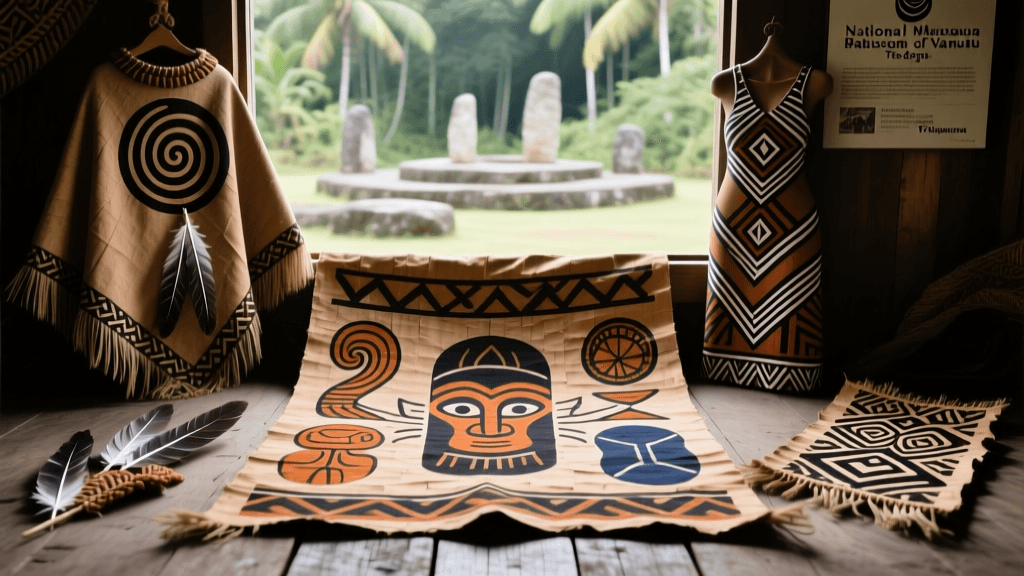
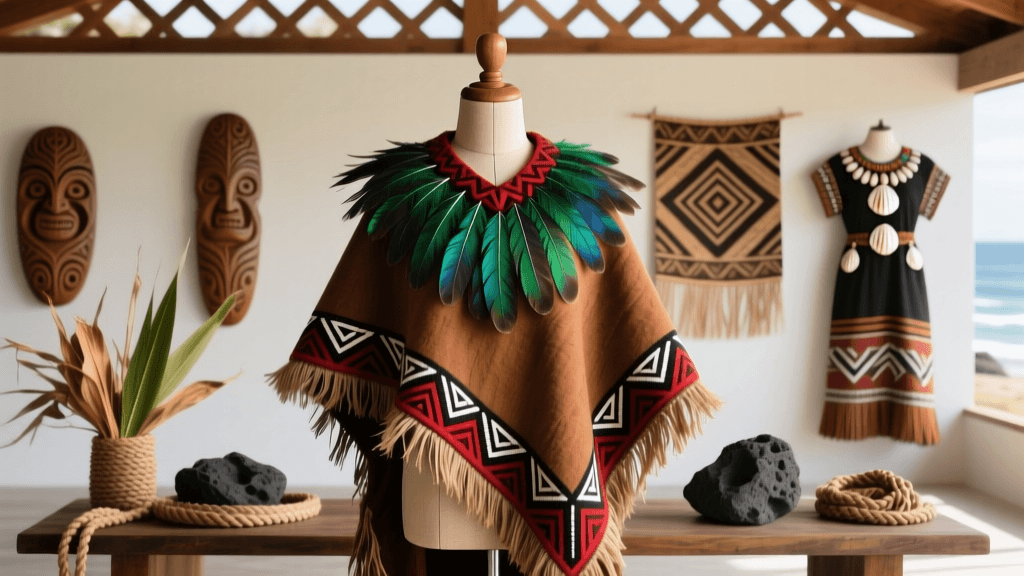
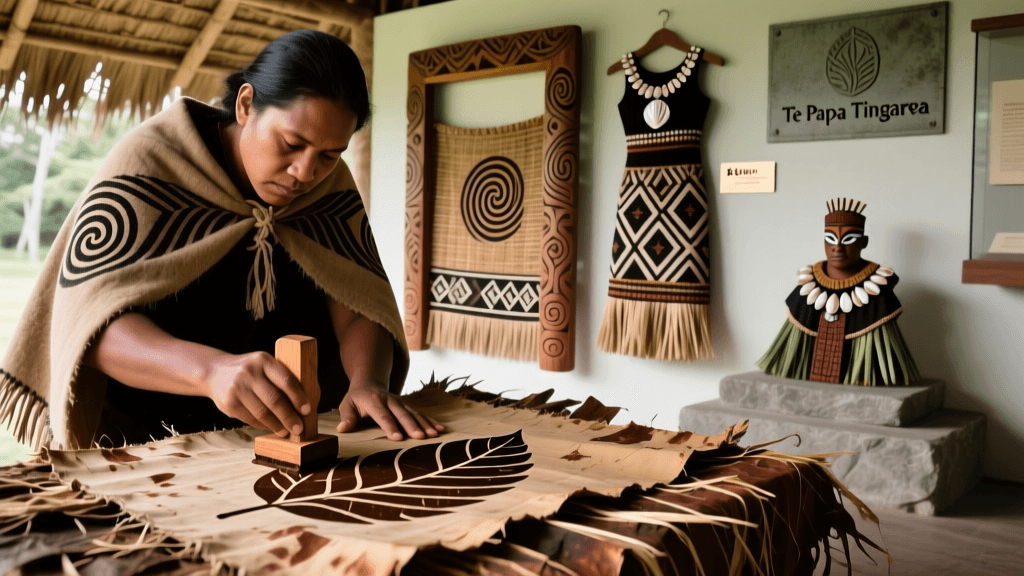
Tokelauan Titi Weaving And Coconut Frond Preparation For Ceremonial Wear
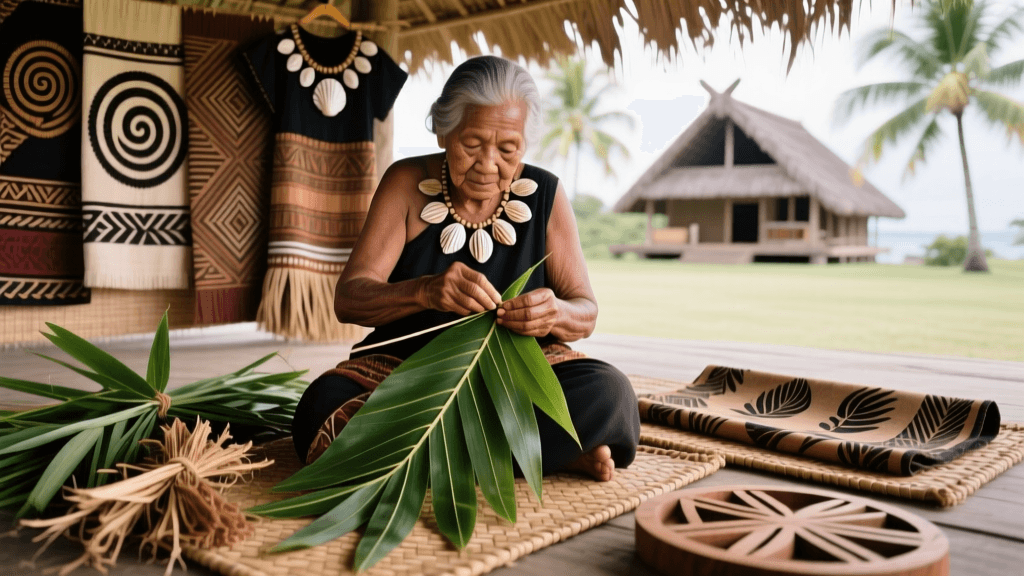
Roots in the Reef: The Living Practice of Titi Weaving
Titi weaving is not merely a craft—it is a living archive of Tokelauan cosmology, kinship, and ecological knowledge. Practiced across the three atolls of Atafu, Nukunonu, and Fakaofo, titi refers specifically to finely plaited ceremonial garments worn during tautua (service), weddings, and fono (council gatherings). Unlike the more widely known tapa or kapa traditions, titi relies exclusively on prepared coconut fronds—never bark, fibre, or imported textiles. Each garment embodies intergenerational transmission: children begin learning frond splitting at age six; mastery of the double-weave technique typically requires twelve to fifteen years of consistent practice under elder guidance.
Harvesting with Protocol: When and How Coconut Fronds Are Gathered
Timing governs every stage. Harvesters observe lunar cycles and seasonal winds, selecting only mature fronds from *Cocos nucifera* var. *tokelauensis*, a locally adapted coconut cultivar. Fronds are cut at dawn during the waning moon—between the 18th and 24th lunar day—to ensure optimal fibre tensile strength and reduced sap seepage. A single adult weaver requires approximately 42–48 fronds per full-length titi skirt, each frond measuring between 1.8 and 2.3 metres in length. No more than two fronds may be taken from any one tree per season, a protocol enforced by village councils to maintain grove health.
The Seven-Step Frond Preparation Sequence
Preparation begins within ninety minutes of harvest to prevent fibre stiffening. The process is strictly gendered: men perform the initial cutting and transport; women and non-binary elders oversee all subsequent stages. Each step carries verbal protocols—specific chants (pehe) must be recited before splitting, soaking, and drying.
- Trimming the rachis base to 5 cm above the petiole
- Splitting midribs longitudinally into 16–20 uniform strips using shark-tooth-edged bone knives
- Soaking in brackish lagoon water for precisely 72 hours at 28–30°C
- Rinsing three times in fresh rainwater collected in volcanic rock cisterns
- Drying horizontally on raised pandanus mats for 4–6 days under partial shade
- Beating with smooth river stones to soften fibres without breaking them
- Twisting pairs of strips into continuous 3.2-metre cords ready for weaving
Weaving as Kinship Mapping
A completed titi skirt contains exactly 1,296 interlaced strands—a number derived from the ancestral genealogical chart (*whakapapa*) of the founding lineage of each atoll. The central panel always features the *tāua* motif: a zigzag pattern representing ocean currents that guided the first canoes to Tokelau. Weavers embed subtle variations—such as knot density or strip width—to signal clan affiliation. For example, Atafu weavers use 0.8 mm-wide strips with 11 knots per 5 cm, while Fakaofo practitioners prefer 1.1 mm strips with 9 knots per 5 cm. These distinctions are never documented but held in oral memory and verified during communal weaving sessions at the Fale Fono o Tokelau in Apia, Samoa.
Materials and Measurements: Precision in Practice
Material integrity is measured empirically. Fibre tensile strength must exceed 145 MPa after preparation, tested annually using calibrated spring gauges maintained by the Tokelau National Museum. Dye consistency is monitored via pH testing: natural dyes from *Morinda citrifolia* roots yield a stable pH of 4.2–4.5 when fermented in clay pots for 12 days. Garment dimensions adhere to strict ratios: a full ceremonial titi measures 1.45 m in length, 0.92 m in waist circumference, and weighs no more than 380 g when fully dry. The smallest functional titi—worn by children aged 7–9—is scaled to 0.87 m in length and uses strips just 0.5 mm wide.
Institutional Stewardship and Contemporary Challenges
The Tokelau Apia Liaison Office coordinates annual frond quality audits across all three atolls, recording moisture content, microbial load, and fibre elasticity. Since 2019, the Pacific Islands Forum Secretariat has funded a digital archive project documenting 217 distinct titi patterns, each linked to named weavers and their villages. However, rising sea temperatures threaten the *tokelauensis* cultivar: average coastal water temperatures have increased by 1.3°C since 1990, correlating with a 37% decline in viable frond yield per hectare (Tokelau National Statistics Office, 2022). Saltwater intrusion has also degraded traditional brackish soaking sites—only four of the original eleven lagoon zones remain suitable for the 72-hour soak phase.
Cultural Protocols in Ceremonial Use
Wearing titi follows codified rules. A newly woven titi must be blessed by a village elder at sunrise on the first day of the new moon. It cannot be worn indoors except during formal fono; outdoor wear requires the wearer to walk barefoot on coral sand. During mourning periods, titi are folded with the *tāua* motif facing inward and stored in sealed wooden chests lined with dried *Pandanus tectorius* leaves. The Pacific Arts Association notes that “the prohibition against folding titi diagonally reflects the belief that diagonal lines fracture spiritual continuity” (Pacific Arts Association, 2021).
Transmission Beyond the Atolls
With only 1,500 Tokelauans residing in the atolls—and fewer than 42 master weavers over age 60—the practice faces acute intergenerational risk. In response, the Tokelau Community Centre in Wellington launched the *Titi Tāua Mentorship Programme* in 2020, pairing youth with elders for weekly virtual and in-person sessions. Participants learn not only technique but also the associated navigation chants, genealogical recitations, and tidal lore embedded in weaving rhythms. Each cohort produces one ceremonial titi for the Tokelau National Museum’s permanent collection, where garments are stored at 18°C and 45% relative humidity—conditions validated through accelerated aging trials conducted at the University of the South Pacific’s Heritage Conservation Lab in Suva.
Frond preparation remains inseparable from land stewardship. Village councils track frond yield per tree annually; data shows that trees within 15 m of traditional stone fish traps produce fronds with 22% higher tensile strength due to enriched soil microbiology. This empirical link between marine conservation and textile resilience underscores why titi weaving is taught alongside reef monitoring in Tokelauan primary schools. Students measure frond width, count leaflets per frond (always an odd number between 39 and 43), and record sap viscosity using calibrated viscometers—tools donated by the UNESCO Pacific Office in 2023.
Every titi tells a story written in fibre, salt, and sunlight. Its narrow strips hold the memory of tides, its knots encode lineage, and its weight carries the responsibility of continuity. There is no abstraction in this work—only precision, reciprocity, and the quiet insistence that culture lives not in museums alone, but in the hands that split, soak, twist, and weave.
“The titi does not clothe the body first. It clothes the relationship—with ancestors, with ocean, with the next generation. To hold a strip is to hold time.” — Fa’asolomone Siale, Senior Weaver, Nukunonu Atoll (quoted in Tokelau National Museum Oral History Archive, 2020)
Conservation efforts now include replanting programs targeting 5,000 new *tokelauensis* seedlings by 2027, with genetic stock sourced exclusively from trees older than 80 years. Each planting site is mapped using handheld GPS units calibrated to the Tokelau Geodetic Datum, ensuring spatial fidelity across generations. Weavers participate in soil pH testing before planting, maintaining the alkaline conditions (pH 7.8–8.1) required for optimal root development. These integrated practices affirm that titi weaving endures not as relic, but as responsive, rooted, and rigorously alive.
| Atoll | Average Frond Yield per Tree (fronds/year) | Strip Width Range (mm) | Knot Density (per 5 cm) | Annual Titī Production (units) |
|---|---|---|---|---|
| Atafu | 3.2 | 0.8 | 11 | 84 |
| Nukunonu | 2.9 | 0.95 | 10 | 67 |
| Fakaofo | 2.6 | 1.1 | 9 | 52 |
Workshops led by master weavers from all three atolls rotate annually among the Tokelau Apia Liaison Office, the University of the South Pacific campus in Apia, and the Pacific Heritage Hub in Suva. Each session includes live frond splitting demonstrations, fibre tensile testing, and comparative analysis of historic titi held in the collections of the Museum of New Zealand Te Papa Tongarewa. These exchanges reinforce that titi is not static heritage but a dynamic field of knowledge—one measured in millimetres, lunar days, and the steady rhythm of hands moving in unison.
When a young weaver in Fakaofo completes her first full titi at age 23, she presents it not to a judge or curator, but to the eldest woman of her maternal line. That woman inspects the edge finish, counts the knots, holds the garment to the light to assess strip uniformity, and finally smells the fibres—checking for residual sap or fermentation odour. Only then does she place the titi over the young woman’s shoulders and say: “Now you carry the current.”
This carrying is physical, cultural, and hydrological. It moves with the tides, shifts with the seasons, and persists—measured, witnessed, and renewed.