Maori Korowai Feather Weaving And Taniko Border Patterns
Feathers, Fibre, and Sacred Geometry: The Living Art of Korowai
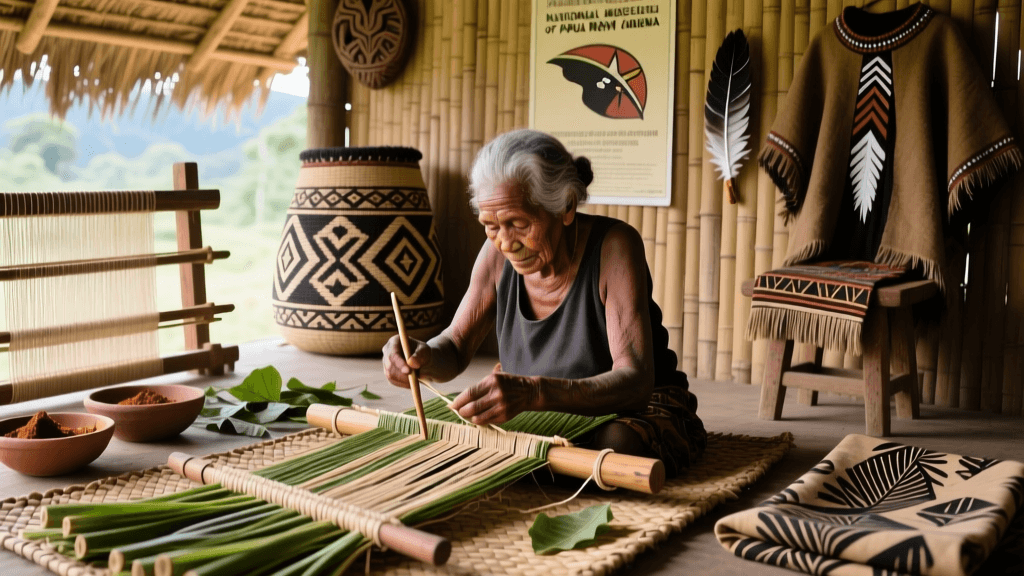
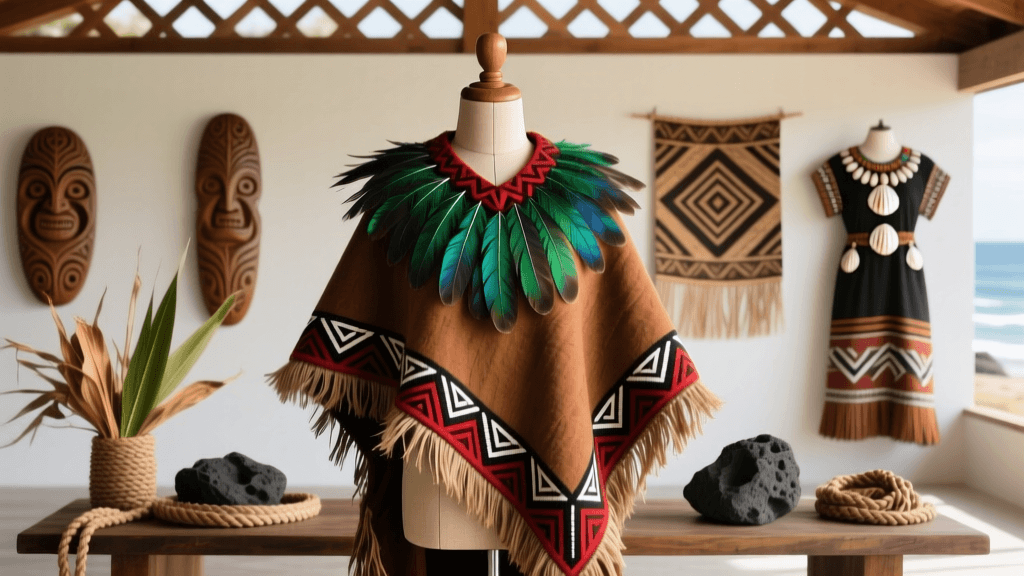
The korowai—a prestigious Māori cloak distinguished by its dense, pendulous hukahuka (tassels)—is far more than ceremonial attire. It is a three-dimensional genealogy, a wearable archive of whakapapa (lineage), mana (prestige), and tikanga (customary protocol). Woven primarily from muka (prepared flax fibre) and adorned with meticulously selected feathers—especially the iridescent black-and-green tail feathers of the kākā parrot—the korowai embodies a profound relationship between people, land, and sky. Each tassel is individually twisted and secured by hand, requiring up to 120 hours for a single medium-sized garment. The process begins with harvesting harakeke (New Zealand flax) at dawn during the waning moon, following strict rāhui (temporary restrictions) to ensure sustainability and spiritual alignment.
Taniko: The Precision of Patterned Borders
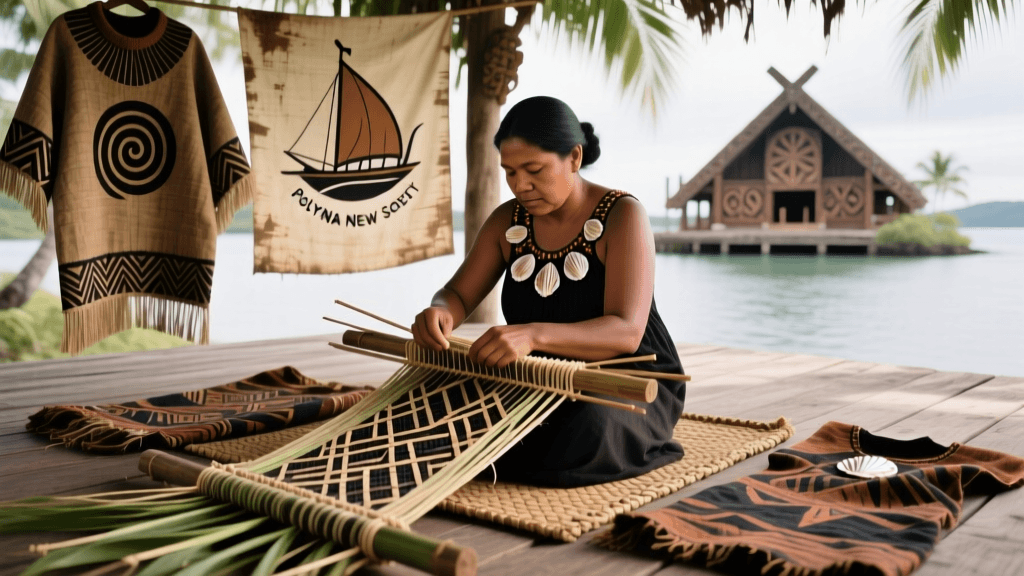
While the korowai’s body commands attention through texture and movement, its taniko border serves as a silent yet potent linguistic field. Taniko is a finger-weaving technique using dyed muka or wool, executed without looms, relying solely on tension, memory, and interlacing fingers. These geometric bands—often no wider than 4–6 cm—encode tribal identity, ancestral narratives, and cosmological concepts. A standard taniko band may contain over 200 individual warp threads per 10 cm width, demanding extraordinary dexterity and continuity of focus. The patterns are not decorative abstractions; they are named and recited—such as *niho taniwha* (taniwha teeth), *pākati* (notched pattern), or *whangai hau* (wind-fed)—each carrying specific oral histories tied to particular iwi (tribes).
Materials Sourced with Intention
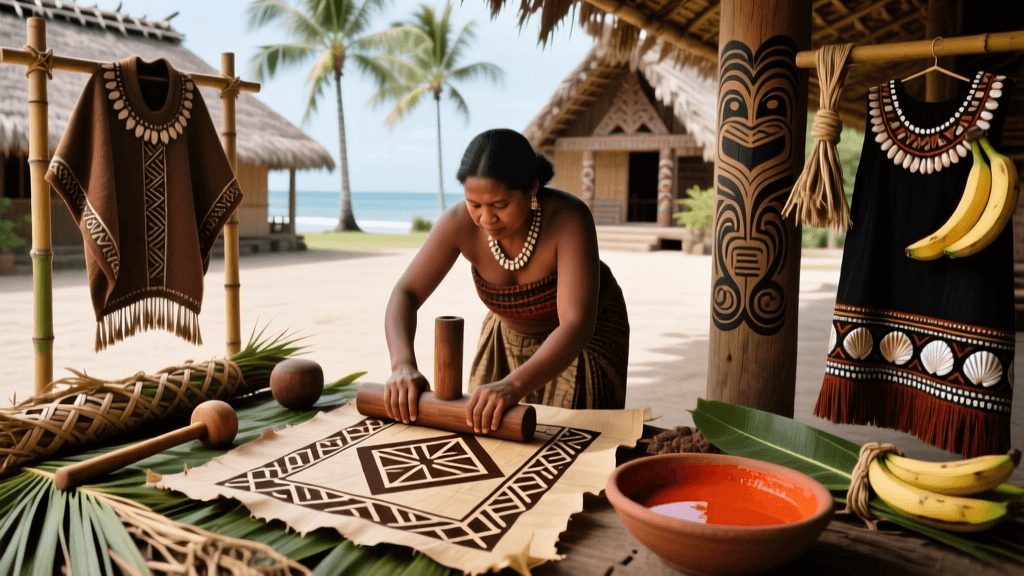
Natural materials are never chosen arbitrarily. Kākā feathers are harvested only from naturally moulted birds or those found deceased, never taken from living birds—a practice codified in Te Ture Whenua Māori Act 1993 and upheld by Te Rūnanga o Ngāi Tahu. Flax leaves are stripped using mussel shells (*kūtai*) or bone tools, then pounded with wooden beaters (*patu muka*) until fibres separate. Dyes derive exclusively from native plants: paruparu (mud rich in iron oxide) yields deep blacks; raupō (bulrush) roots produce warm ochres; and kōwhai bark creates golden yellows. One documented dye vat at Te Papa Tongarewa contains sediment layers dated to pre-1840, confirming centuries-old pigment consistency.
Protocols Governing Creation and Use
Weaving a korowai is governed by strict tikanga. The weaver must be in a state of *noa* (ritual neutrality) before beginning; menstruating individuals traditionally refrain from handling muka during active weaving phases. Completed cloaks are never placed on the ground—they rest on clean cloths or suspended racks. During pōwhiri (formal welcome ceremonies), a korowai is presented draped over the shoulders of a guest only after karakia (prayers) and the exchange of *hongi* (pressing of noses). At the Museum of New Zealand Te Papa Tongarewa in Wellington, korowai are stored horizontally in climate-controlled cabinets at 50% relative humidity and 18°C, conditions validated by the International Council of Museums (ICOM) Pacific Regional Committee in 2021.
Regional Variations Across Aotearoa
While korowai are pan-iwi, regional distinctions persist. In Taranaki, taniko borders frequently incorporate diagonal zigzags representing the descent of Tāne Mahuta into the forest; each motif spans precisely 17 mm in width across five repeats. In contrast, Ngāti Porou cloaks from the East Coast often feature vertical *tāniko whakarere* bands that extend up to 12 cm in length, incorporating subtle variations in twist tension to create optical depth. The Te Kōhanga Reo National Trust reports that since 2015, 37 registered master weavers have taught taniko techniques to over 2,100 learners across 147 kōhanga reo (Māori language nests), ensuring intergenerational transmission.
Institutional Stewardship and Contemporary Revival
Cultural institutions serve as vital custodians—not owners—of these taonga (treasures). Te Papa Tongarewa holds 187 documented korowai in its collection, including the 1863 *Korowai o Te Whānau* gifted by Te Whānau-ā-Apanui to Governor Grey. The Auckland War Memorial Museum houses the earliest known surviving example, collected in 1842, with 3,240 individually knotted hukahuka. At the University of Otago’s Hocken Collections in Dunedin, researchers have digitised 42 historical taniko pattern diagrams drawn by Rāwiri Taonui (Ngāpuhi) in 1928, revealing 11 distinct motif families previously unrecorded in ethnographic literature.
Measuring Cultural Continuity
Quantitative markers affirm resilience: a 2022 survey by Te Puni Kōkiri (Ministry for Māori Development) found that 68% of active weavers identify as under 45 years old; 41 marae across the North Island now host monthly taniko workshops; and the average korowai takes between 300–500 hours to complete, depending on size and complexity. One exceptional piece, *Te Ara o te Rangi* (The Path of the Sky), woven by Hinewehi Mohi (Tūhoe) in 2019, contains 4,892 kākā feathers arranged in concentric arcs corresponding to the 12 lunar months—each arc measuring exactly 8.3 cm in radius.
- A korowai’s hukahuka density averages 18–22 tassels per 10 cm of edge length
- Taniko bands require a minimum of 80 warp threads per 5 cm for structural integrity
- Traditional muka preparation reduces raw flax leaf mass by 85%, yielding only 15% usable fibre
- Feather attachment uses a double-loop stitch measured at 2.5 mm intervals along the selvedge
- Te Papa Tongarewa’s korowai conservation lab conducts biannual pH testing of storage materials, maintaining levels between 6.8–7.2
“The pattern is not on the cloth—it is in the breath between the fingers, in the rhythm of the twist, in the silence before the first knot. To weave taniko is to speak with ancestors who never used ink.” — Dr. Maata Hura, Senior Curator, Mātauranga Māori, Te Papa Tongarewa, 2020
Interwoven Knowledge Systems
Korowai weaving intersects with broader Oceanic textile traditions—not through imitation, but through shared epistemologies. Like Hawaiian *kapa* makers who chant while beating barkcloth, Māori weavers use *waiata* (songs) to regulate pace and embed meaning. Similarly, Torres Strait Islander *dhari* headdresses employ precise feather arrangements aligned with celestial navigation, echoing the korowai’s use of kākā feathers to signify connection to Tāne Mahuta, god of forests and birds. Yet distinctions remain grounded in place: while Polynesian tapa relies on paper mulberry (*Broussonetia papyrifera*), Aotearoa’s flora offered harakeke, whose long, strong fibres enabled structural durability unmatched in tropical counterparts.
This material specificity extends to geography. The volcanic soils of the central North Island yield harakeke with thicker, more resilient fibres—ideal for korowai foundations—while coastal varieties produce finer muka suited to taniko. Weavers from Whanganui iwi historically travelled 120 km inland to harvest flax near Mount Ruapehu, where elevation and rainfall patterns produce optimal leaf thickness: an average of 2.1 mm at the mid-leaf section, confirmed by scanning electron microscopy at Victoria University of Wellington’s Materials Science Lab in 2018.
The resurgence of korowai is neither nostalgic nor aesthetic. It is a sovereign act of knowledge reclamation. When Dame Rangimārie Hetet (Te Āti Awa) wove her first korowai at age 72 in 1967, she did so using notes transcribed from her grandmother’s oral instructions—notes now held at the Alexander Turnbull Library. Today, digital archives at the National Library of New Zealand include 3D scans of 14 historic taniko bands, each annotated with iwi attribution, motif name, and associated whakataukī (proverb). These resources are accessible only to registered iwi representatives, affirming data sovereignty principles adopted by the Waitangi Tribunal in its 2017 report on Indigenous Digital Heritage.
At the heart of every korowai lies a paradox: immense labour rendered invisible by its final elegance. The weight of a full-length korowai—typically 1.8–2.3 kg—carries the physical imprint of hundreds of hours, yet it drapes with lightness, swaying like wind through a stand of harakeke. Its value is not in rarity, but in relationality: the weaver’s intent, the wearer’s status, the feathers’ origin, the flax’s provenance, and the pattern’s lineage. This is not textile art as object—it is textile art as covenant.
| Institution | Location | Key Korowai Holding / Initiative |
|---|---|---|
| Museum of New Zealand Te Papa Tongarewa | Wellington | 187 korowai; Taniko Conservation Certification Programme (est. 2014) |
| Auckland War Memorial Museum Tāmaki Paenga Hira | Auckland | Holds earliest documented korowai (1842); runs annual Korowai Weaving Intensive |
| Hocken Collections | Uare Taoka o Hākena | Dunedin | Archives Rāwiri Taonui’s 1928 taniko diagrams; hosts biennial Mātauranga Māori Textile Symposium |
Contemporary weavers continue this covenant. In 2023, the collective *Te Roopu Raranga o Aotearoa* launched a national korowai loan scheme, enabling 22 iwi to borrow ancestral cloaks for use in graduation ceremonies—each loan accompanied by a *kōrero* (narrative) booklet co-authored by elders and youth. One such korowai, *Te Whare o ngā Hua*, woven in 1891 and returned to Ngāti Manawa in 2022 after 117 years in overseas collections, was worn by 14 graduating students over three days—its 2,100 hukahuka swaying in unison with their footsteps. That motion is not decoration. It is memory in motion. It is continuity made visible.
The korowai does not belong in glass cases alone. It belongs on shoulders bearing responsibility, in marae ātea where decisions are made, in classrooms where children learn the names of their ancestors’ hands. Its feathers catch light not to glitter—but to reflect back who we are, and who we promise to become.