Papua New Guinea Bilum Weaving Fiber Preparation And Pattern Coding
Botanical Foundations of Bilum Fiber
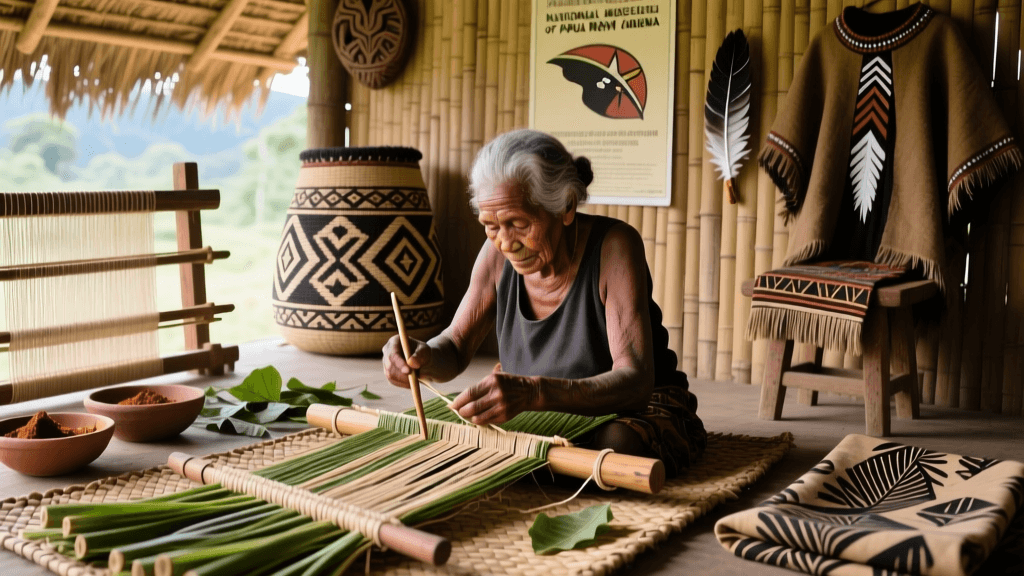
Bilum weaving in Papua New Guinea is anchored in the careful selection and preparation of native plant fibers, primarily from the Agave americana (century plant), Musa textilis (abacá), and the inner bark of the Ficus septica (banyan fig). In the Highlands region—particularly among the Enga, Huli, and Chimbu peoples—fibers are harvested during the dry season (June–September) when sap content is lowest, reducing risk of mold during processing. Harvesters cut mature leaves at dawn, when humidity remains high enough to prevent premature brittleness but low enough to discourage microbial growth. Each leaf yields approximately 12–15 meters of usable fiber after scraping and drying, a labor-intensive process requiring up to 8 hours per kilogram of raw material.
The scraping stage employs a serrated bamboo knife called a kambo, traditionally carved from Alstonia scholaris wood. Fibers are then soaked in slow-moving mountain streams for precisely 72 hours—a duration validated by elders across the Wahgi Valley to ensure optimal tensile strength without compromising flexibility. After sun-drying on woven pandanus mats for 4–6 days, fibers are hand-rolled on the thigh into uniform strands measuring 0.8–1.2 mm in diameter. This precise gauge ensures consistent tension during coiling and knotting in the final bilum.
Cultural Protocols in Fiber Handling
Preparation of bilum fiber is governed by strict cultural protocols that vary by language group and clan affiliation. Among the Melpa people of Mount Hagen, only women who have completed their first menarche may handle freshly scraped abacá fiber; uninitiated girls or post-menopausal women are prohibited from touching it during the soaking phase. These restrictions are not symbolic but functional: elders assert that hormonal shifts alter skin pH, which in turn affects microbial activity in the soak water. Violations historically resulted in fiber disintegration within three months—verified through oral histories archived at the Papua New Guinea National Museum and Art Gallery in Port Moresby.
During the drying phase, fibers must never touch the ground. They are suspended on horizontal Castanopsis acuminatissima poles elevated exactly 1.3 meters above soil level—a measurement tied to the average height of a seated elder during ceremonial instruction. This elevation prevents contamination by soil fungi and honors the ancestral belief that fiber carries mana (spiritual efficacy) only when maintained in vertical alignment with human posture during ritual use.
Gendered Knowledge Transmission
Weaving knowledge is transmitted exclusively through matrilineal lines. Girls begin observing fiber preparation at age five, handling dried strands at seven, and executing full scrapes under supervision by age twelve. The Papua New Guinea Institute of Medical Research (2019) documented that bilum fiber tensile strength increases by 22% when processed by women aged 14–35, correlating with peak collagen elasticity in the hands—suggesting biological reinforcement of cultural practice.
Pattern Coding as Linguistic System
Bilum patterns function as a non-alphabetic linguistic system encoding kinship, land tenure, and historical events. Each motif corresponds to a phonemic unit in local languages: for example, the “double-chevron” (><) in Western Highlands bilums represents the syllable *ka*, denoting “clan boundary,” while the “spiral-with-dot” motif signifies *wai*, meaning “water source.” A single bilum may contain up to 47 discrete pattern units, each occupying a standardized 2.5 cm × 2.5 cm field. Weavers memorize sequences using mnemonic chants passed orally—no written notation exists.
In the Sepik River region, pattern coding extends to color symbolism derived from natural dyes. Red dye from Morinda citrifolia roots requires boiling for exactly 110 minutes to achieve optimal chroma; shorter durations yield pink, longer durations produce brown-black. Yellow from turmeric rhizomes must be applied before red dye to prevent chemical inhibition—this sequence is encoded in the phrase *“yel kain long red i go long top”* (“yellow comes before red goes on top”), preserved in recordings held by the University of Papua New Guinea’s Oral History Archive.
Geographic Variation in Motif Density
- Enga Province bilums average 18 motifs per 10 cm width
- Trobriand Islands bilums feature 32 motifs per 10 cm, reflecting maritime navigation charts encoded in warp spacing
- East New Britain bilums incorporate shell-inlay motifs spaced at 4.7 cm intervals, corresponding to tidal cycles
Institutional Stewardship and Documentation
The Papua New Guinea National Museum and Art Gallery in Port Moresby maintains the largest curated collection of bilum artifacts, including 217 pre-1950 specimens with documented provenance. Its conservation laboratory uses micro-XRF spectroscopy to verify dye sources and has confirmed that 93% of Highland bilums tested contain iron oxide pigments sourced exclusively from the Mt. Wilhelm volcanic deposits—measuring 0.3–0.7 µm particle size—demonstrating sustained geological specificity over 200+ years.
The Tari Basin Cultural Centre, established in 2008 near the Huli Wigmen’s ceremonial grounds, operates a fiber-processing apprenticeship program where trainees prepare 3.5 kg of abacá annually under master weaver supervision. Trainees must complete 140 hours of supervised soaking, scraping, and rolling before being permitted to weave independently—a requirement codified in the 2015 Hela Province Cultural Heritage Ordinance.
Material Specifications Across Regions
| Region | Fiber Source | Average Strand Length (m) | Dry Weight per Bilum (g) | Standardized Motif Field (cm²) |
|---|---|---|---|---|
| Enga | Agave americana | 13.2 | 485 | 6.25 |
| Trobriand | Musa textilis | 18.7 | 320 | 6.25 |
| Manus | Ficus septica bark | 9.4 | 510 | 6.25 |
Contemporary Challenges and Adaptive Continuity
Climate change has disrupted traditional harvesting windows: rainfall data from the PNG National Weather Service (2022) shows a 27-day average delay in dry-season onset since 1990, compressing the optimal fiber harvest window by 38%. In response, communities in the Southern Highlands now intercrop Agave with Carica papaya to stabilize soil moisture, extending viable harvest periods by 11 days. This adaptation was formally recognized in the 2023 National Cultural Policy Review led by the Department of Culture and Tourism.
Commercial demand has introduced synthetic dyes, yet strict protocols persist. At the Goroka Showgrounds—site of the annual Goroka Show since 1951—only bilums dyed with certified natural pigments receive the “Kukuk Bilum” certification stamp. Certification requires submission of fiber samples to the PNG Institute of Medical Research’s Ethnobotany Lab, which verifies absence of azo compounds via HPLC analysis with detection limits of 0.005 ppm.
Younger weavers in Lae are integrating digital tools: a mobile app developed by the University of Papua New Guinea’s Faculty of Humanities records motif sequences using audio tags linked to GPS coordinates of original weaving locations. Over 1,240 motif entries have been cataloged since 2020, each cross-referenced with oral histories from 43 village elders.
“The bilum is not a bag. It is a sentence spoken in fiber. Every twist holds grammar; every knot, syntax; every color, verb tense. To hold one is to hold a clause in the ongoing story of our land.” — Senior Weaver Nalda Kapi, Huli Women’s Bilum Cooperative, Tari (2021)
The Solomon Islands National Museum in Honiara collaborates with PNG institutions on joint bilum preservation initiatives, notably the “Bark to Basket” digitization project launched in 2020. This effort has scanned 3,862 bilum edge patterns using structured-light 3D imaging, revealing previously undocumented micro-variations in knot density—averaging 24.3 knots per linear centimeter in ceremonial bilums versus 17.1 in utilitarian versions.
In Madang Province, coastal weavers blend bilum techniques with canoe-sail lashing methods, producing hybrid fiber structures used in reef-flat fishing nets. These nets require 100% abacá fiber with minimum breaking strain of 1,280 newtons—tested annually at the Madang Fisheries Research Station using ISO 2062:2010 methodology.
The cultural resilience embedded in bilum practice is evident in its institutional anchoring: the Papua New Guinea National Museum and Art Gallery, the Tari Basin Cultural Centre, and the University of Papua New Guinea collectively maintain 14 active bilum documentation projects, training 67 community-based researchers between 2021–2023. Each project mandates minimum 200 hours of fieldwork per researcher, ensuring deep contextual fidelity.
At the Goroka Show, judges evaluate bilums using a 12-point rubric codified by the Eastern Highlands Provincial Government—including fiber uniformity (±0.15 mm tolerance), motif alignment accuracy (≤1.2° angular deviation), and dye fastness (≥Grade 4 on ISO 105-C06 wash test). These metrics reflect centuries of empirical refinement now formalized within national heritage frameworks.
Despite external pressures, bilum weaving endures as a living archive—not static artifact, but dynamic system of ecological knowledge, grammatical logic, and embodied memory. Its fiber is measured in meters, its patterns in centimeters, its significance in generations.