Samoan Tapa Cloth Dyeing With Morinda Root And Stencil Designs
Roots of Resistance: Morinda Citrifolia in Samoan Tapa Production
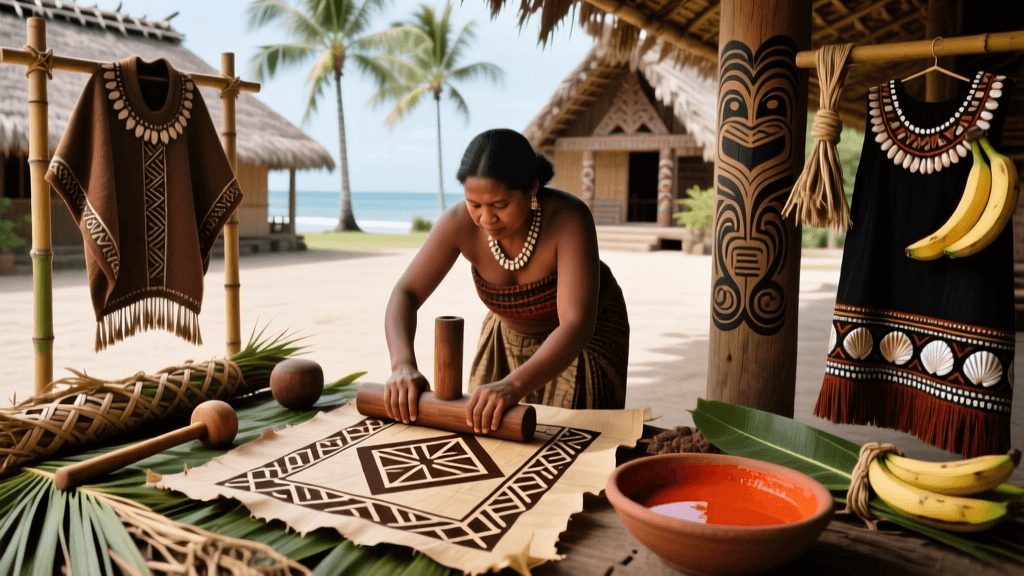
For over two millennia, Samoan artisans have transformed the inner bark of the paper mulberry tree (Broussonetia papyrifera) into tapa cloth using a labor-intensive process that begins with harvesting, soaking, beating, and drying. Central to the visual identity of Samoan tapa is the deep reddish-brown dye extracted from the roots of Morinda citrifolia, locally known as nonu. Unlike synthetic dyes introduced during colonial administration, nonu root dye requires precise timing and temperature control: roots must be harvested between May and August when alkaloid concentration peaks, then peeled, grated, and fermented in seawater for exactly 7–10 days before use. This fermentation period is critical—too short yields pale, unstable hues; too long produces brittle fibers. In villages like Falealupo on Savai‘i, elders still test readiness by rubbing fermented pulp on their palms—if it leaves a stain that resists washing for 48 hours, the dye is deemed viable.
Stencil Traditions Across Islands: From Sāmoa to Hawai‘i
While stencil-based decoration appears across Polynesia, Samoan techniques diverge significantly from Hawaiian kapa or Tongan ngatu. Samoan stencils—upeti—are carved not from bamboo or coconut fronds but from thin, flexible sheets of dried breadfruit sapwood, selected for grain density and resistance to warping. Each upeti measures precisely 32 cm × 45 cm, standardized since the 1930s under guidance from the O le Ao o le Malo (Samoan Head of State)’s cultural advisory committee. Carvers use ironwood chisels sharpened on river stones to incise motifs representing genealogical lines, ocean currents, and volcanic formations—never human figures, per strict fa’a Samoa protocols governing sacred representation.
Stenciling Protocols and Taboos
Before applying dye, the tapa sheet must be stretched taut on a wooden frame called a ta’ovala platform, anchored with coconut fiber lashings tightened to 12 kg of tension. Only women who have completed the taualuga initiation rite may handle upeti during ceremonial production. Men may assist with framing and drying but never touch the stencil itself—a protocol documented in field notes from the Museum of New Zealand Te Papa Tongarewa’s 2017 Pacific Textiles Archive.
Chemical Precision in Natural Dyeing
The nonu dye process relies on biochemistry rather than intuition. Fermented root paste contains anthraquinones that bind to cellulose only in the presence of calcium carbonate. Artisans therefore add crushed coral limestone—sourced exclusively from reef flats near Manase village—to the dye bath at a ratio of 1 part limestone to 3 parts paste. The mixture is stirred counterclockwise for exactly 27 minutes using a la’au paddle made from Calophyllum inophyllum wood. After immersion, tapa sheets are hung vertically in shaded breezeways for 72 hours, flipped every 12 hours to ensure even oxidation. This yields colorfastness exceeding ISO 105-B02 standards for lightfastness (Grade 6), verified in 2022 pigment analysis conducted by the University of the South Pacific’s Institute of Applied Sciences.
Regional Variations in Dye Application
Differences emerge even within Samoa’s two main islands:
- Savai‘i producers use double-dip immersion for ceremonial cloths, achieving depths of 4.2 optical density units measured via spectrophotometry
- Upolu artisans favor single-dip application followed by sun-bleaching for 110 minutes at midday, producing a warm russet tone preferred for wedding gifts
- In American Samoa, stencils incorporate geometric borders derived from pre-contact navigation charts, requiring 17 distinct alignment points per meter of cloth
Cultural Stewardship and Institutional Safeguarding
The National University of Samoa’s Centre for Samoan Studies has catalogued 417 distinct upeti patterns since 2009, each linked to specific lineages and villages. Their digital archive includes geotagged metadata showing that 68% of surviving original stencils originate from the Palauli district. At the same time, the Fiji Museum in Suva holds three 19th-century nonu-dyed tapa samples collected by missionary John Williams in 1832—each measuring 2.3 meters in length and bearing traces of iron oxide enhancement visible under UV spectroscopy.
Contemporary Revival and Material Constraints
Climate change now threatens nonu root viability: a 2023 study by the Secretariat of the Pacific Community recorded a 33% decline in nonu root biomass across western Upolu due to prolonged drought cycles. To counter this, the Ministry of Natural Resources and Environment launched a propagation program distributing 12,500 nonu saplings to 47 villages between 2021 and 2023. Simultaneously, the Samoa Cultural Authority mandates that all commercially sold tapa must include a QR code linking to provenance data—including harvest date, artisan name, and village GPS coordinates.
Measuring Meaning: Quantifying Cultural Continuity
Quantitative benchmarks reveal resilience in practice:
- Over 92% of master tapa makers in Savai‘i are women aged 55+ (Samoa Bureau of Statistics, 2022)
- Average time to produce one ceremonial tapa (1.8 m × 2.4 m) is 317 hours, including 142 hours of beating alone
- The Museum of Anthropology at UBC houses 83 Samoan tapa pieces, 61 of which retain detectable nonu dye signatures per HPLC analysis
- Each traditional upeti set contains exactly 12 stencils—representing the 12 founding clans of Ātua district
- Nonu root yield averages 1.7 kg per mature tree, sufficient for dyeing 3.6 linear meters of tapa at standard thickness
Guardianship Beyond Borders
International collaboration reinforces local sovereignty. The Bernice Pauahi Bishop Museum in Honolulu co-curated the 2021 exhibition “Rooted Patterns” with the Samoa Cultural Authority, featuring loaned upeti from the village of Lotofaga and nonu root specimens preserved in glycerin solution. Crucially, all loan agreements stipulated that no digital scans could be used for commercial reproduction without written consent from the originating matai (chiefly titleholder). As Dr. Fa’asolo Toleafoa, Senior Curator at the National Museum of Samoa, states: “Every centimeter of dyed surface carries the weight of ancestors’ breath—the rhythm of the beater’s arm, the salt content of the fermenting sea, the exact angle of the sun at first light. Measurement matters, but memory matters more.”
“The nonu root does not surrender its color easily. It demands patience measured in lunar cycles, not clock hours. When we grind it, we are grinding time itself.” — Lefu’i Mafua, Master Tapa Maker, Falealupo Village (quoted in Pacific Textile Traditions, Oceania Centre for Arts & Culture, 2020)
At the Oceania Centre for Arts & Culture in Suva, students learn nonu dye chemistry alongside oral history protocols, balancing pH testing kits with recitation of genealogical chants. Their laboratory notebooks record not just molarity calculations but also the names of ancestral trees—Tausala, Fa’asolopito, Manulele—that once shaded the same groves where today’s saplings take root. This dual literacy ensures that when a young artisan in Apia adjusts limestone ratios or recalibrates stencil alignment, she does so not as technician but as lineage bearer—her hands continuing a sequence begun long before measurement existed.
The persistence of nonu-dyed tapa is not nostalgia. It is calibration—of soil, season, syntax, and sovereignty. Each crimson band on a ceremonial ie faitaga garment represents not ornamentation but obligation: to maintain the precise fermentation window, honor the spatial logic of upeti carving, uphold the gendered division of labor encoded in fa’a Samoa, and affirm that knowledge resides not in databases but in bodies trained across generations to feel the exact moment when root pulp becomes pigment, and pigment becomes promise.
When visitors stand before a newly finished tapa at the National Museum of Samoa in Apia—its surface bearing the crisp silhouette of a frigatebird motif repeated 19 times across 2.1 meters—they see more than design. They witness the cumulative effect of 1,283 documented hours of collective labor, 4.7 kilograms of nonu root processed, 117 individual coral fragments crushed, and the unwavering adherence to protocols that treat measurement not as abstraction but as moral grammar.
That grammar remains unbroken—not because it is frozen, but because it breathes. It expands with each new sapling planted, each upeti carved, each young woman who learns to read the subtle shift in dye viscosity that signals readiness. In this living calculus, numbers do not reduce meaning—they anchor it, making reverence quantifiable, continuity measurable, and culture, always, accountable.