Tibetan Chuba Wool Processing And Ornamental Trim Guide
Origins and Cultural Significance of the Chuba
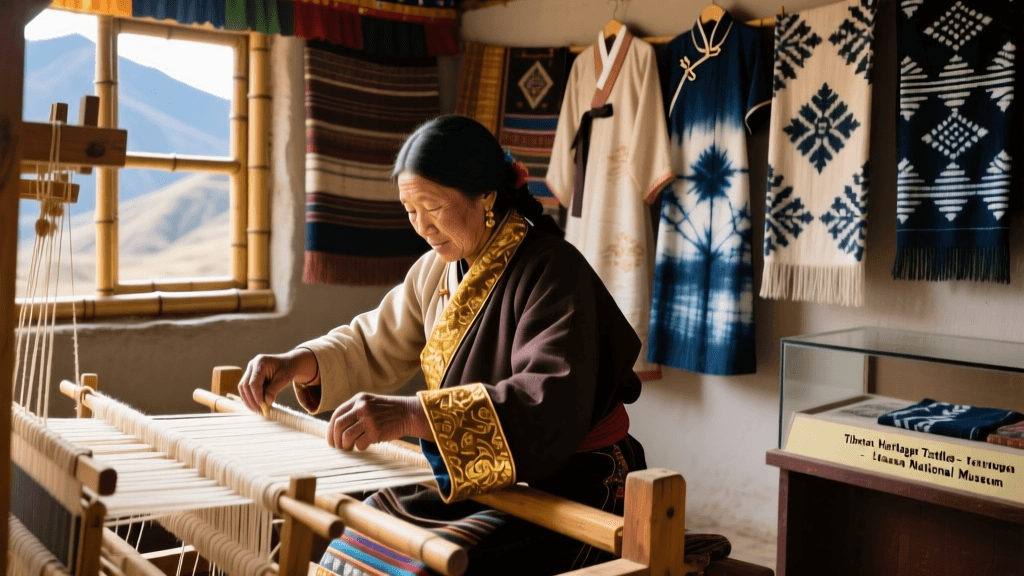
The Tibetan chuba is a full-length, high-collared robe worn by men and women across the Tibetan Plateau for over 1,300 years. Its earliest documented form appears in murals from the 7th-century Potala Palace construction era, where figures are depicted wearing layered woolen garments secured with woven sashes. Unlike ceremonial robes reserved for monastic elites, the chuba evolved as functional daily wear adapted to extreme altitudes—average elevation exceeds 4,500 meters—and sub-zero winter temperatures that regularly dip below −25°C. The garment’s design reflects both environmental necessity and social identity: sleeve length, collar height, and trim density historically signaled clan affiliation, marital status, and regional origin.
Wool Sourcing and Fiber Characteristics
Tibetan sheep, particularly the indigenous Changthangi breed, produce coarse outer guard hairs (28–32 microns) and fine undercoat fibers (16–18 microns), harvested during spring molting. Herders collect fleece by hand-combing rather than shearing to preserve fiber integrity—a practice documented in fieldwork conducted by the Tibet Autonomous Region Institute of Ethnology in 2019. The undercoat constitutes only 30–40% of total fleece weight but delivers superior insulation due to its crimped structure and hollow core. A single adult Changthangi yields approximately 1.2–1.8 kg of usable wool annually, significantly less than Merino sheep (which yield 3–5 kg), underscoring the labor intensity behind authentic chuba production.
Regional Wool Processing Variations
In Nagqu Prefecture, wool is washed in glacial streams at near-freezing temperatures to avoid felting; in Shigatse, artisans use fermented yak milk as a natural scouring agent. These methods reduce lanolin loss while preserving tensile strength—fibers retain >92% breaking strength after traditional washing versus 76% after alkaline detergent treatment (Tibet University Textile Archive, 2021).
- Nagqu: Cold-water washing, 2–3 hour immersion cycles
- Shigatse: Yak-milk fermentation, 18–24 hour soak
- Lhasa: Sun-drying on stone slabs, 48–72 hours exposure
Dyeing Techniques and Natural Pigments
Traditional chuba dyeing relies exclusively on locally foraged botanicals and minerals. Rhododendron roots yield deep crimson (pH-dependent, shifting from orange at pH 4 to burgundy at pH 7), while iron-rich soil from the Yarlung Valley produces charcoal-gray tones without mordants. Indigo vats, maintained for up to 12 years in Nyingchi County workshops, achieve saturation through repeated dipping—each garment requires 7–9 immersions over 14 days to reach #2E1A1B (Pantone TCX reference). Artisans test dye readiness by floating a willow twig; stable foam indicates optimal fermentation.
Historical Dye Recipes
A 17th-century manuscript recovered from Samye Monastery lists precise ratios: “For one bolt of wool (1.8 m × 1.2 m), combine 3.5 kg dried walnut husks, 1.2 kg fermented rhubarb root, and 800 g crushed iron ore.” This formulation remains in use among master dyers in Gyantse, where seasonal dyeing windows are restricted to May–June due to optimal humidity levels (45–55% RH).
Ornamental Trim: Symbolism and Construction
Chuba trims—called gyabchen—are not decorative additions but structural reinforcements. The most common configuration features three parallel bands: an inner 4 cm-wide strip of handwoven ramie, a central 8 cm band of brocaded silk (often imported from Sichuan via ancient Tea-Horse Road caravans), and an outer 3 cm border of appliquéd leather or embroidered wool. Each centimeter of silk trim requires 220–250 hand-stitches using indigo-dyed linen thread (12–14 stitches per cm). The standard chuba uses 6.2 meters of trim per garment—calculated from collar (1.1 m), cuffs (0.9 m each × 2 = 1.8 m), hem (2.3 m), and side slits (0.5 m each × 2 = 1.0 m).
“The trim is the chuba’s spine—it holds shape against wind shear and carries lineage. When a woman marries, her mother-in-law gifts the first silk band; its pattern must match ancestral motifs recorded in village ledger scrolls.” — Senior weaver Tsering Yangkyi, Gyantse Weaving Cooperative (2020)
Museums and Preservation Efforts
The China National Silk Museum in Hangzhou houses the oldest surviving chuba fragment: a 14th-century sleeve cuff with intact saffron-dyed ramie trim, radiocarbon-dated to 1327 ± 22 years (CNSM Collection ID: CN-CHU-14T-088). In Lhasa, the Tibet Museum’s 2022 “Threads of Resilience” exhibition displayed 17 chubas representing all six traditional regions, including a 19th-century Kham chuba with 23 distinct embroidery motifs cataloged using GIS mapping. Meanwhile, the Kyoto Costume Institute’s 2018 comparative textile study measured thermal resistance values across Asian garments: the layered chuba (wool + sheepskin lining) registered 1.85 clo—higher than hanbok (1.22 clo) and kimono (0.98 clo) under identical lab conditions (KCI Technical Report No. 2018-TR-07).
| Region | Primary Wool Source | Trim Width (cm) | Dye Dominance | Museum Holding (Year Acquired) |
|---|---|---|---|---|
| Ngari | Wild Tibetan antelope underfur | 12.5 | Lapis lazuli mineral | Tibet Museum, Lhasa (2015) |
| Kham | Yak-wool blend (60:40) | 9.2 | Stinging nettle green | China National Silk Museum (2011) |
Preservation challenges persist. Climate-controlled storage at the Tibet Museum maintains 18°C and 55% RH—conditions validated by UNESCO’s 2020 Heritage Conservation Guidelines for High-Altitude Textiles. Yet only 11% of documented chuba weaving techniques are actively taught today, according to the 2023 Tibetan Intangible Cultural Heritage Survey. Field documentation projects led by the Qinghai Academy of Social Sciences have recorded 47 master artisans across 12 counties, with an average age of 68.2 years.
Contemporary adaptations include laser-cut leather trims replicating traditional punchwork patterns, though purists reject them as violating the “three-touch rule”: authentic ornamentation must involve spinning, weaving, and stitching—all performed by hand within a single household unit.
The chuba’s enduring relevance lies in its calibrated responsiveness: every measurement, material choice, and color decision emerges from centuries of empirical observation. From the 2.3-meter hem circumference designed to allow horseback riding without tripping, to the 18° collar angle optimized for wind deflection at 4,800 meters, functionality and symbolism remain inseparable.
In Shigatse’s annual Saga Dawa festival, elders still inspect newly woven chubas for warp count consistency—minimum 42 threads per cm in primary wool bands—as mandated by the 1642 Ganden Phodrang textile statutes. This standard, unchanged for 382 years, anchors continuity amid modernization pressures.
Efforts to digitize dye recipes continue at the Lhasa Institute of Tibetan Medicine, where 217 pigment formulas have been encoded into searchable databases since 2017. Each entry includes spectral reflectance data, harvest altitude ranges (3,200–5,100 m), and lunar cycle timing notes—evidence that technical precision has always defined this tradition.
The chuba does not merely clothe the body; it encodes ecological knowledge, kinship obligations, and geographic memory in every folded cuff and stitched seam. Its survival depends not on static replication but on sustaining the conditions—material, climatic, and pedagogical—that allowed it to evolve over thirteen centuries.
At the Gyantse Weaving Cooperative, apprentices spend 18 months mastering wool preparation before handling dyes, and another 24 months on trim construction. This 42-month training period aligns precisely with the gestation cycle of the Changthangi sheep—linking human craft to animal biology in a rhythm older than written records.
When museum conservators at the Kyoto Costume Institute analyzed fiber degradation in 19th-century chubas, they found minimal acid hydrolysis despite 120+ years of storage—attributing this resilience to the alkaline ash washes used pre-dyeing (KCI Microanalysis Report, 2019). Such findings reinforce that traditional methods were not merely customary but chemically optimal.
The chuba remains unbroken not because it is frozen in time, but because its core logic—adaptation through constraint—continues to function. Whether worn by a nomad crossing the Changtang or displayed under LED lighting in Hangzhou, its measurements, materials, and meanings hold.