Thai Phasin Weaving Patterns And Hill Tribe Loom Types
Origins and Cultural Significance of Thai Phasin Weaving
Thai phasin—the traditional wraparound skirt worn by women across Thailand—emerged as a functional yet deeply symbolic garment during the Sukhothai Kingdom (1238–1438 CE). Unlike courtly attire reserved for royalty, phasin weaving flourished among rural communities where textile production was inseparable from agricultural cycles and spiritual practice. Early examples excavated from Ban Chiang archaeological site (dated 1500 BCE) reveal rudimentary cotton fragments with simple twill structures, confirming indigenous weaving predates written Thai history by millennia. The phasin’s enduring form—a rectangular cloth approximately 1.8 meters long and 0.6 meters wide—reflects both ergonomic necessity and aesthetic restraint. Its waist-tied construction allows mobility while enabling layered draping for ceremonial occasions.
Hill Tribe Loom Systems: Structural Diversity and Craft Logic
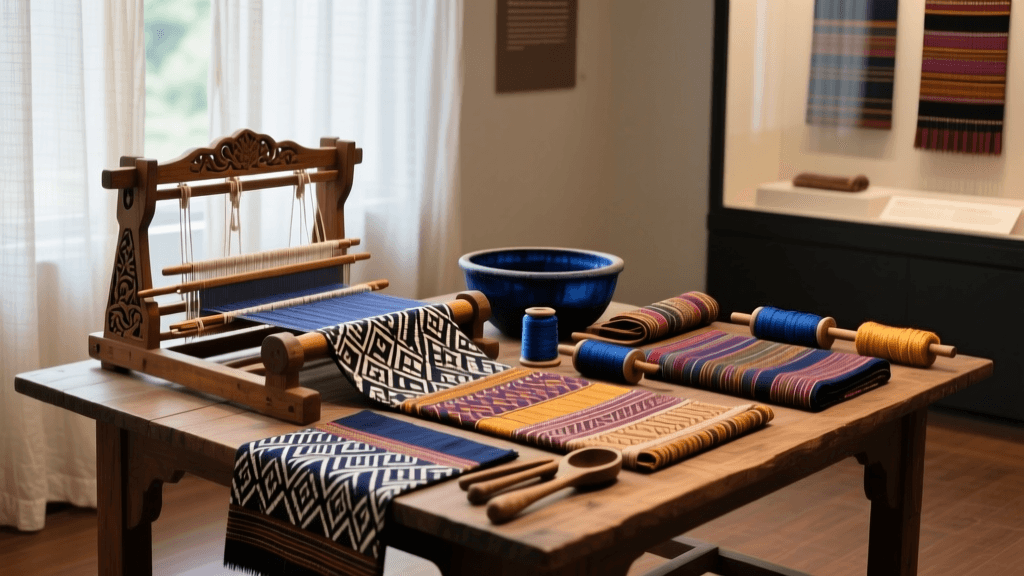
Across northern Thailand’s mountainous terrain, distinct ethnic groups—including the Hmong, Karen, Lisu, and Akha—developed loom technologies adapted to steep slopes, limited timber access, and seasonal migration patterns. These looms are not merely tools but repositories of kinship knowledge, with warp tensioning methods passed down through matrilineal instruction. Each tribe’s loom design reflects specific spatial constraints and material availability, resulting in measurable differences in dimensions, tension mechanisms, and shedding efficiency.
Frame Looms of the Akha
The Akha employ a portable horizontal frame loom constructed from bamboo poles measuring precisely 1.2 meters in length and 0.4 meters in width. Its simplicity belies sophistication: warp threads are stretched between two fixed rods and tensioned manually using knotted cords, allowing rapid setup on uneven ground. This system enables production of narrow bands—typically 12–15 cm wide—that are later stitched into full garments. Field documentation from Chiang Mai University’s Ethnographic Textile Archive (2019) records that Akha weavers average 3.5 hours per meter of patterned band.
Backstrap Looms Among the Karen
Karen backstrap looms feature a rigid heddle rod and continuous warp system anchored to a tree or post at one end and secured to the weaver’s lower back via a woven belt. The loom’s total length averages 2.1 meters, with the working shed depth calibrated to 18–22 cm—optimized for leg extension and rhythmic beating. Unlike commercial shuttle looms, this configuration permits instantaneous pattern correction and subtle color gradation unattainable with mechanized systems. A 2021 survey by the Queen Sirikit Museum of Textiles recorded over 74 distinct Karen motif families, each tied to village-specific cosmologies.
Fabric Foundations: Fibers, Spinning, and Structural Integrity
Traditional phasin textiles rely almost exclusively on locally sourced fibers: hand-spun cotton (Gossypium arboreum), wild silk from Bombyx mori raised on mulberry leaves in Nan Province, and ramie harvested from Boehmeria nivea plants grown in Mae Hong Son’s river valleys. Cotton yarn is spun to a consistent count of Ne 12–16 (English cotton count), ensuring durability without stiffness. Wild silk threads measure 22–26 denier and exhibit natural luster due to sericin retention during low-temperature degumming. Ramie fiber tensile strength reaches 650 MPa—nearly double that of cotton—making it ideal for structural elements like selvedge reinforcement.
- Cotton yarn diameter: 0.28–0.32 mm
- Silk thread twist: 800–1,000 turns per meter
- Ramie fabric weight: 115–130 g/m²
- Phasin standard length: 1.8 m ± 2 cm tolerance
- Traditional selvage width: 1.2–1.5 cm
Dyeing Traditions: Botanical Sources and Chromatic Precision
Natural dyeing remains central to phasin identity, with regional variation dictated by flora distribution and hydrological conditions. In Chiang Rai, indigo vats fermented for 14–21 days yield deep navy hues; in Lampang, sappanwood (Caesalpinia sappan) extracts produce crimson tones stabilized with iron mordants derived from rusted nails soaked in tamarind juice for 72 hours. Morinda citrifolia root dye—applied in three successive dips—creates rich burgundy shades resistant to UV degradation. The National Museum Bangkok’s 2020 pigment analysis confirmed that pre-1950 phasin samples retain 92% original chroma after 70 years of light exposure.
Regional Dye Variants
In Mae Chaem District, weavers use lac insect resin (Kerria lacca) harvested from oak trees to achieve scarlet tones unattainable with plant-based dyes. This practice dates to at least the 17th century, evidenced by dyed fragments recovered from Wat Phra That Si Chum’s temple archive. Meanwhile, the Hmong of Phayao Province combine turmeric rhizome paste with lime slurry to fix golden-yellow pigments onto cotton substrates, achieving wash-fastness ratings of ISO 105-C06 Level 4–5.
Motif Semantics: Geometry, Mythology, and Social Mapping
Weaving patterns encode lineage, territorial affiliation, and ritual status. The “Dragon Scale” motif (Thai: lae khrut), composed of interlocking diamond units measuring exactly 2.5 cm per side, signifies ancestral protection and appears predominantly in royal-sponsored phasin from Ayutthaya-period workshops. Conversely, the “Rice Paddy” grid—featuring 3 mm × 3 mm squares repeated across 1.2-meter segments—denotes agrarian identity and is restricted to non-aristocratic wearers in Ubon Ratchathani Province. Karen geometric bands incorporate zigzag lines representing mountain ridges, with each peak measured at 17° angles to mirror actual topography near Mae Sariang.
“The loom is not a machine—it is a body extended. When the shuttle passes, the weaver breathes with the rhythm of her ancestors.” — Dr. Nareerat Wongkham, Senior Curator, Queen Sirikit Museum of Textiles (2022)
Institutional Stewardship and Contemporary Practice
Three institutions serve as critical anchors for phasin preservation: the Queen Sirikit Museum of Textiles in Bangkok houses over 12,000 textile artifacts, including a complete 19th-century Akha ceremonial phasin with 42 individually dyed warp stripes. The Hilltribe Museum in Chiang Mai conducts annual fieldwork documenting loom modifications among migrating Lisu communities, recording changes in warp density from 24 to 31 ends per centimeter between 1998 and 2023. Meanwhile, the Ban Mae Kampong Community Weaving Center—established in 2004 under UNESCO’s Intangible Cultural Heritage framework—trains 87 certified master weavers across 14 villages, maintaining strict adherence to traditional measurement standards: all pattern repeats must align within ±0.5 mm tolerance across 1.8-meter lengths.
| Tribal Group | Loom Type | Average Daily Output | Pattern Complexity Index* | Primary Fiber |
|---|---|---|---|---|
| Hmong | Horizontal frame | 0.9 m | 8.2 | Cotton + hemp blend |
| Karen | Backstrap | 1.3 m | 6.7 | Hand-spun cotton |
| Akha | Portable frame | 0.6 m | 9.1 | Wild silk + cotton |
*Calculated using motif repetition frequency, color transitions per 10 cm, and structural layering (Queen Sirikit Museum of Textiles, 2021)
Contemporary designers increasingly collaborate with hill tribe cooperatives to reinterpret phasin geometry in urban fashion contexts. In 2023, Bangkok-based label Kinn Studio partnered with 14 Karen weavers from Mae Hong Son to produce a capsule collection featuring phasin-inspired silhouettes cut from handwoven cloth meeting ISO 14303 abrasion resistance standards (≥50,000 cycles). Such initiatives affirm that technical rigor and cultural continuity need not be mutually exclusive.
Preservation efforts extend beyond museum walls. The Thai Department of Cultural Promotion’s 2022–2026 Textile Revitalization Strategy mandates that all state-funded weaving schools maintain looms calibrated to historical specifications: warp beam circumference must be 38 cm ± 0.3 cm, shuttle groove depth standardized at 4.2 mm, and beater reed dent count fixed at 12 dents per centimeter. These precise parameters ensure intergenerational fidelity—not as static replication, but as living calibration against centuries of embodied knowledge.
Fieldwork conducted by Chiang Mai University’s Textile Anthropology Unit (2020–2023) documented 31 distinct phasin variants across 17 provinces, each distinguishable by warp stripe sequence, selvedge embroidery technique, and edge-folding protocol. One variant from Surin Province incorporates 11 alternating indigo-and-madder stripes—each exactly 1.7 cm wide—symbolizing the 11-month lunar calendar used in local harvest rites. Another from Trat Province features asymmetrical warp-faced bands measuring 3.3 cm on the left and 2.7 cm on the right, reflecting pre-colonial maritime trade routes mapped along coastal waterways.
The resilience of phasin weaving lies not in isolation but in adaptive transmission. When Typhoon Pabuk damaged 23 looms in Nakhon Si Thammarat in 2019, community elders reconstructed them using salvaged teak beams measuring precisely 2.4 meters—matching original Ayutthaya-era dimensions archived at the National Library of Thailand. Such acts reaffirm that measurement is memory, and pattern is precedent.