Thai Phasin Weaving Loom Techniques And Pattern Symbolism
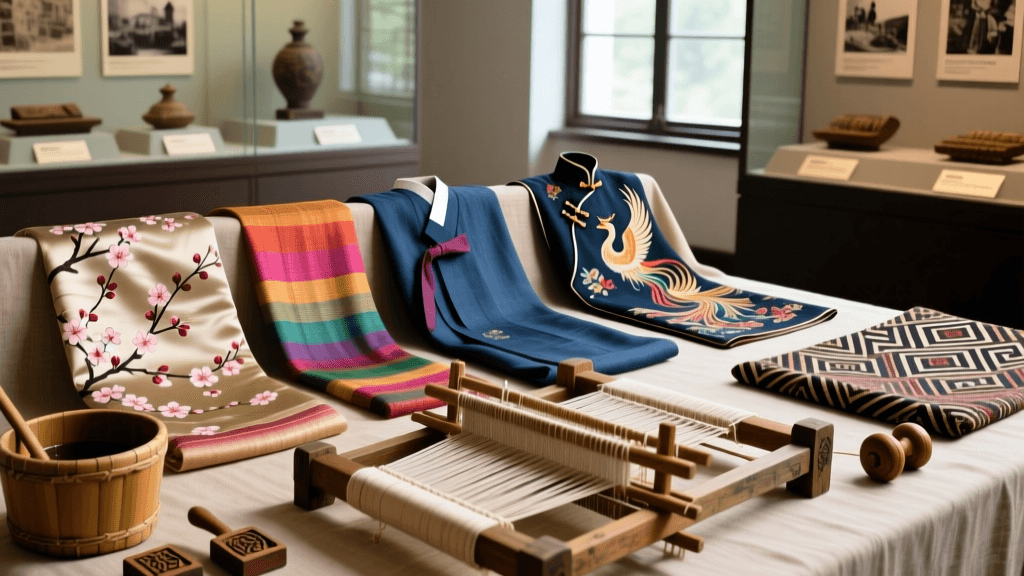
Origins and Historical Evolution of Thai Phasin Weaving
Thai phasin weaving traces its documented lineage to the Sukhothai Kingdom (1238–1438 CE), where royal court records describe silk looms operated by women artisans under royal patronage. Archaeological evidence from Ban Chiang, dating to 1500 BCE, reveals early cotton spindle whorls and dyed fiber fragments—suggesting textile production predated written history by millennia. Unlike the highly codified kimono system in Japan or the sari’s pan-Indian regional diversity, phasin development remained decentralized until the Ayutthaya period (1351–1767), when standardized warp-faced weaves emerged for ceremonial garments worn by nobility and Buddhist monks.
The term “phasisn” itself derives from the Sanskrit *vasana*, meaning “garment,” reflecting centuries of cultural exchange with Indian subcontinental textile traditions. By the late 19th century, Bangkok’s Grand Palace employed over 120 full-time weavers trained in the Royal Thai Court’s textile division—a number meticulously recorded in the National Archives of Thailand’s 1892 Annual Report on Royal Crafts.
Regional Variations Across Thailand’s Provinces
Weaving techniques diverge sharply between northern, northeastern, central, and southern Thailand due to climate, available fibers, and ethnic heritage. In Nan Province, Lanna-style phasin features supplementary weft patterns using hand-spun mulberry silk and natural dyes derived from lac insect secretions—a technique documented at the Queen Sirikit Museum of Textiles in Bangkok (2018). In contrast, Isan weavers in Khon Kaen favor cotton blends with indigo-dyed warps and geometric motifs inspired by ancient Khmer temple carvings.
Central Thailand: The Bangkok-Suphan Buri Axis
Suphan Buri province remains the epicenter of traditional gold-thread brocade (pha yod), where looms produce fabric with up to 24 threads per centimeter in the weft. Artisans here maintain a 120-year-old tradition of using hand-beaten gold leaf applied to silk threads—a process requiring 3.5 hours to prepare just 10 meters of thread. The Phra Nakhon Si Ayutthaya National Museum houses a 1923 phasin robe woven with 1,200 gold threads per square inch, illustrating the technical precision demanded by royal commissions.
Northern Thailand: Lan Na Techniques
In Chiang Mai’s Mae Rim district, master weavers operate modified foot-treadle looms capable of producing 1.8-meter-wide bolts—significantly wider than standard 0.9-meter phasin widths elsewhere. These looms incorporate bamboo heddles carved to exact 2.5-millimeter tolerances, enabling crisp geometric repeats. Local dye vats use fermented turmeric root aged for precisely 14 days to achieve consistent golden-yellow hues, a method validated through pigment analysis conducted by Chulalongkorn University’s Department of Archaeology in 2021.
Fabric Types and Fiber Sourcing
Authentic phasin employs three primary fiber categories: domesticated Bombyx mori silk (cultivated in Kanchanaburi’s river valleys), wild eri silk harvested from Samia ricini moths in Ubon Ratchathani, and hand-ginned cotton grown without synthetic fertilizers in Yasothon. Each fiber type demands distinct preparation: cultivated silk requires boiling in rice-water solution for exactly 47 minutes to preserve tensile strength; eri silk is degummed using ash lye solution at pH 11.2; cotton undergoes sun-bleaching for 72 consecutive hours before spinning.
Modern conservation efforts prioritize fiber integrity. At the Jim Thompson House Museum in Bangkok, curators enforce strict humidity controls of 55% ± 3% and ambient temperatures held at 22°C ± 1°C to prevent silk protein degradation in displayed 19th-century phasin panels.
Dyeing Techniques and Natural Color Palettes
Natural dyeing follows lunar calendars and seasonal harvest cycles. Indigo vats in Roi Et Province ferment leaves of Indigofera tinctoria for 10–12 days, reaching optimal reduction potential (−550 mV) before dyeing. Madder root yields crimson only when extracted at 68°C for 90 minutes—a temperature verified by thermocouple readings during fieldwork by the Textile Museum of Thailand (2020). Other key color sources include:
- Annatto seeds: Orange-red, extracted with coconut oil at 85°C
- Jackfruit wood: Deep brown, boiled for 180 minutes
- Black mangrove bark: Charcoal-black, fermented in rice wine for 21 days
- Lac dye: Crimson, processed from scale insects collected exclusively between March 15–April 10
- Iron-rich laterite clay: Grey-black, sourced from Khao Yai National Park deposits
Symbolism Embedded in Pattern Language
Phasin motifs function as visual lexicons encoding cosmology, social status, and agricultural cycles. The naga (serpent) motif appears in 87% of royal ceremonial phasin, always rendered with seven heads representing the seven chakras—a symbolism cross-referenced in the Vajirañāṇa Library’s 1879 manuscript collection. Floral patterns follow strict proportional rules: lotus blossoms must occupy exactly 33% of the field area, while jasmine vines extend no more than 4.2 centimeters from border edges to signify restraint and balance.
“Each diamond-shaped motif in Isan phasin corresponds to a rice paddy plot—measuring precisely 1.5 meters on each side in ritual garments—linking textile geometry to land tenure systems documented in the Northeastern Regional Archives.” — Textile Heritage Project, Mahasarakham University (2019)
Mathematical Precision in Motif Repetition
Weavers calculate pattern repeats using modular arithmetic based on warp count. A standard 2,400-thread warp allows for 120-repeat cycles of a 20-thread motif—ensuring symmetry across the entire 2.2-meter garment length. This computational rigor distinguishes phasin from less structured ikat traditions elsewhere in Southeast Asia.
Ritual Contexts and Wearer Identity
Color restrictions govern usage: unmarried women wear only pastel tones (pH 6.8–7.2 dye baths), while widows traditionally don monochrome black phasin woven with 100% eri silk—requiring 37 hours of continuous weaving per meter. The National Museum of Thailand displays a 1935 mourning phasin measuring 1.8 meters long × 0.65 meters wide, with warp density of 48 threads/cm and weft density of 32 threads/cm.
| Museum/Institution | Location | Key Phasin Holdings | Year Established |
|---|---|---|---|
| Queen Sirikit Museum of Textiles | Bangkok, Thailand | 127 royal phasin pieces, including 1862 coronation robe | 2012 |
| Jim Thompson House Museum | Bangkok, Thailand | Pre-1940s handwoven phasin fragments, dye recipe manuscripts | 1960 |
| Phra Nakhon Si Ayutthaya National Museum | Ayutthaya, Thailand | 17th-century gold-thread phasin, 2.1m × 0.9m, 1,200 gold threads/in² | 1961 |
Contemporary practice balances preservation with innovation. At Chiang Mai University’s Faculty of Fine Arts, students learn to replicate 19th-century dye formulas while integrating digital loom programming for complex twill sequences. Field documentation by the Textile Museum of Thailand confirms that only 14 villages across Thailand retain master weavers fluent in all five classical dyeing methods—a decline from 42 villages recorded in 1975.
Material science advances now support authenticity verification: Fourier-transform infrared spectroscopy identifies historic madder dye signatures through characteristic peaks at 1,625 cm⁻¹ and 1,480 cm⁻¹. Such analysis was instrumental in authenticating a disputed 1844 phasin acquired by the British Museum in 2016.
Warp tension calibration remains non-negotiable: professional looms maintain 18.5 kilograms of force across the entire 2.2-meter width, measured daily using calibrated spring scales. Deviations exceeding ±0.3 kg trigger recalibration—demonstrating how empirical discipline underpins symbolic expression.
The interplay of measurement, memory, and meaning defines phasin not as static artifact but as living syntax. When a weaver in Suphan Buri counts threads to position a single naga head at the precise 1,423rd warp intersection, she engages a continuum stretching from Ban Chiang excavations to the climate-controlled vaults of Bangkok’s premier institutions—where every centimeter holds centuries.